The Competitive Imperative Driving Diversification
Suzlon Energy faces intensifying market pressures that make its pure-play wind model increasingly vulnerable. Grid instability has become a critical concern—nearly 20% of the time in FY25 second half, grid frequency exceeded norms, creating demand for more reliable, dispatchable renewable solutions. The economic landscape has shifted dramatically: wind tariffs hover around ₹3.6-3.7 per kWh, while solar-plus-battery combinations cost approximately ₹6.5-6.75 per kWh, making wind-plus-storage economically competitive.
The market opportunity is substantial. India's total renewable market through FY30 represents ₹12 lakh crore, with hybrid renewable projects accounting for ₹7.25 lakh crore. Customers increasingly seek integrated solutions rather than fragmented procurement, driving Suzlon's strategic evolution.
Suzlon 2.0: Rebranding and Strategic Architecture
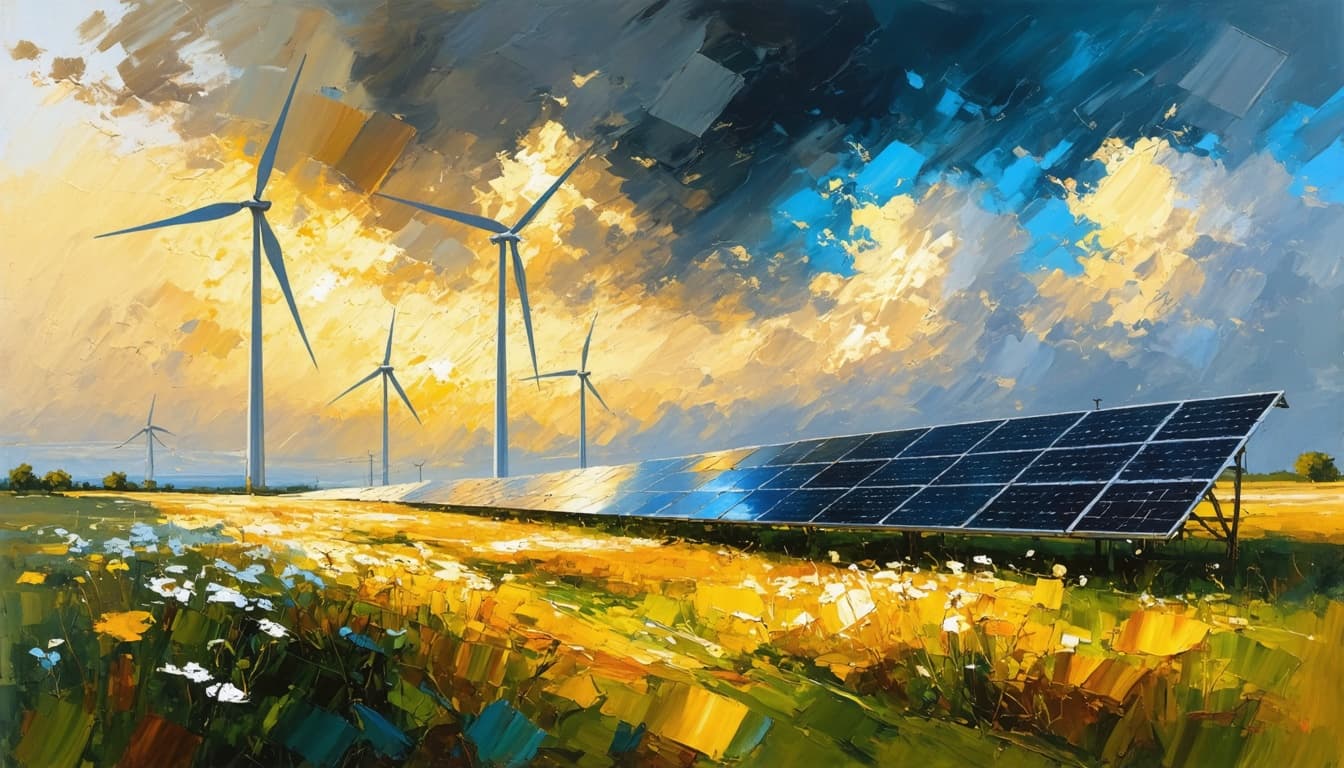
Under the rebranded "Suzlon 2.0" framework with the tagline "Good Energies That Work," the company is transitioning from a wind original equipment manufacturer to a wind-first full-stack renewable energy solutions provider. The new business architecture comprises four verticals: RE Tech (wind turbine innovation), RE DevCo (integrated co-development platform), RE Projects (EPC for integrated solutions), and RE Asset Management Services (lifetime servicing).
This rebranding reflects a fundamental shift in strategic priorities—from product sales to lifetime partnerships. The company now focuses on 3-5 year demand planning with customers rather than transactional turbine sales, enabling projects to be "construction-ready" well in advance and reducing execution timelines from two years to 12-18 months. The revenue model transforms from cyclical equipment sales to annuity-based recurring revenue, with O&M services typically offering 30%+ EBITDA margins compared to turbine sales.
The 70 GW AUM Target: Cornerstone of Diversification
The target to grow assets under management fourfold to 70 GW by FY31 represents the cornerstone of Suzlon's diversification strategy. Currently managing 3,509 MW across wind (2,182 MW), solar (148 MW), and BOP (1,178 MW), Suzlon aims to create a large annuity business that provides stable, high-margin recurring revenue. This expansion addresses the industry challenge of maintaining long-term reliability, efficiency, and returns from renewable energy assets. AnnualReports
The 70 GW target drives the entire diversification strategy. Suzlon is expanding asset management services across wind, solar, hybrid, and multi-brand portfolios, leveraging digital pathways and its nationwide service network to maximize asset performance throughout the lifecycle. The company's development subsidiary maintains a pipeline of 25 GW assets across the nation, with 8-10 GW "well-baked" projects providing the foundation for achieving this ambitious target. AnnualReports
Capital Allocation Strategy: Disciplined Expansion
Suzlon's capital allocation strategy for solar and battery storage expansion follows a deliberately capital-light approach, marking a sharp contrast with its previous debt-heavy expansion cycles. The company plans no solar panel manufacturing (avoiding a crowded market) and no battery cell manufacturing, instead pursuing partnerships for module supply and exploring partnerships for battery-pack assembly with only ~₹200 crore planned investment.
Run-rate capital expenditure is approximately ₹600 crores (±50) annually, covering sustenance capex, R&D, IT systems, and capacity augmentation. The company maintains a threshold of ₹300 crores specifically for Development Company activities, with current deployment between ₹300-350 crores.
Revenue Mix Transformation and Margin Evolution
The transition to a full-stack model fundamentally alters Suzlon's revenue mix and profitability profile. Currently, O&M contributes approximately 30% of revenue with higher margins compared to turbine sales. By FY31, RE DevCo is expected to contribute nearly 60% of overall volumes, while the EPC share in the order book grows from 20% to 28%, targeting 50% by FY28. Transcripts
This transformation impacts margins dynamically. While O&M services offer 30%+ EBITDA margins and provide stability against cyclical turbine manufacturing, the increasing EPC mix temporarily dilutes overall margins as project revenue carries lower margins than pure supply. However, management aims to maintain consolidated EBITDA margins in the 40-42% range despite business mix changes, with WTG contribution margins around 23%. Transcripts +2
Financing the 70 GW Target: Leverage and Cost of Capital
Suzlon's strong financial position provides flexibility for financing the 70 GW expansion. With net cash of ₹2,384 crore, debt-to-equity of 2.8%, and interest coverage of 5.9x, the company has substantial headroom for prudent leverage build-up. The strategy prioritizes internal accruals over external debt, with operating cash flow of ₹12 billion supporting growth initiatives. Transcripts
The company's current cost of capital includes WACC of 15.9%, cost of equity of 16.00%, and cost of debt of 14.20%. Credit rating upgrades completed as part of debt restructuring facilitate favorable financing terms for the expansion. The transition to higher annuity revenues from 70 GW AUM should reduce business risk and potentially improve the company's cost of capital over time through enhanced cash flow stability.
Operational Challenges and Technology Integration
Integrating solar and battery storage with existing wind infrastructure presents substantial operational complexity. Management acknowledges that "designing hybrids is most complex on the wind side," with incorrect energy mixes potentially raising power costs even if total output remains unchanged. Battery storage doesn't add generation capacity—it only matches load curves with generation curves—and currently cannot economically replace wind unless battery costs fall below ₹1.2/kWh. Transcripts
Current execution bottlenecks compound these challenges. Land acquisition issues, Right of Way problems, and grid connectivity delays have stranded 253 MW of pre-commissioned capacity. The company faces supply chain constraints, with component suppliers operating at only 25-26% utilization despite industry having 15-16 GW manufacturing capacity but executing only 6 GW annually. These execution challenges limit Suzlon to 10% market share versus its 25% target. Transcripts +2
Supply Chain Evolution and Execution Risks
Achieving the 70 GW target requires significant supply chain evolution. Current 4.5 GW manufacturing capacity can expand to 5.5 GW through productivity improvements and three-shift operations without major capital expenditure. However, new technology supply chains present risks—single-source dependency for batteries could tighten the supply chain, and battery price volatility creates uncertainty similar to recent solar module price fluctuations. Transcripts +1
Key execution risks include managing a 70 GW distributed asset base across multiple technologies, supply chain bottlenecks in turbine component manufacturing, and fluctuations in raw material costs like steel and copper. The company must also address skill gaps for multi-technology projects, requiring expertise in battery storage system integration, solar technology, and multi-technology project management capabilities.
Competitive Positioning: Wind Heritage as Strategic Foundation
Suzlon's transformation creates a unique competitive positioning that leverages its wind heritage while building integrated capabilities. Against pure-play wind competitors, Suzlon maintains advantages through its end-to-end business model, comprehensive 25-year O&M service commitment, 75% local content (above industry average of 64%), and 32% domestic market share. Transcripts +1
The FDRE market is "wind dominated", and during evening peak demand, wind contributes 21% while solar contributes 0%. Suzlon's in-house wind energy forecasting system, specialized product portfolio tailored for India's low-wind conditions, and >96% fleet availability provide differentiation. Transcripts +2
Integrated Solutions Impact on Tender Success
Suzlon's integrated solutions approach significantly enhances its ability to win large-scale tenders and PPAs. The company is expanding EPC offerings, which grew from 20% to 28% in H2 FY26, with management noting this "enhances our competitive edge and further helps to accelerate order book growth". A significant trend shows customers like NTPC moving from split contracts to turnkey EPC contracts, positioning Suzlon well with its significant pipeline of projects converting to integrated models. Transcripts +1
The DevCo platform provides strategic advantages by identifying sites 3-5 years in advance, securing land and connectivity before execution, and enabling faster project completion. Suzlon is also targeting emerging opportunities in C&I and data center markets, with bilateral discussions underway with major technology firms for captive renewable energy plants. With 51% of its order book from the C&I segment, Suzlon has demonstrated strong capability in serving commercial and industrial customers seeking integrated solutions. Transcripts +1
Strategic Transformation Assessment
Suzlon Energy's transformation from pure-play wind to integrated renewable energy solutions represents a strategic response to fundamental market shifts. The company's Suzlon 2.0 strategy, targeting 70 GW AUM by FY31, creates a unique competitive space that combines wind technology leadership with integrated solutions capabilities. While significant operational challenges exist in building solar and storage expertise, Suzlon's strong foundation in wind technology, manufacturing integration, service leadership, and customer relationships provides sustainable competitive advantages.
The capital-light expansion approach preserves financial discipline while enabling diversification, and the transition to annuity-based revenue models improves business quality. Success will depend on execution excellence across technology integration, supply chain evolution, and multi-technology project management. If Suzlon can navigate these challenges effectively, its transformation positions it well for India's integrated renewable energy future, where comprehensive solutions addressing grid reliability and round-the-clock power requirements will increasingly dominate market dynamics.