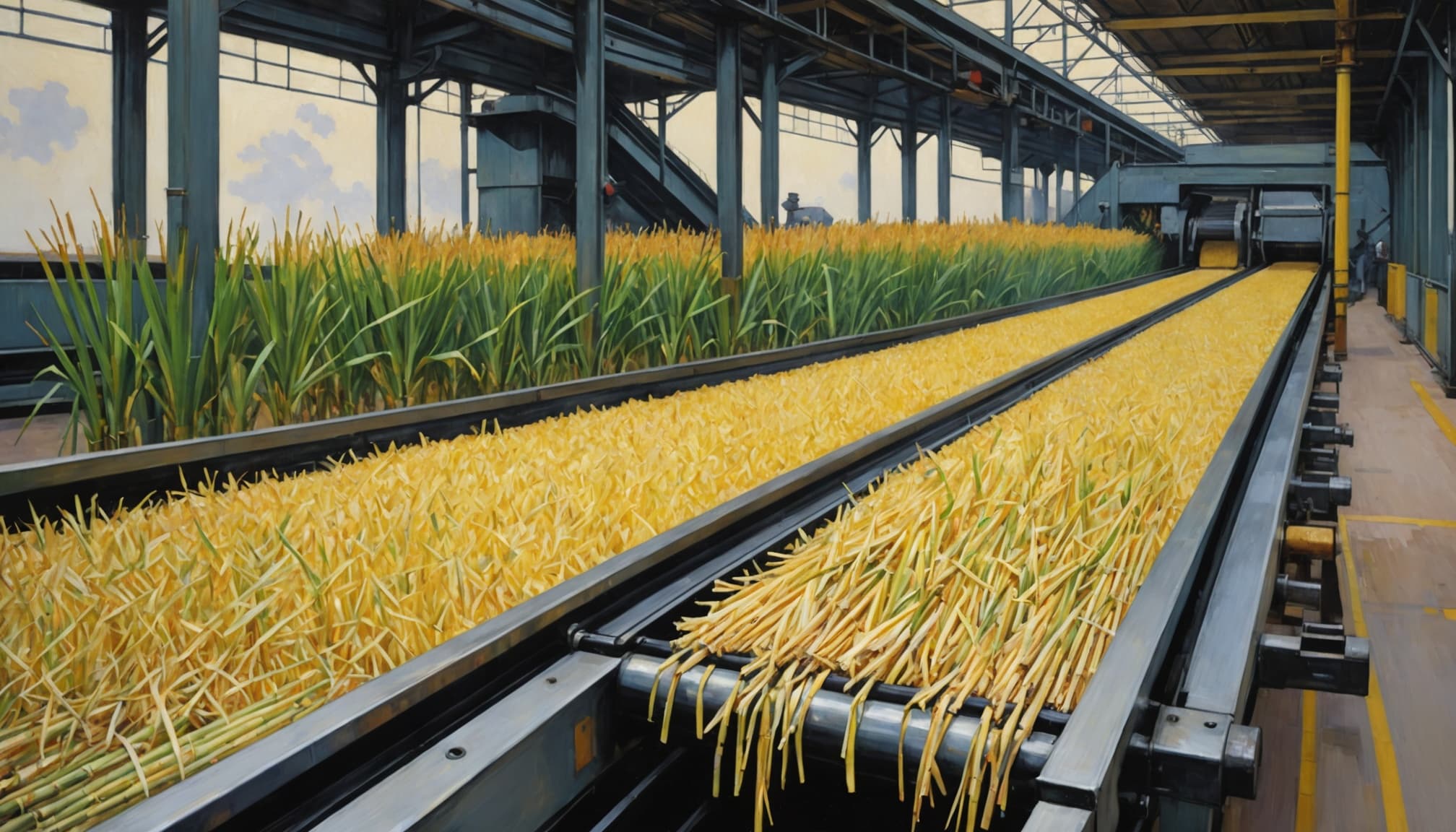
India's sugar sector is facing its most significant regulatory intervention in years. The government has announced a dual measure: duty-free imports of 10 lakh tonnes of raw sugar under a Tariff Rate Quota (TRQ) until October 31, 2026, coupled with strict stockholding limits on bulk consumers.
The import quota represents 20-25% of the estimated supply deficit of 8-18 lakh tonnes for the 2026-27 season. Opening stocks are projected at 40-42 lakh tonnes (industry estimates) or 32-35 lakh tonnes (researcher estimates), both below the domestic requirement of around 50 lakh tonnes. This supply-demand imbalance has driven prices to historic highs, with retail sugar climbing 13% year-on-year to ₹52.30 per kg as of August 18.
Pricing Power Under Pressure
The duty-free imports will fundamentally alter domestic supply dynamics. Currently, sugar mills enjoy exceptional pricing power with ex-mill realizations at record levels. However, the influx of 10 lakh tonnes of raw sugar—equivalent to roughly 8% of annual domestic consumption—will introduce competitive pressure that could compress prices by 15-20%.
Balrampur Chini, with 74.86% revenue from sugar, could see its operating margins decline from current levels of 5.49% to 2.5-3.0% under a 15% price decline scenario [stock_agent]. Shree Renuka, with nearly 100% sugar exposure and existing operational inefficiencies (103.16% expense ratio), faces even greater vulnerability—its margins could deteriorate from -6.39% to -10% to -12% under similar conditions [stock_agent].
The impact on Dalmia Bharat Sugar and Bajaj Hindusthan Sugar could be more severe. Both companies have high domestic market exposure—95-98% for Dalmia Bharat and similar levels for Bajaj Hindusthan—making them directly susceptible to domestic price corrections.
The Working Capital Squeeze
The stockholding restrictions create a dual challenge. Dealers are limited to 4,000 quintals for 30 days (effective August 1-November 30), while bulk consumers using more than 10 tonnes monthly can hold only 15 days of inventory (effective September 1-November 30). This eliminates the traditional pre-festival inventory buildup that typically drives demand surges during Ganesh Chaturthi, Dussehra, and Diwali.
For EID Parry and Dalmia Bharat Sugar, this means working capital cycles could elongate by 25-30%. The cash conversion cycle (CCC)—the time between paying suppliers and receiving payment from customers—could extend from current levels of 60-70 days for EID Parry to 70-80 days, and from 95-110 days for Dalmia Bharat to 120-140 days. This elongation increases financing requirements by ₹35-40 crore quarterly for EID Parry and ₹90-100 crore for Dalmia Bharat.
The inventory turnover ratios will also deteriorate. Bajaj Hindusthan Sugar already has a "very poor" inventory turnover ratio of 1.71x (214 days inventory). Under import pressure, this could decline to 1.2-1.4x (260-300 days inventory), creating a severe liquidity crisis for a company already facing financial distress.
Timing Complexities and Opening Stock Valuations
The policy timing creates additional complexity. The import window closes on October 31, while the 2026-27 crushing season begins on October 1. This overlap means imports will arrive just as mills are trying to clear opening stocks valued at current high prices of ₹5,400-5,500 per quintal.
If prices correct by 15-20% due to import competition, mills holding high-cost inventory could face significant valuation losses. The industry-wide inventory carrying cost—estimated at 11.5-16% of inventory value annually—will further strain profitability. For opening stocks valued at ₹18,090-22,140 crore (depending on which estimate proves accurate), annual carrying costs could range from ₹2,080-3,542 crore, or ₹173-295 crore monthly.
Mills will need to accelerate inventory liquidation during the October-December quarter, potentially accepting lower prices to clear stocks before new season production arrives. This creates a prisoner's dilemma: sell early at potentially lower prices or risk holding inventory that may depreciate further.
The Diversification Divide
The impact varies significantly based on business models. EID Parry is best positioned due to its minimal sugar exposure—only 18.68% of revenue comes from sugar, with 62.83% from nutrients and 13.65% from crop protection [stock_agent]. Its strong ROCE of 89.3% and diversified business model provide substantial insulation from sugar price volatility [stock_agent].
Shree Renuka Sugars offers a different kind of resilience through global operations. The company has significant presence in Brazil through acquisitions, with 13.6 MTPA crushing capacity in its Brazilian subsidiaries. This geographic diversification provides a natural hedge against Indian policy changes, and the complementary crushing seasons in India and Brazil enable year-round production.
Balrampur Chini Mills falls in the middle—moderately resilient due to its ethanol diversification (32.97% of revenue) and operational excellence (91.84% expense ratio) [stock_agent]. However, its 90-95% domestic revenue exposure leaves it vulnerable to policy interventions.
Dalmia Bharat Sugar and Bajaj Hindusthan Sugar face the greatest challenges. Both are essentially pure-play domestic sugar producers with limited diversification and high regulatory sensitivity. Bajaj Hindusthan's existing financial stress—100% promoter pledge, poor ROE of -9.85% over three years, and low interest coverage—makes it particularly vulnerable to policy-induced margin pressure.
Strategic Responses and Future Outlook
Sugar companies are pursuing several strategies to mitigate these pressures. Ethanol capacity expansion remains a priority, as the E20 blending target provides guaranteed offtake at fixed prices. Co-generation from bagasse offers additional stable revenue streams, with potential returns of ₹531.95 per ton of sugarcane compared to ₹345.75 from other by-products.
The regulatory environment itself may evolve. The Rangarajan Committee has previously recommended deregulation of the sugar sector, including removing levy sugar requirements and liberalizing trade policies. However, given the current focus on food inflation control, near-term policy predictability remains low.
For investors, the key takeaway is clear: the sugar sector is undergoing a structural shift. Integrated players with strong diversification—EID Parry, Shree Renuka Sugars, and to a lesser extent Balrampur Chini Mills—are better positioned to navigate this challenging environment. Standalone mills with high domestic exposure face significant headwinds, and their survival may depend on successful execution of diversification strategies or potential consolidation.
The festival season will be the true test. If the government's measures successfully moderate prices without causing severe disruption to mill economics, the sector may stabilize. However, if the policy interventions prove too aggressive, we could see financial distress among weaker players, potentially accelerating industry consolidation.