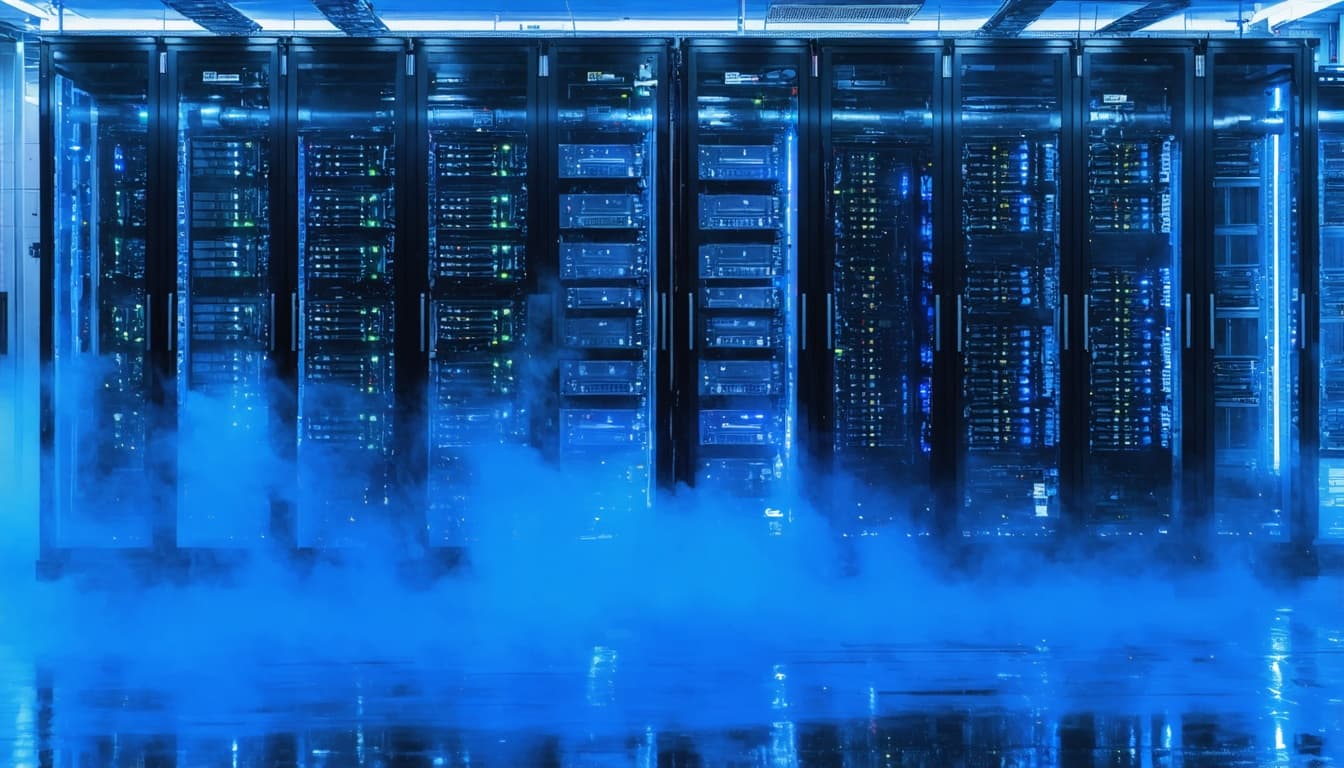
Artificial intelligence is fundamentally transforming data center infrastructure requirements, creating unprecedented demand for specialized power and cooling solutions.
This dramatic shift is driving Schneider Electric Infrastructure Limited's India data center business to grow at double-digit pace, significantly outpacing the company's core operations growth.
The numbers tell a compelling story.
The India data center market is expected to reach USD 31.36 billion by 2035 at a 13.37% CAGR. This expansion creates substantial revenue visibility for Schneider, with data centers contributing "almost double digit" revenue in India, up from approximately 15% of the company's focus in Q4 FY25. Transcripts +1
Strategic Resource Allocation
The 15-20% revenue contribution from data centers has triggered significant strategic reallocation.
This move aims to accelerate decision-making and enhance strategic focus on India, Schneider's third-largest market and one of its four global hubs. The company plans to expand its Indian operations by 2.5 to 3 times and anticipates double-digit organic sales growth annually.
The listed entity, Schneider Electric Infrastructure Limited, has outlined a comprehensive CAPEX program including INR 200 crore for expansion initiatives. Specific investments include enhanced capex of INR 156.4 crore for switchgear capacity enhancement at the Vadodara facility (expanding from 8,000 to 14,000 panels per year) and INR 90 crore for a new circuit breaker plant at Kolkata with annual capacity of 40,000 units. Transcripts
AI-Driven Differentiated Demand
The AI boom is creating fundamentally different requirements across Schneider's product portfolio. In UPS systems, traditional solutions are being replaced by AI-ready architectures. Schneider's Galaxy VXL UPS, launched specifically for AI-ready data centers, delivers unprecedented power density of 1,042 kW/m² with 99% efficiency in eConversion mode. The system provides 1.25 MW scalable and modular solution with 125 kW/3U power modules in a 1.2m² footprint, capable of supporting up to 5 MW with 4 units in parallel.
Precision cooling requirements are equally transformed. GPU-powered AI servers consume over 20 times the power of standard CPU servers, with racks now pushing 132-240 kW of thermal load. Traditional air cooling systems struggle with AI-level heat densities, necessitating liquid cooling solutions including rear-door heat exchangers and direct-to-chip cooling. Schneider's acquisition of a 75% stake in Motivair in October 2024 integrated power and thermal management for high-density data centers.
Energy management software has evolved from basic monitoring to AI-driven optimization. Schneider's EcoStruxure platform now includes machine learning models that predict cooling requirements 4 hours ahead based on workload patterns and weather forecasts. Predictive analytics identify failing components 30 days before failure, while digital twins enable thermal modeling and configuration testing virtually.
Geographic Expansion Beyond Traditional Hubs
Hyperscalers and colocation operators are increasingly building data center capacity beyond Mumbai and Chennai into states like Gujarat and Rajasthan. This dispersion is driven by multiple factors. Grid congestion on the Mumbai-Kalwa 400 kV ring is delaying new feeder approvals by up to 18 months, forcing hyperscale developers to pivot to adjacent districts or relocate farther to Gujarat. ISTS-exempt solar-wind PPAs allow operators to secure low-cost power, pushing new campuses toward Gujarat, Rajasthan, Tamil Nadu, and Karnataka.
Gujarat's Reliance Industries has proposed a 3 GW AI campus integrated with green-hydrogen production, signaling a new era of energy-compute symbiosis. Rajasthan's Data Center Policy-2025 aims to attract INR 20,000 crore investment in 5 years, offering annual incentives of INR 10-20 crore for 10 years, 5% interest subsidies, and full exemptions from banking, transmission, and wheeling charges.
This geographic dispersion creates both opportunities and challenges for Schneider's local manufacturing and service capabilities. The Vadodara facilities are strategically positioned in Gujarat, which is emerging as a major data center hub. However, expanding into Tier-2 and Tier-3 cities creates challenges for technical support coverage, spare parts logistics, and skilled technician availability.
Competitive Advantages Through Integration
Schneider's integrated portfolio spanning power distribution, cooling, and software creates significant competitive advantages against pure-play vendors. The EcoStruxure platform integrates cooling with power, IT, and building management systems, appealing to organizations seeking single-vendor solutions. This integration enables total facility PUE of 1.08 in optimal configurations, compared to traditional air cooling PUE contributions of 0.30.
Local manufacturing capabilities play a critical role in securing contracts from Indian hyperscalers and enterprises seeking supply chain resilience.
Schneider's local manufacturing in Vadodara and Kolkata provides significant time-to-market advantages, particularly given the geopolitical tensions affecting global supply chains.
The Make in India alignment and government incentives favoring domestic equipment under the Data Centre Incentivization Scheme (DCIS) further strengthen Schneider's position. The company's "India for India" programs leverage its ability to work fast and execute projects with speed and precision, with products manufactured end-to-end in India using Schneider's global technology platform. Transcripts
Margin Profile and Profitability Implications
While specific segment-level margin data is not publicly disclosed, several factors suggest the data center segment commands premium margins compared to core businesses. AI-specific solutions like the Galaxy VXL UPS with 99% efficiency and liquid cooling systems command premium pricing due to their specialized nature and the criticality of AI workloads. Downtime can cost operators millions per minute, driving investment in reliability tools that support premium pricing.
The data center segment has higher attach rates for software licenses and long-term service contracts. Schneider aims to grow digital and service-linked revenue to 30% of total by 2027 via SaaS, subscription services, and long-term contracts. Field services revenue, which accounted for 11% of first-quarter global revenues, grew organically by 12% driven by performance in data center and infrastructure markets.
Overall, Schneider Electric Infrastructure Limited targets margins around 40% for its businesses, with recent financial performance showing EBITDA margins improving to 17.2% in Q3 FY26. The strategic shift toward more profitable transactional products and services, combined with the higher-margin data center segment growing at "almost double digit" revenue, suggests positive margin trajectory. InvestorPresentations +1
Critical Risks and Challenges
Despite the optimistic growth trajectory, Schneider faces significant risks if the projected 6-7 GW data center capacity by 2030 fails to materialize. India's power grid was not designed to handle the round-the-clock, high-load demand that modern data centers generate. In 2024-25, only 8,830 circuit kilometres of new transmission lines were commissioned against a target of 15,253 ckm, representing a 42% gap. Mumbai's data center IT load could approach 1 GW by the end of the decade, potentially exceeding 1.5 GW total demand including cooling—roughly a third of Mumbai's peak demand.
Regulatory hurdles create additional complexity. The fragmented policy landscape requires over "30+ approvals" for data center development, with variations in definitions, land use laws, and building norms across states preventing standardized designs. While states like Gujarat and Rajasthan have introduced aggressive incentives, implementation challenges persist.
Schneider's growth trajectory is highly dependent on hyperscaler capital expenditure plans.
However, analysts characterize current spending as potentially cyclical rather than structural, with risks of front-loaded inventory accumulation and weakening operating leverage.
Competitive threats from global players like ABB, Siemens, Eaton, Vertiv, and Huawei (which holds 8.1% market share in Asia Pacific modular data centers) intensify competition. Local specialists like CtrlS, ESDS, and Sify Technologies leverage deep understanding of the Indian regulatory environment and cost structures to offer cost-effective, regionally optimized solutions.
Strategic Outlook
Schneider Electric's India data center business represents a compelling growth story driven by structural shifts in AI infrastructure demand. The company's integrated portfolio, local manufacturing capabilities, and strategic investments position it well to capture this opportunity. However, success will depend on navigating power infrastructure constraints, managing hyperscaler capex dependency, and maintaining competitive differentiation in an increasingly crowded market.
The convergence of data centers with grid modernization creates additional cross-selling opportunities across Schneider's Secure Power and broader energy management portfolios. The One Digital Grid Platform, which can reduce outages by up to 40% and decrease DER interconnection timelines by 25%, combined with microgrid solutions and demand response programs, positions Schneider uniquely to address the integrated needs of data center operators and utilities.
As India's data center capacity expands and AI workloads continue to drive power density requirements higher, Schneider Electric's comprehensive portfolio spanning power distribution, cooling, software, and grid management solutions positions it to capture the full value of this convergence—provided it can successfully navigate the substantial risks that accompany this opportunity.