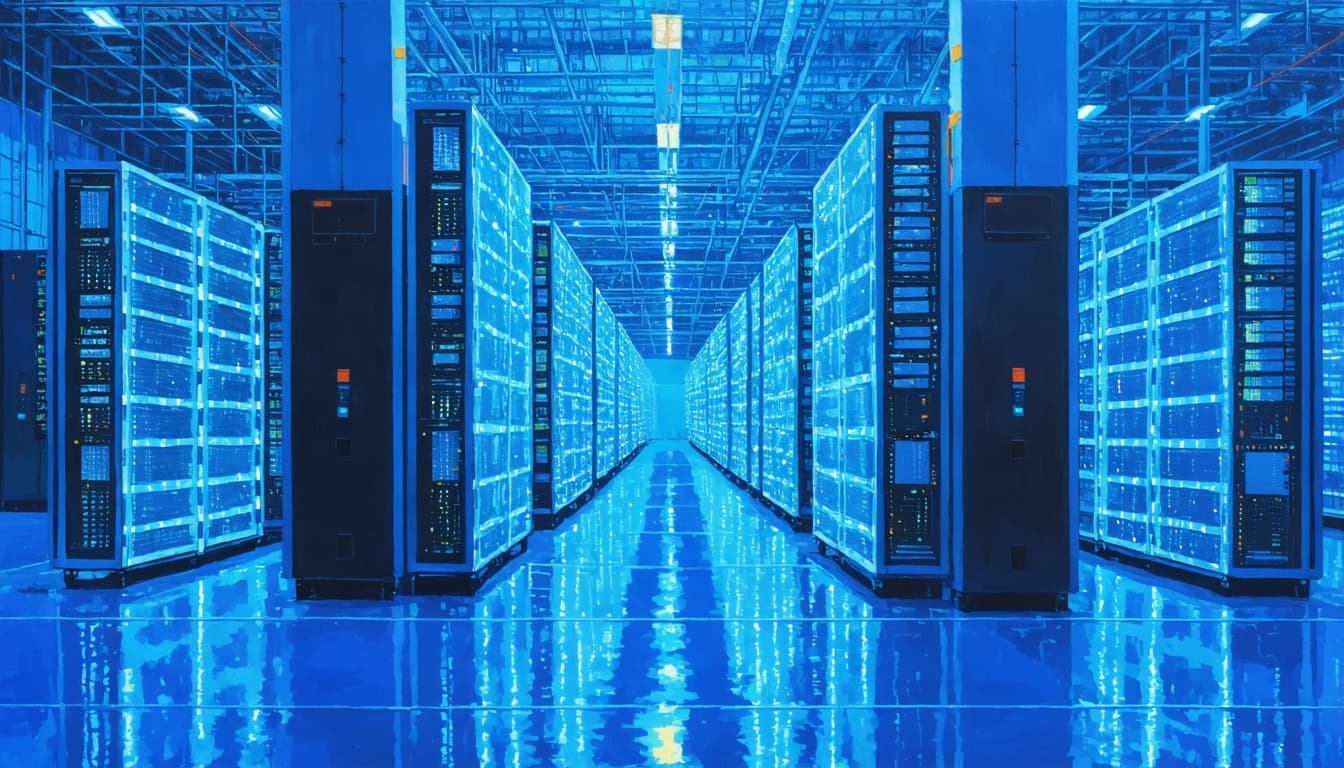
This isn't just another corporate handshake—it's a calculated move to combine Foxconn's manufacturing dominance with Schneider's energy management expertise. Production begins later this year, targeting a market where AI infrastructure demand is growing at 25% CAGR through 2030.
The partnership focuses on co-developing reference architectures for AI data centers, exploring innovations in closed-loop energy optimization, modular power and cooling skids, and standardized design frameworks. Think of it as creating repeatable blueprints for AI factories worldwide.
Revenue Opportunities and Market Position
Schneider's data centers and networks business already accounts for 24% of end-market exposure, with "pure data centers" making up 20% of that total. The AI investment boom supports annual growth of 10% or more through 2027 in this segment. The Foxconn partnership positions Schneider to capture incremental revenue from the rapidly expanding AI data center market, which is projected to grow from USD 269.79 billion in 2025 to USD 699.13 billion by 2034.
The partnership creates a high-margin growth lever. Schneider Electric Infrastructure's Indian subsidiary, with an order book exceeding ₹1,500 crore, is likely to see spillover demand for localized switchgear and transformer solutions as Foxconn expands AI server assembly lines in India. The global data center industry is undergoing a structural shift driven by Large Language Model training requirements, making energy efficiency a regulatory and financial imperative.
Manufacturing Scale: The Foxconn Advantage
Foxconn brings manufacturing capabilities that competitors simply cannot match. With 230+ campuses across 24 countries, 900,000 employees during peak season, and 40%+ market share in electronics manufacturing services, Foxconn produces millions of units monthly. This scale enables significant economies of scale that translate into competitive pricing for tier-one clients.
The vertical integration is particularly powerful. Foxconn manufactures connectors, casings, and PCB assemblies in-house, reducing supplier costs and shortening supply chains. This "Foxconn Speed" capability allows ramping from prototype to millions in weeks—a critical advantage in a market where AI-specific power demand is projected to double globally every 100 days.
Operational Efficiencies and Cost Structure
The partnership delivers substantial operational efficiencies. Direct OEM integration between Schneider and Foxconn reduces deployment lead times by 20%. Advanced liquid-to-liquid cooling systems are integrated at the factory level, ensuring quality control and reducing field installation issues. This factory-level integration represents a shift from traditional air-based cooling to advanced systems designed for high-density GPU clusters.
The cost structure transformation is significant. Production costs benefit from economies of scale, supply chain costs decrease through vertical integration, and deployment costs drop with faster lead times. The partnership targets a 30% reduction in energy consumption for high-density GPU clusters and Power Usage Effectiveness below 1.1—metrics that create differentiated value supporting premium margins.
Competitive Differentiation
Schneider Electric already leads with over 10% market share in data center power infrastructure, but the Foxconn partnership creates defensible competitive advantages. The top 5 players in this market collectively hold 48% market share, so every percentage point matters.
The partnership creates a unique vertically integrated solution that competitors cannot easily replicate. While ABB launched an AI-ready MegaFlex UL 415V UPS in June 2025, and competitors like Eaton and Vertiv have strong positions, none have equivalent manufacturing scale and hardware integration capabilities. The collaboration places immense pressure on traditional electrical component manufacturers who lack advanced digital power management software.
Capital Allocation and Returns
No specific CAPEX figure has been disclosed for the partnership, which follows a capital-efficient collaboration model rather than heavy investment commitment. Schneider plans to invest about €2 billion through 2027 for production capacity expansion, much of it in North America. The partnership aligns with Schneider's capital allocation priorities: maintaining strong investment-grade credit ratings, funding organic growth, and supporting progressive dividends.
Schneider Electric Infrastructure Ltd demonstrates strong returns with current ROIC of 24.6%, up from 14% over the last three years. The AI initiatives, with 25% CAGR growth potential and premium pricing from efficiency gains, suggest ROIC potential in the 22-28% range. The capital-efficient structure preserves free cash flow generation—Schneider generated record free cash flow of around €4.6 billion in 2025.
Market Reaction and Valuation
The market responded enthusiastically. Schneider Electric Infrastructure Ltd (Indian subsidiary) surged 10% to hit the upper circuit limit, moving from Rs 1,105.70 to Rs 1,216.20. The stock has gained 112.68% from its 52-week low, reflecting strong upward momentum.
Valuation multiples have expanded significantly. The Indian subsidiary trades at 71.4x EV/EBITDA compared to industry averages of 29.9x. The parent company trades at more moderate but still premium multiples: 31.4x P/E and 19.4x EV/EBITDA. The market expects significant EBITDA growth to justify these valuations—projections show EBITDA growing from ₹4.1B in December 2025 to ₹8.5B by March 2028.
Technical Integration and Time-to-Market
The partnership implements a multi-layered integration approach combining energy management capabilities with AI data center architectures. This includes modular power skids, high-density power management for 100kW+ per cabinet configurations, and advanced liquid cooling systems integrated at the factory level.
Traditional development cycles of 42-63 months compress to 17-26 months through shared R&D investment, immediate access to manufacturing capacity, and standardized solutions. This acceleration is achieved through technical integration (factory-level integration reducing deployment time by 20%), commercial acceleration (established customer relationships), and operational acceleration (global manufacturing network).
Strategic Outlook
The partnership positions Schneider Electric as an essential infrastructure provider for the AI revolution. As AI moves from a software trend to a massive hardware infrastructure build-out, companies that control the power and cooling layer are becoming the backbone of the digital economy. The collaboration addresses key strategic priorities: capital efficiency through shared investment, market access through Foxconn's hyperscale relationships, technology leadership through factory-level integration, and geographic diversification through Foxconn's global footprint.
The risks are real—execution risk in integrating complex liquid cooling systems, geopolitical shifts impacting Foxconn's manufacturing footprint, and potential slowdown in AI capital expenditure by major hyperscalers. But the structural growth drivers, competitive positioning, and strategic importance of AI infrastructure suggest the premium valuations are sustainable.
This isn't just about building better data centers. It's about positioning Schneider Electric at the foundation of the AI infrastructure build-out that will define the next decade of technology investment. The Foxconn partnership provides the manufacturing scale, technical expertise, and market access needed to capture this opportunity effectively.