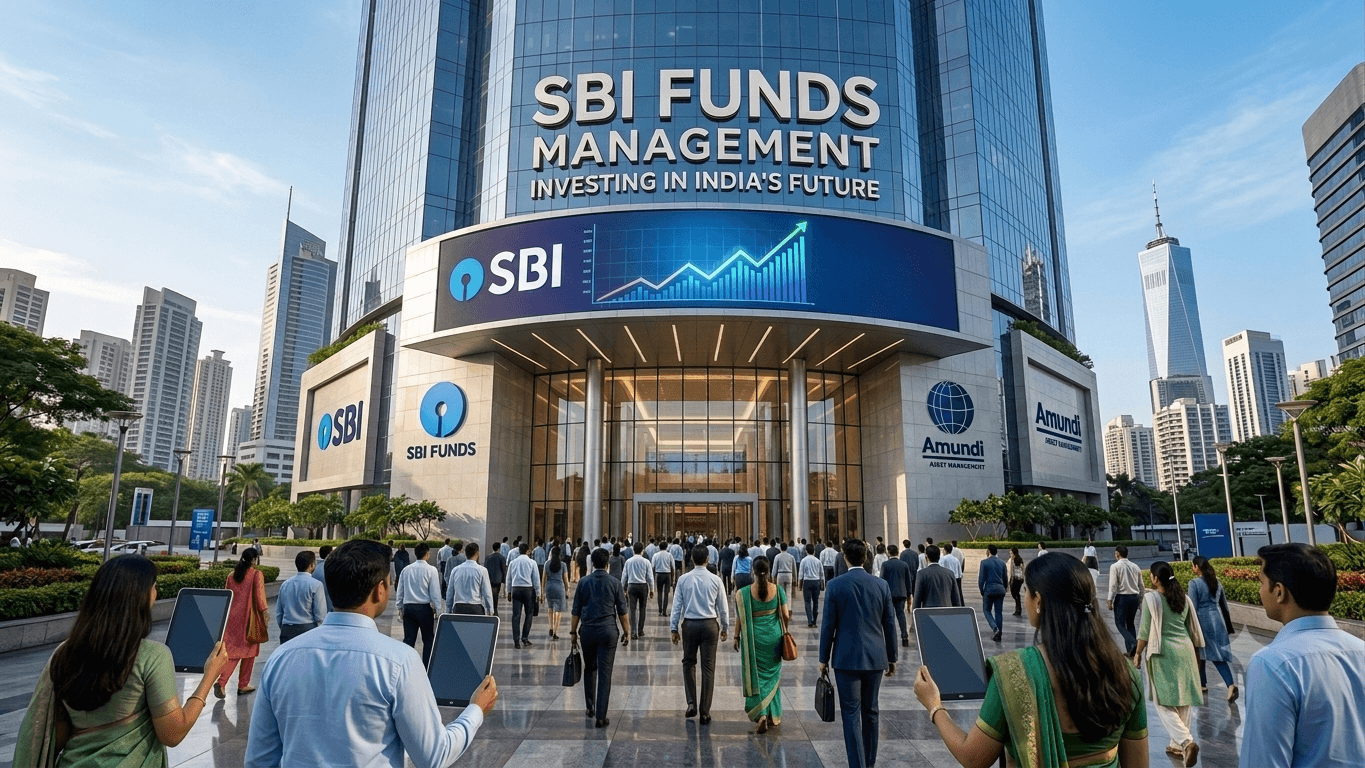
SBI Funds Management made a remarkable market debut on July 21, 2026, listing at ₹613.30 per share—a solid 6.85% premium over its issue price of ₹574. This positive opening is particularly noteworthy given that the issue was India's largest IPO so far in 2026, raising approximately ₹9,812.91 crore. The stock closed its first trading session around 6.2% above the issue price, valuing the company at nearly $13 billion. The grey market had signaled optimism, with premiums indicating an expected listing gain of 16-17%, but the actual debut reflected more measured investor sentiment while still delivering healthy returns for allottees.
The subscription numbers told a story of robust demand. The IPO was subscribed 41.62 times overall, with qualified institutional buyers leading the charge at approximately 140 times subscription. Non-institutional investors came in at 22.51 times, while retail investors subscribed 3.6 times. This strong institutional backing, including anchor investments from BlackRock and Goldman Sachs, provided a solid foundation for the listing performance.
Context: How It Compares to Peers
When viewed against recent mutual fund industry IPOs, SBI Funds Management's 7% premium sits in an interesting middle ground. HDFC AMC's blockbuster debut in August 2018 saw the stock list at a 58% premium and close 65% higher on day one—a performance that set a high watermark for the sector. Nippon Life India AMC (then Reliance Nippon) listed at a 17% premium in November 2017. In contrast, UTI AMC's October 2020 listing was disappointing, with shares debuting at a 9.7% discount to the issue price.
This mixed historical performance reflects evolving market conditions. HDFC AMC's debut came during a period of strong market optimism, while UTI AMC faced challenging times. SBI Funds Management's more moderate but positive premium indicates rational investor sentiment in 2026—appreciative of quality and scale but avoiding the euphoria that drove some earlier listings. The 7% gain suggests confidence in the business fundamentals without overpaying for growth.
The Brand and Market Position Advantage
Several factors drove SBI Funds Management's premium valuation, with brand equity and market leadership at the forefront. As India's largest asset management company with ₹16.32 lakh crore in assets under management (AUM) and a 15.5% market share, the company commands significant trust. The SBI brand, backed by 23,125 branches reaching 97.87% of India's pincodes, provides unparalleled distribution reach, particularly in tier-2 and tier-3 cities where the company holds a 19.3% market share—well above its national average.
The company's financial strength also played a crucial role. With a profit after tax of ₹3,067 crore in FY26 and exceptional PAT margins of nearly 70%, SBI Funds Management demonstrated profitability that few financial services companies can match. A return on equity of 43.01% and a debt-free balance sheet further reinforced investor confidence. The company's dominance in passive products, with a 27.9% market share in ETFs and index funds, positioned it to benefit from the secular shift toward low-cost investing.
The IPO Proceeds Reality: A Strategic Choice
An important clarification about the IPO structure: it was a pure offer for sale, meaning SBI Funds Management received no proceeds from the issue. All ₹9,812.91 crore went to selling shareholders—State Bank of India and Amundi India Holding. This means the company's growth ambitions must be funded through internal cash generation, which is substantial given operating cash flows of ₹2,488 crore in FY26.
Despite the absence of fresh capital, SBI Funds Management has outlined clear growth strategies. The company is making significant investments in alternative investment funds (AIF), with new product capabilities planned across Category II AIFs. It's also expanding its passive product lineup, developing international offerings through GIFT City, and targeting NRI investors. The goal is to reach 1.4 million wealth-qualifying customers by 2030, up from a current base where mutual fund penetration represents less than 4% of SBI's 530 million customers.
Competitive Advantages and Distribution Strength
SBI Funds Management possesses several structural advantages that support its market leadership aspirations. The distribution network is formidable—23,125 branches with 13,000+ NISM-certified employees create an embedded sales force that digital-only competitors struggle to replicate. This physical presence is amplified by digital integration with SBI's YONO platform, which has 96 million users. The company also holds the lowest operating expense ratio among India's top 10 AMCs at 0.08% of QAAUM, compared to 0.10-0.25% for peers.
The dual parentage structure provides unique benefits. SBI contributes domestic distribution strength and regulatory relationships, while Amundi brings global investment expertise and operational best practices. This combination has enabled SBI Funds Management to build a diversified product portfolio across equity, debt, hybrid, and passive categories, with 126 mutual fund schemes serving over 16 million investors.
Employee Wealth Creation: The Crorepati Story
The IPO created significant wealth for employees through a well-structured employee stock option plan (ESOP) introduced in 2018. At the IPO issue price, 13 employees held vested equity worth more than ₹1 crore each. Deputy Managing Director Devinder Pal Singh emerged as the largest beneficiary with holdings valued at approximately ₹121 crore, while Chief Investment Officer Srinivasan Rama Iyer held stakes worth around ₹105 crore. Several other senior executives, including heads of strategy, fixed income, risk, and legal functions, also became crorepatis. RHP
The ESOP scheme featured attractive exercise prices ranging from ₹39 to ₹455 per share, compared to the IPO price of ₹574. An Employee Welfare Trust facilitated the implementation, transferring over 1 million shares to employees during FY26. This wealth creation mechanism aligns employee interests with company growth and helps retain talent in a competitive industry. RHP
Parent Company Dynamics: Control with Autonomy
SBI's decision to reduce its stake from approximately 63% to 61.86% through the IPO (plus a 1.42% pre-IPO placement) maintains controlling interest while enabling public market listing. This controlled dilution preserves strategic autonomy in day-to-day operations while ensuring alignment with SBI's broader objectives. The company continues to function as an independent entity with professional leadership, including MD & CEO Nand Kishore and Deputy CEO Denys de Campigneulles from Amundi.
The governance structure evolves from a private joint venture to a public listed entity with enhanced disclosure requirements and independent directors. While SBI's controlling stake ensures strategic alignment—particularly in distribution and cross-selling initiatives—the company maintains operational independence in investment management and product development. The balance between parent company control and professional management has created a structure that leverages SBI's strengths while developing independent capabilities.
Profitability Evolution and Future Outlook
SBI Funds Management's profitability metrics are exceptional and should improve as operations scale. The company demonstrates powerful operating leverage, with total expenses declining from 21.96% to 19.50% of total income over three years. Employee costs have become more efficient, dropping from 10.75% to 8.86% of total income, indicating that the company can scale without proportional headcount increases. The asset-light business model allows revenue to grow faster than fixed costs as AUM expands. RHP +1
Looking ahead, the mutual fund industry is projected to grow from ₹72.2 lakh crore in 2025 to ₹100 lakh crore by 2030 at a 14-18% CAGR. SBI Funds Management's strong SIP franchise—with 15.76 million live SIPs—provides stable recurring revenue. The company's dominance in B-30 cities, where it holds a 19.3% market share, positions it to capture growth in India's tier-2 and tier-3 markets. Digital investments, including AI-powered platforms like InvesTap Nxt, will drive operational efficiency and customer acquisition.
The long-term stock performance will correlate with AUM growth, margin sustainability, and competitive positioning. In a base case scenario of 15-18% AUM CAGR, the company could deliver 18-22% annualized shareholder returns. The key risks include market volatility, regulatory pressure on fees, and competition from digital-first platforms like Zerodha and Groww. However, SBI Funds Management's structural advantages—scale, distribution, brand trust, and operational excellence—provide a strong foundation for sustainable long-term value creation.