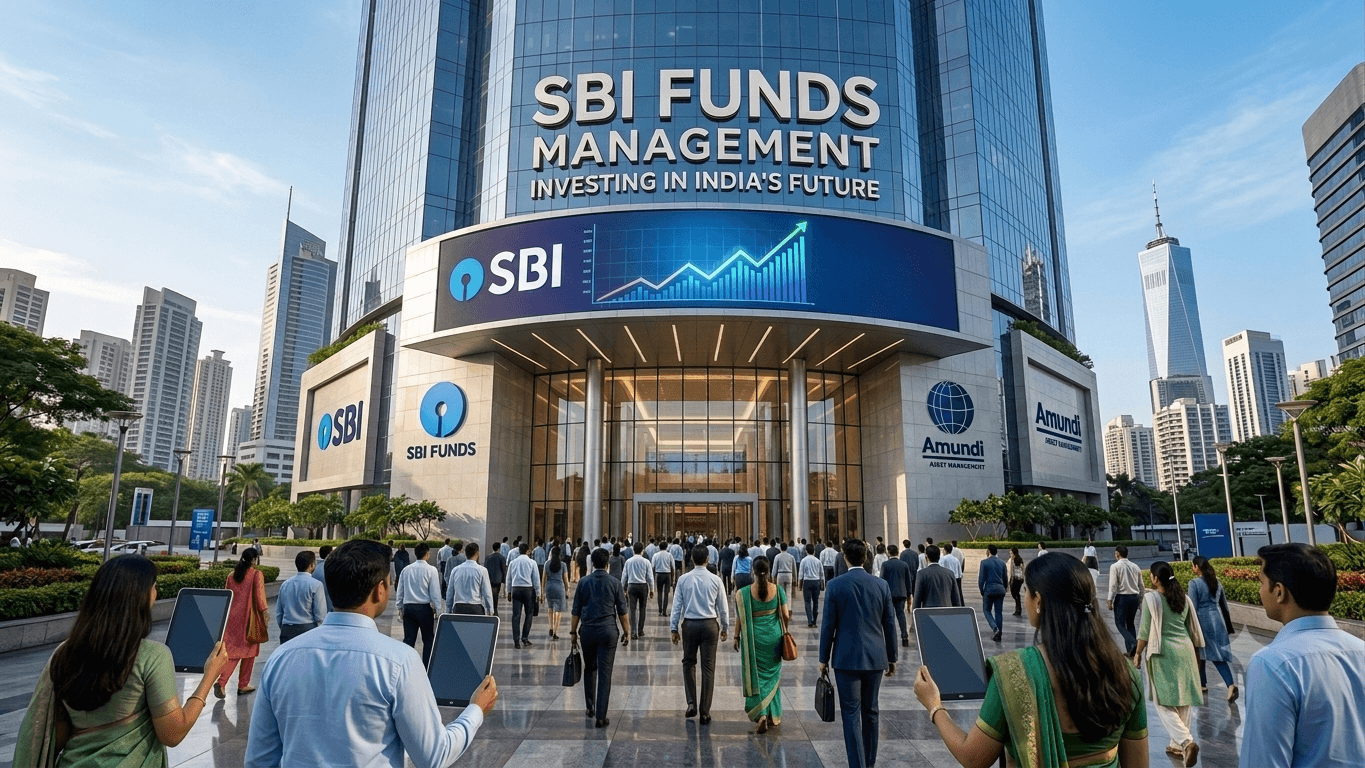
India's IPO market has hit a pause button in 2026. After two record-breaking years, companies are deferring listings due to global volatility, geopolitical tensions, and valuation concerns. DRHP filings dropped 48% in February 2025, and approximately two-thirds of early 2025 IPOs now trade below their issue price. Yet, two giants—SBI Funds Management and Manipal Health Enterprises—are proceeding with their offerings between June-end and July 2026. This calculated move signals confidence in fundamental strength over market timing.
SBI Funds Management: The Numbers
SBI Funds Management, India's largest asset manager, filed its Draft Red Herring Prospectus (DRHP) with SEBI on March 19, 2026. The IPO is a pure Offer for Sale (OFS) of up to 20.37 crore shares—representing a 10% stake—with no fresh issue component. SBI will offload 12.83 crore shares (6.3% stake), while Amundi India Holding will sell 7.53 crore shares (3.7% stake). The company manages ₹12.5 trillion in assets under management (AUM), commanding a 15.4% market share. For FY25, net profit grew 22.7% year-over-year to ₹2,531 crore, up from ₹2,062 crore in the previous fiscal year.
Valuation Dynamics and Competitive Positioning
The ₹13,000 crore IPO size for a 10% stake sale implies an estimated valuation of approximately ₹130,000 crore (~$15.5 billion).
The causal relationship between AUM scale, profit growth, and valuation multiples is well-established in the AMC industry. SBI's 15.4% market share and ₹12.5 trillion AUM position it for strong investor interest, especially when compared to Canara Robeco AMC's ₹1,326 crore IPO in October 2025, which listed with a 5% premium and saw 9.74x subscription.
Regulatory Timing and Government Push
The expected regulatory approval from the Registrar of Companies in the coming weeks creates significant timing certainty for SBI Funds Management's IPO. This marks SBI's third subsidiary listing after SBI Cards and SBI Life Insurance, providing established regulatory pathways. The government's push for PSU subsidiary listings—evidenced by Canara Robeco's successful IPO—creates strong regulatory tailwinds.
This policy-driven support, combined with SEBI's experience with Canara Robeco, provides a clear regulatory advantage.
Joint Venture Competitive Advantages
SBI Funds Management's joint venture structure between SBI (61.86% stake) and Amundi (36.33% stake) provides unique competitive advantages. SBI's 22,000+ branch network offers unparalleled distribution reach, particularly in Tier-2, Tier-3, and rural markets. Amundi, managing €2.3 trillion globally, brings world-class investment processes and risk management frameworks. This combination creates synergies that purely domestic or purely foreign AMCs cannot match. The partnership has demonstrated stability over 20+ years, with strong financial metrics including a 98.03% EBITDA margin and 31.25% return on equity.
Banker Syndicate and Institutional Reach
The nine-banker syndicate managing the IPO—Kotak Mahindra Capital, Axis Capital, ICICI Securities, JM Financial, Motilal Oswal Investment Advisors, SBI Capital Markets, Bank of America, HSBC, and Jefferies—creates a powerful institutional distribution network. This balanced domestic-global composition provides comprehensive coverage while maintaining coordination efficiency. The syndicate enables broad institutional reach across domestic mutual funds, insurance companies, and foreign portfolio investors, with anchor investor commitments potentially reaching up to 60% of the QIB portion.
Retail Investor Participation
SBI Funds Management's addition of 6.2 million new investors in FY25, building a total base of 16.05 million investors, provides an unprecedented retail investor foundation. This is significantly higher than previous AMC IPOs. The extensive SBI branch network, YONO digital platform integration, and brand trust create powerful cross-selling synergies. The company captured 9% of industry net fund flows in FY25 and became the first fund house to cross ₹10 trillion in AUM, demonstrating strong momentum that should translate to robust retail IPO participation.
OFS Structure and Investor Expectations
The pure OFS structure fundamentally differentiates valuation expectations between institutional and retail investors. Institutional investors focus on yield, cash flow characteristics, and proven business models, making the OFS structure appealing. Retail investors prioritize growth stories and brand value, with the OFS structure being less of a concern given SBI's strong brand and market leadership. The company receives no proceeds from the IPO, which means no immediate equity dilution at the entity level but also no fresh capital for growth initiatives. This structure preserves the capital structure while creating public market liquidity.
Market Timing and Future Outlook
The deferral of several large IPOs creates competitive advantages for these quality issuers, including reduced competition for institutional capital and enhanced visibility. Their success could pave the way for a broader IPO market rebound in H2 2026 by establishing valuation benchmarks and restoring investor confidence.
What Investors Should Watch
The IPO's success will depend on several factors. Regulatory approval timing remains critical, with both SBI Funds and Manipal Health targeting similar June-July windows. Valuation discipline will be tested in the current market environment, with investors demanding realistic pricing. The OFS structure means proceeds go entirely to selling shareholders, not the company, which may impact growth expectations. Post-listing, SBI will maintain majority control at 55.6%, with Amundi holding 32.6%, ensuring partnership continuity while meeting SEBI's minimum public shareholding requirements.