The PM E-DRIVE Scheme, launched in October 2024 with a Rs 10,900 crore outlay, was designed to accelerate India's electric vehicle adoption. For electric two-wheelers, it initially offered Rs 5,000 per kilowatt-hour of battery capacity, capped at Rs 10,000 per vehicle. From April 1, 2025, that rate was halved to Rs 2,500 per kWh with a Rs 5,000 cap. More critically, the electric two-wheeler subsidy window officially closed on July 31, 2026, though the broader scheme continues until March 31, 2028 for other segments like three-wheelers, buses, and charging infrastructure.
This isn't just a number on a spreadsheet. For Ather Energy, whose 450S starts at Rs 1.01 lakh and Rizta at Rs 1.21 lakh, the Rs 5,000 reduction represents roughly 4-5% of the ex-showroom price. For Ola Electric, with models like the S1 Pro at Rs 1.25 lakh, the impact is similar—about 4.5% of vehicle cost. Both companies face a Rs 1.5 lakh ex-factory price cap for subsidy eligibility, which constrains their ability to add premium features without losing government support.
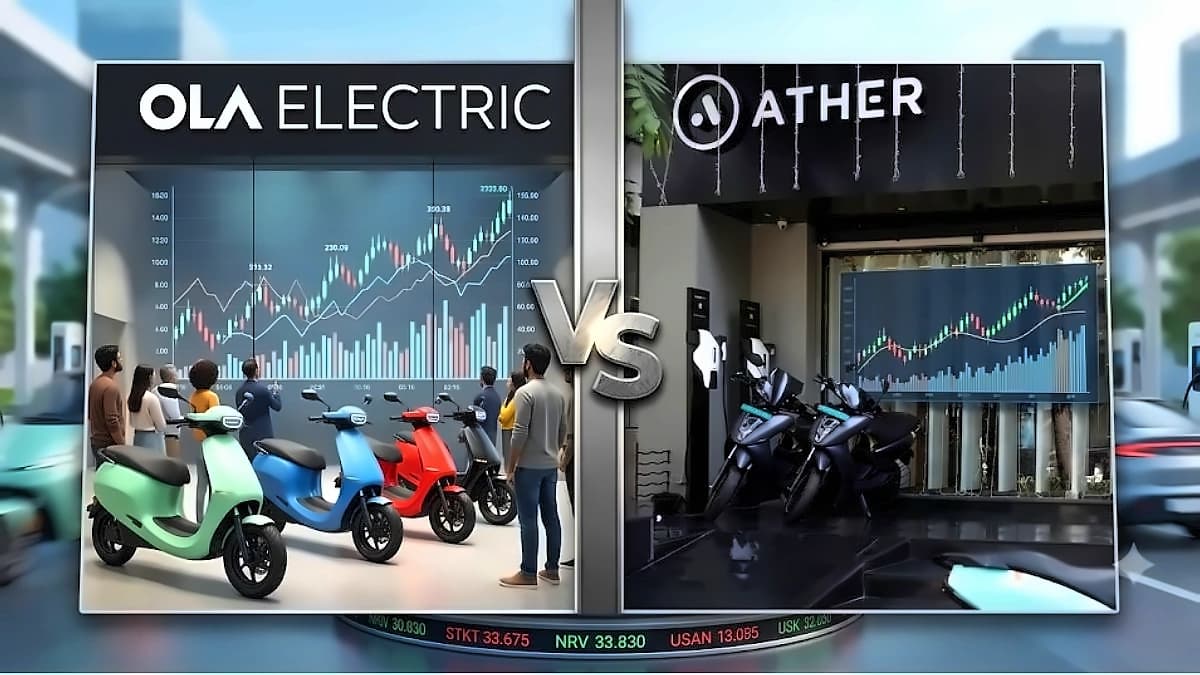
Ather Energy is navigating this subsidy reduction through a combination of premium positioning and operating leverage. The company's gross margin stood at 23% in Q1 FY26, improving to positive EBITDA territory by Q1 FY27 at Rs 9 crore. This improvement came despite the subsidy headwind, driven largely by higher volumes—Ather sold 2.63 lakh units in FY26, up 69% year-on-year, capturing 18.6% market share.
The Rs 5,000 subsidy reduction translates to approximately 165-200 basis points of margin pressure for Ather. However, the company has demonstrated an ability to absorb about 60-70% of this impact through scale efficiencies. Its growth is now product-led rather than discount-led, with the Rizta family scooter accounting for 75-76% of monthly volumes by early 2026. This shift toward mainstream family buyers, combined with a growing network of 500-plus service centers and regular OTA updates, has strengthened Ather's value proposition beyond just price.
Ather's manufacturing expansion tells the story of its confidence. The company is building a new plant in Aurangabad, Maharashtra, with a planned capacity of 10 lakh units—5 lakh in the initial phase. This facility is designed for deeper vertical integration, bringing battery pack assembly, transmission, painting, and electronics under one roof. The EL platform, launching August 29, 2026, targets sub-₹1 lakh pricing and will test whether Ather can profitably sell in the mass market without subsidies.
Ola's Approach: Vertical Integration and Aggressive Cost Cutting
Ola Electric is taking a different path—vertical integration combined with aggressive cost rationalization. The company reported consolidated gross margins of 38.5% in Q4 FY26, up dramatically from 13.7% a year earlier. This margin expansion came despite a 56% year-on-year revenue decline, as Ola intentionally slowed production during its transition to the Gen-3 platform.
The company is targeting a 50% reduction in operating costs through increased automation, job cuts, and ramping up in-house production of EV cells. Operating expenses fell from Rs 844 crore in Q4 FY25 to Rs 428 crore in Q4 FY26—a 49% reduction. Management has indicated that monthly operating expenses could decline further to Rs 100-120 crore, with EBITDA breakeven achievable at 20,000-25,000 units per month, down from previous estimates of 30,000-35,000 units.
Central to Ola's strategy is battery manufacturing. The company has invested Rs 127.64 crore in its battery manufacturing unit and plans to expand capacity from 6 GWh to 20 GWh by 2027. Around 15% of current vehicle orders already run on Ola's own 4680 Bharat Cells, with a target of 100% in-house cell adoption by September 2026. This vertical integration could reduce battery costs by 30-40%, potentially improving gross margins by 700-1,000 basis points.
The Price Cap Squeeze
The Rs 1.5 lakh ex-factory price cap under PM E-DRIVE creates real product positioning constraints.
However, higher Rizta Z variants, priced up to Rs 1.93 lakh, exceed the threshold and lose subsidy eligibility. This forces Ather to either de-feature premium variants to stay under Rs 1.5 lakh, accept the Rs 5,000 disadvantage, or absorb the difference to maintain price parity.
Ola faces similar constraints. Its S1 Pro starts at Rs 1.25 lakh and S1 X+ at Rs 1.05 lakh, both within the cap. But adding premium features—larger batteries, advanced displays, enhanced connectivity—risks pushing variants above the threshold. The cap effectively creates a margin ceiling for eligible vehicles, as manufacturers must balance feature content, battery capacity, and profitability within Rs 1.5 lakh.
Both companies are responding through platform standardization and cost reduction. Ather's EL platform and Ola's Gen-3 architecture represent purpose-built approaches to mass-market pricing. The question is whether these platforms can deliver sufficient cost reductions to maintain margins without subsidies.
Market Share Dynamics in a Post-Subsidy World
The subsidy landscape has fundamentally altered competitive dynamics. When PM E-DRIVE launched, it aimed to support 24.79 lakh electric two-wheelers with a Rs 1,772 crore allocation. By early 2026, the scheme had supported 19.19 lakh electric two-wheeler sales, with Rs 1,703 crore reimbursed to manufacturers. The remaining quota was rapidly depleting, creating a race to capture subsidized sales before the July 31, 2026 deadline.
Ather emerged as a clear winner during this period. Its market share nearly doubled from around 10-11% in FY25 to 18.6% in FY26. The company captured approximately 4.6 lakh of the 24.79 lakh subsidized quota—about 20% of the total. Ola, by contrast, saw its market share collapse from 34.8% in FY24 to 29.9% in FY25 and roughly 8-9% in FY26. This dramatic decline meant Ola captured a shrinking portion of the subsidized quota despite its early dominance.
The post-subsidy competitive landscape favors manufacturers with strong brand equity, efficient operations, and sustainable unit economics. TVS Motor leads with 24.36% market share, followed by Bajaj Auto at 20.64%, with Ather in third position. Legacy manufacturers have leveraged their extensive dealership networks and established service infrastructure to gain ground, while pure-play EV startups like Ola have struggled with service quality and reliability issues.
Financial Trajectories: Who Reaches Profitability First?
The subsidy reduction impacts both companies' financial paths, but differently. Ather achieved positive EBITDA of Rs 9 crore in Q1 FY27, with net loss narrowing 71% year-on-year to Rs 51.1 crore. The company's revenue grew 89% to Rs 1,216.9 crore, driven by an 81% increase in vehicle deliveries to 83,173 units. This operating leverage—revenue growing faster than costs—has been Ather's primary margin protection mechanism.
Ola's financial picture is more complex. The company reported its first operating cash flow positive quarter in Q4 FY26 at Rs 91 crore, with the auto business generating Rs 173 crore in free cash flow. However, this came alongside a 56% revenue decline as Ola prioritized margin improvement over volume growth. The company's gross margin expansion to 38.5% demonstrates significant cost control, but its market share decline raises questions about sustainable demand at current price points.
Looking forward, both companies are projected to reach profitability around FY28, but through different routes. Ather's path relies on steady volume growth, operating leverage, and premium positioning. Ola's path depends on vertical integration benefits, scale economies, and successful execution of its in-house battery strategy. The subsidy reduction accelerates the need for both to demonstrate sustainable unit economics without government support.
What Comes Next
With the electric two-wheeler subsidy now ended, the competitive landscape enters a new phase. The Rs 5,000 per vehicle incentive that once provided a cushion is gone, and manufacturers must compete on product merit, operational efficiency, and brand strength alone.
For Ather, the focus shifts to executing its EL platform launch and scaling the Maharashtra plant efficiently. The company's strong Q1 FY27 performance—positive EBITDA, 89% revenue growth, 81% volume increase—suggests it's building momentum that can continue without subsidies. Its premium positioning and growing non-vehicle revenue stream (13% of total income) provide additional insulation.
For Ola, the challenge is rebuilding market share while maintaining the margin improvements achieved through cost cutting. The company's vertical integration strategy, particularly in battery manufacturing, offers significant potential if executed successfully. But its declining market share—from 34.8% to roughly 8-9%—raises questions about whether its products resonate with consumers at current price points.
The next 18 months will be critical. Both companies have the manufacturing capacity, technology platforms, and capital resources to compete. The question is which can adapt faster to a market where government support is no longer the primary differentiator. In this new reality, operational excellence, product innovation, and customer experience will determine who leads India's electric two-wheeler revolution.