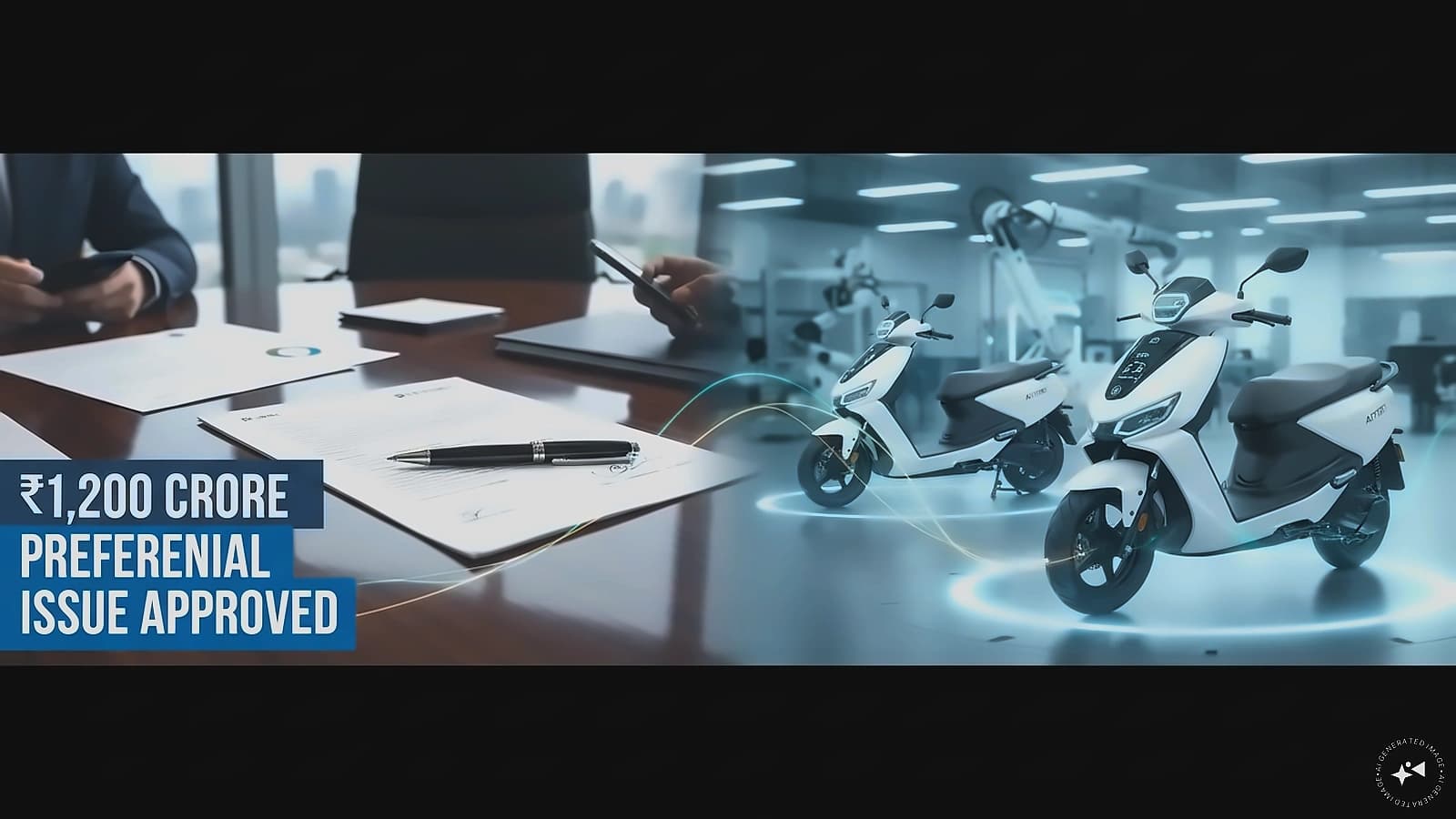
This funding is anchored by strategic investors: the Government of India through the India-Japan Fund (Rs 200 crore), Hero MotoCorp (Rs 960 crore), and co-founders Tarun Mehta and Swapnil Jain (Rs 40 crore collectively).
Government Investment and Policy Alignment
The Government of India’s Rs 200 crore investment through the India-Japan Fund, managed by the National Investment and Infrastructure Fund Limited (NIIFL), is a strategic move aligned with national EV policy objectives. This fund is a $600 million bilateral initiative with 49% commitment from the Government of India and 51% from the Japan Bank for International Cooperation (JBIC). It focuses on environmental sustainability and low-carbon emission strategies, aiming to enhance Japanese investments in India. By backing Ather, the government supports a company with strong domestic value addition and indigenous R&D capabilities, directly contributing to the Production Linked Incentive (PLI) schemes for automobiles and advanced chemistry cells. The investment seeks to accelerate domestic manufacturing capacity, localize critical EV components, and strengthen the supply chain ecosystem, all key pillars of India’s FAME India Scheme and PM E-DRIVE initiatives.
The bilateral structure involving JBIC adds a unique strategic dimension. It facilitates technology collaboration and transfer, particularly in battery technology where Japan is a global leader. The fund aims to promote business partnerships between Japanese and Indian companies, potentially helping Japanese firms set up manufacturing bases in India. For Ather, this means access to advanced technology ecosystems and potential integration into global supply chains, a competitive advantage that pure-play domestic rivals may find harder to replicate. The government’s equity participation is not merely financial; it is a policy tool to catalyze market development, create jobs, and position India as a global EV manufacturing hub.
Hero MotoCorp’s Strategic Bet and Founder Commitment
This investment increases Hero’s stake to approximately 30.68% post-allotment.
It also allows Hero to hedge its traditional ICE dominance with a robust, tech-heavy EV portfolio without a full takeover, preserving Ather’s entrepreneurial culture. The convertible warrant structure is particularly strategic—it defers dilution and aligns Hero’s upside with Ather’s long-term performance, as conversion is likely only if the stock price appreciates beyond the warrant price. Transcripts
The co-founders’ commitment of Rs 20 crore each through warrants sends a powerful signal of management conviction. Despite marginal dilution in their individual stakes from 4.93% to 4.85%, this “skin in the game” reassures investors about leadership’s long-term commitment and belief in the company’s trajectory. Together, government backing and Hero’s continued investment create a formidable competitive moat. While rivals like TVS and Bajaj have strong manufacturing and distribution, they lack this unique blend of policy support, strategic corporate partnership, and technology leadership. This combination provides Ather with capital stability, regulatory insights, and operational synergies that are difficult for competitors to match quickly.
Fundraising Structure: Pricing, Sequencing, and Dilution
The preferential issue is priced at Rs 1,230 per share for the India-Japan Fund and Rs 1,260 per warrant for Hero and founders, representing a discount of approximately 5.1% to the current market price of around Rs 1,296. This pricing is strategic—it ensures regulatory compliance while providing an attractive entry point for strategic investors and minimizing immediate dilution for existing shareholders. The planned Rs 1,500 crore QIP tranche will likely be priced based on SEBI formulas linked to the two-week average market price, potentially commanding a smaller discount given the current momentum and the strong signal sent by the preferential allotment.
Sequencing the preferential issue before the QIP is a deliberate strategy. It locks in commitments from key strategic investors first, establishing a valuation benchmark and enhancing confidence for subsequent institutional investors. This approach provides Ather with quick capital infusion (within 15 days of approvals) while maintaining flexibility to time the QIP based on favorable market conditions. The use of convertible warrants for Hero and the co-founders further optimizes the dilution timeline. Unlike direct equity, warrants defer full dilution for up to 18 months, as only 25% is paid upfront with the balance due upon conversion. This structure aligns investor incentives with stock performance and provides Ather with phased funding while protecting existing shareholders from immediate, significant dilution.
Competitive Dynamics and Capital Deployment
The Rs 2,500 crore infusion is critical for Ather to defend and expand its 16.2% market share against leaders like TVS (25%+) and Bajaj (22%+), as well as a recovering Ola Electric. Ather has been losing share due to capacity constraints, slipping from around 18.5% to 16.5% despite strong demand. The capital directly addresses this bottleneck by funding Factory 3.0, which will scale total capacity from 4.2 lakh units to 1.42 million units annually. This production scaling is the causal link between fundraising and market share defense—higher volumes enable economies of scale, reduce per-unit costs, and support geographic expansion into tier-2 and tier-3 cities where Ather is rapidly growing its retail footprint.
The competitive urgency is heightened by Ola Electric’s recent Rs 780 crore QIP, which has fueled its sequential recovery. Ola’s capital raise and operational improvements signal that the EV two-wheeler race has entered a capital-intensive phase where funding success directly correlates with market share gains. Ather’s war chest allows it to compete on volume, not just premium positioning, and accelerates its R&D investments to maintain technology leadership. The funds are allocated across three main areas: manufacturing expansion (Rs 1,200-1,400 crore) with an ROI timeline of 24-36 months; working capital and operations (Rs 600-800 crore) showing results in 12-18 months; and technology development (Rs 300-500 crore) with longer-term payoffs over 18-48 months.
Financial Impact and Capital Structure Advantages
The preferential issue pricing at a premium to book value (approximately Rs 67) immediately strengthens Ather’s balance sheet. While the fundraise will dilute EPS in the short term due to increased share count and financing costs, the path to break-even is accelerated by the revenue growth and operational leverage enabled by the capital. Return on Equity (ROE), currently deeply negative, is expected to improve significantly as losses narrow and profitability approaches. Book value per share could see an immediate accretion of 27-34% post-preferential issue, with further long-term gains from retained earnings.
Government and strategic capital comes with implicit costs of 8-12%, compared to 14-16% for market-based institutional funding. This blended cost of capital, combined with the non-financial strategic value from policy alignment and operational synergies, enhances Ather’s financial flexibility. It reduces dilution pressure, provides diverse funding options, and aligns long-term investor objectives beyond mere financial returns, positioning Ather strongly for the intensifying battle in India’s EV two-wheeler market.