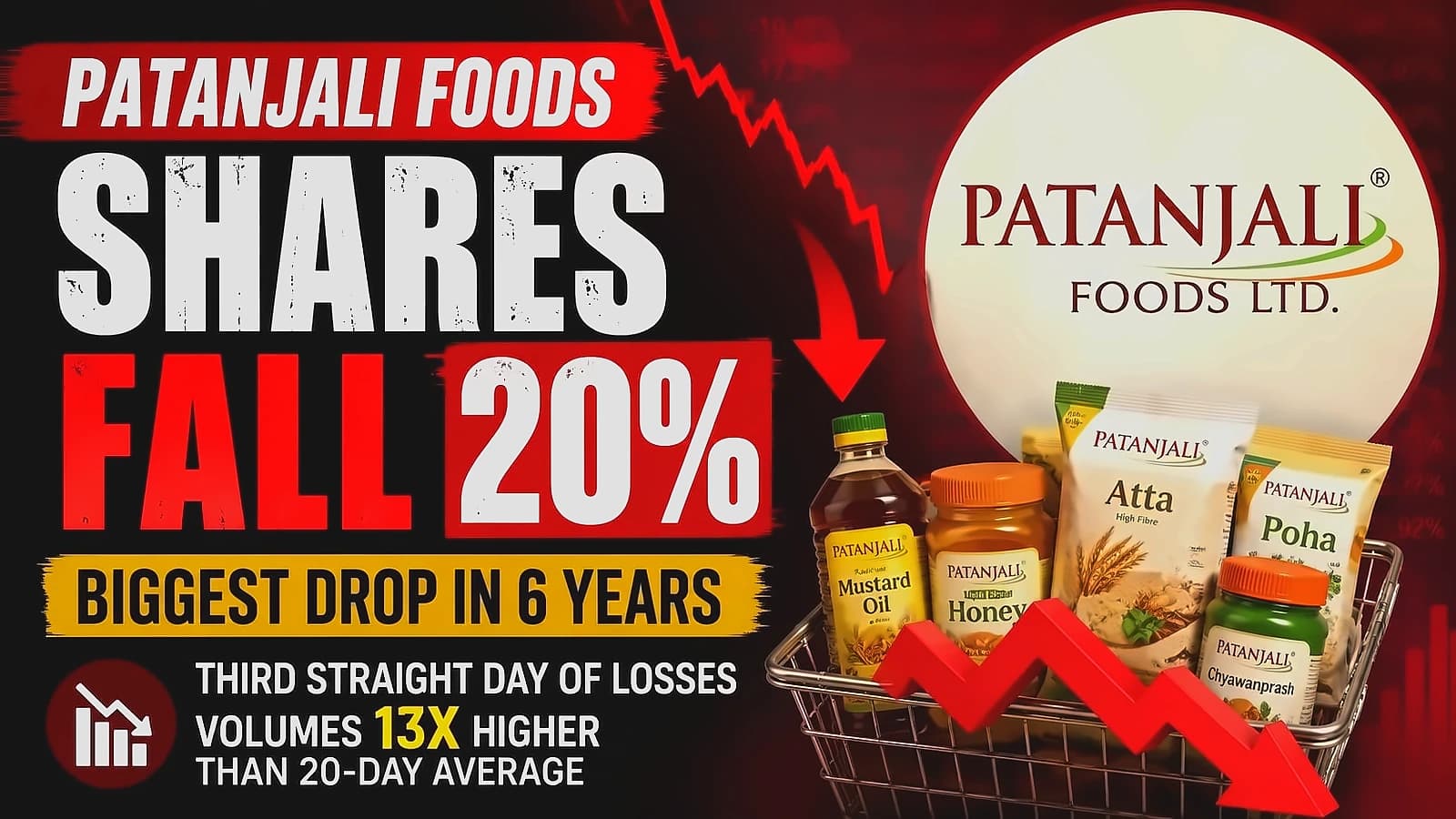
On July 15, 2026, Patanjali Foods shares crashed 17-20% to a fresh 52-week low of ₹328.05 after a 1.5% equity block sale worth ₹195 crore changed hands at an average price of ₹355 per share. This wasn't just another bad trading day—it was the culmination of a year-long unraveling that has seen the stock lose nearly half its value.
The block deal itself involved 54.24 lakh shares changing hands through block deals, but the market reaction was disproportionately severe. Trading volume exploded to over 2.3 crore shares—roughly nine times the 20-day average of around 25 lakh shares. This surge in volume accompanied by a sharp price decline tells an important story about market structure and liquidity constraints.
When large institutional investors need to exit positions in mid-cap stocks with limited free float, the order book simply lacks the depth to absorb such selling without significant price concessions. The block deal at ₹355 served as a new reference point, dragging the market price down to ₹328.05 as stop-loss orders triggered and technical selling accelerated. The company's market cap slipped to ₹37,132 crore, erasing billions in shareholder value in a single session.
The Real Story: Fundamentals Under Pressure
While the block deal triggered the immediate crash, the underlying cause runs much deeper. Patanjali Foods has experienced severe margin compression over the past 18 months, with EBIT margins collapsing from 5.7% in FY25 Q3 to just 2.4% in FY26 Q4—a 58% decline. Net margins followed suit, dropping from 5.3% to 2.1% over the same period. Transcripts +1
Perhaps more concerning is the extreme earnings volatility. Net profit swung wildly from ₹180 crores in Q1 FY26 to ₹524 crores in Q4 FY26, with EPS ranging unpredictably from ₹1.66 to ₹5.46 within a single fiscal year. This unpredictability undermines investor confidence and makes forecasting nearly impossible. Transcripts
The company faces significant operational headwinds. Palm oil prices surged 30-40%, wheat prices increased 12%, and rice prices collapsed nearly 10%, causing an estimated ₹250 crore sales loss in the staples business. Edible oil volumes dropped 27,000 tons in Q3 FY25, and the foods business margins collapsed from 18% at the start of FY24 to just 7.5% in Q3 FY25. Transcripts +3
Competitive and Regulatory Pressures Mount
Patanjali Foods operates in a tough competitive landscape. The company faces intense competition from established FMCG majors like Britannia, Nestlé, and Dabur in the foods segment, while competing with global giants Cargill, ADM, Wilmar International, and Bunge in edible oils. India imports approximately 60% of its edible oil needs, creating significant exposure to global supply chain disruptions and commodity price inflation.
Regulatory challenges have also weighed on sentiment. In May 2026, the company received a GST show cause notice of ₹1,352.92 crore for alleged discrepancies in FY23 tax returns. Although this demand was subsequently dropped in June 2026 after the company successfully contested the allegations, the period of regulatory uncertainty created significant investor concern and volatility.
Management's Response Misses the Mark
. Others
This generic template response failed to address investor concerns about margin compression, earnings volatility, or operational challenges. The market's interpretation was clear: the stock continued declining, remaining 16-17% lower around ₹345 per share, with heavy selling pressure and fresh short build-up in derivatives markets.
Derivatives data showed July futures down 18.08% with open interest up 22.25%, August futures down 18.61% with OI up 283.2%, and September futures down 19.8% with OI surging 637.5%. This combination of declining prices with rising open interest indicated traders were adding new bearish positions, signaling they remained unconvinced by management's assurances.
Institutional Exit and Valuation Compression
The past year has witnessed significant institutional ownership reduction. Foreign Institutional Investors decreased their holdings from 9.20% to 8.53% in the June 2026 quarter, while Domestic Mutual Funds cut their stake from 2.25% to 1.27%. The number of FII investors dropped from 178 to 172, and mutual fund schemes decreased from 31 to 28. Overall institutional ownership declined from 21.26% to 19.58%, representing a clear vote of no confidence from professional investors.
This institutional exodus has driven severe valuation multiple compression. The stock's P/E ratio has compressed from 30x in May 2026 to 24.44x currently—an 18.5% derating. Market capitalization has plummeted from approximately ₹44,743 crores to around ₹12,058 crores, a staggering 73% decline.
Despite trading at significant discounts to peer averages—45.7% below the peer average P/E of ~45x and 80% below the peer average P/B of ~17x—the stock continues to underperform. This suggests the market is pricing in substantial fundamental risks rather than viewing the current valuation as an opportunity.
The Path Forward: What Needs to Change
Analyst consensus targets remain optimistic at ₹580, implying 66-76% upside from current levels, with bull case scenarios reaching ₹665-700. However, achieving these targets requires significant operational improvements.
Near-term catalysts include margin stabilization and improvement, with EBIT margins needing to return to the 4-5% range from the current 2.4%. The company must demonstrate more consistent earnings delivery with reduced volatility, and successfully execute its HPC integration while accelerating growth in the foods segment.
Medium-term, Patanjali Foods needs to reduce its dependence on edible oils, which currently contribute approximately 80% of revenues. Success in higher-margin segments like biscuits, noodles, and nutraceuticals could drive a re-rating, but this requires massive marketing investments and distribution build-out against entrenched competitors.
The current valuation provides a margin of safety compared to premium-valued peers, but the path to recovery requires consistent execution across operational efficiency, margin improvement, and strategic diversification. Until Patanjali Foods demonstrates it can stabilize margins and deliver predictable earnings growth, the stock is likely to remain under pressure despite its attractive valuation on paper.