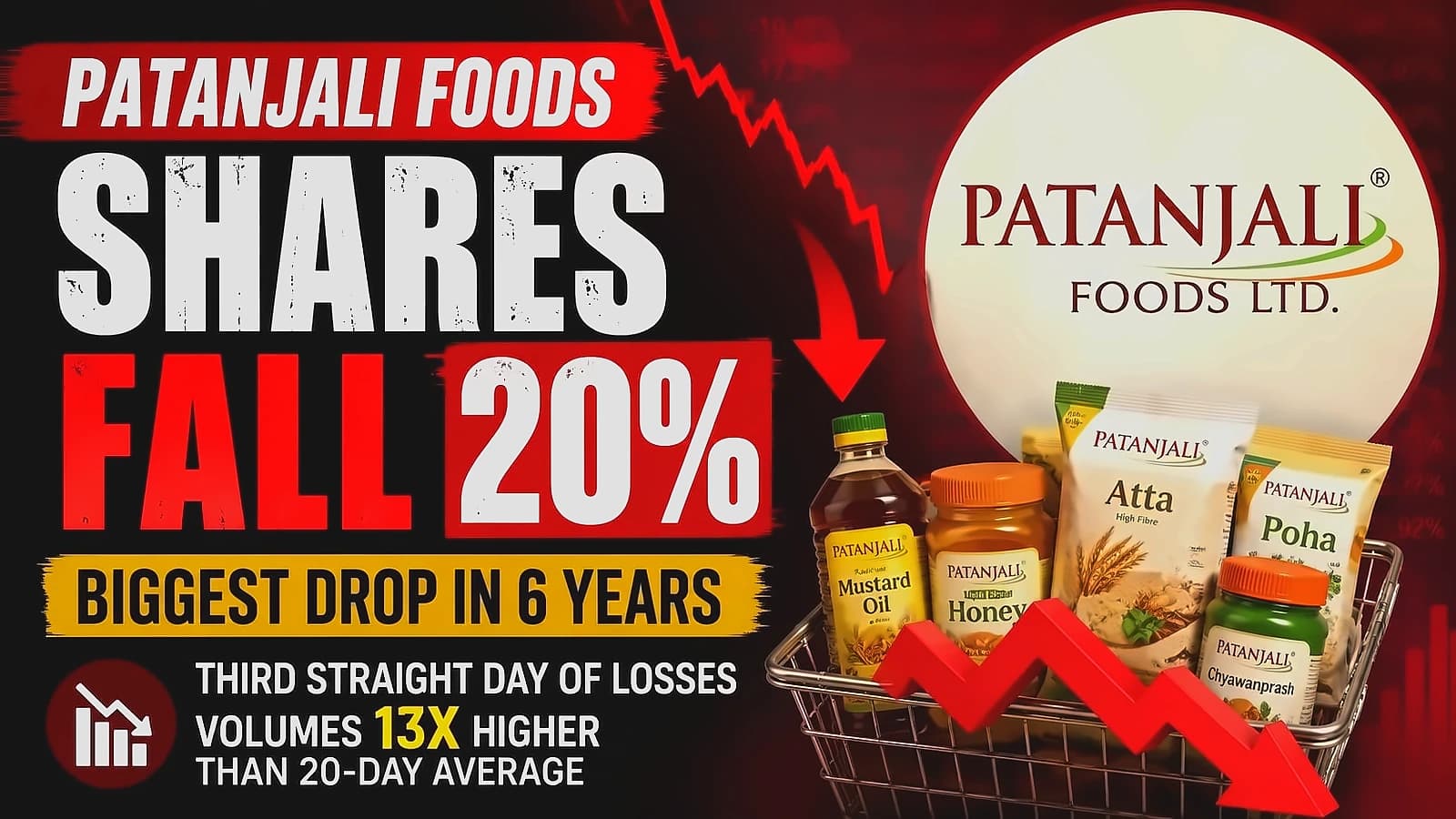
Patanjali Foods shares crashed 19% to hit a fresh 52-week low of ₹328.05 on Wednesday, extending their decline to nearly 36% year-to-date and nearly halving in value from the high hit in July last year. The stock has been trading below all key moving averages, including the 5-day, 20-day, 50-day, 100-day, and 200-day lines, signalling sustained selling pressure. This contrasts sharply with the broader market, where the Sensex climbed 0.65% to 77,555.91, supported by mega-cap stocks and indices such as S&P BSE Healthcare and NIFTY MIDCAP150 hitting new 52-week highs. The decline has been accompanied by exceptional trading volumes with over 2.3 crore equity shares changing hands against a 20-day average of around 25 lakh shares, alongside a sharp spike in delivery volumes, pointing to sizeable institutional activity rather than pure intraday churn. According to latest reports, the stock later made some recovery, trading around 16% lower at ₹348.25 apiece as of 1 pm, though it remains significantly below previous levels. Around 1.5% equity worth ₹195 crore changed hands on Wednesday, with 54.24 lakh shares worth ₹195 crore changing hands at an average price of ₹355 apiece via block deals, as reported by CNBC TV18. Turnover rose to a high of ₹117.47 crore with 32.79 lakh shares changing hands.
According to Sudeep Shah, Head of Technical and Derivatives Research at SBI Securities, the crash confirmed a major consolidation breakdown on the daily chart, accompanied by a sharp surge in volumes that lends credibility to the bearish move. The RSI has broken down, indicating strengthening bearish momentum, while the DI lines have widened with DI- positioned well above DI+ on the ADX indicator, highlighting strong seller dominance. Patanjali Foods stock is trading significantly below the lower Bollinger Band, reflecting heightened selling pressure. Shah identifies the next key support on the downside as ₹330–325 zone, with a decisive breach below this level potentially accelerating decline towards ₹310 in the short term. On the upside, the ₹380–385 zone is likely to act as immediate resistance. Technical momentum indicators largely align with the downtrend, with the MACD bearish on both weekly and monthly charts, while Bollinger Bands also signal bearishness over these timeframes. The On-Balance Volume (OBV) lacks a clear trend, suggesting that volume has not yet confirmed a reversal, with only the weekly RSI showing a bullish divergence.
Despite the sharp stock decline, Patanjali Foods reported robust financial performance for the quarter ended March 2026. The company reported a 46% rise in its consolidated net profit to ₹523.97 crore in Q4 FY2026 compared to ₹358.51 crore in the year-ago period, driven by higher income from sale of cooking oils and other food items. Revenue from operations increased 17% year-on-year and 6% sequentially to ₹11,217 crore during the January-March period of 2025-26 fiscal from ₹9,564.47 crore in the corresponding period of the preceding year. During 2025-26 fiscal, the company's net profit rose to ₹1,814.47 crore from ₹1,300.70 crore in the preceding year. Total income rose to ₹40,347.78 crore last fiscal from ₹33,890.68 crore in the 2024-25 financial year. This strong financial performance contrasts sharply with the stock's dramatic decline, highlighting the disconnect between market sentiment and fundamental business metrics. The company has reported positive results for three consecutive quarters, with net sales reaching a record quarterly high of ₹11,155.60 crore and PAT climbing to ₹692.79 crore, representing a 54.8% increase in profits over the past year, even as the stock has declined by nearly 33%.
The latest crash extends Patanjali Foods' monthly decline to 21% and three-month decline to 28%, with the stock having dropped 38% in six months and plunged 42% over the past year. This substantial underperformance against the broader market index highlights the company's specific challenges and investor concerns about its business prospects. The stock has been extending its year-to-date losses, with Patanjali Foods having declined 40% in calendar year 2026, significantly outperforming the 9% decline in the BSE Sensex during the same period. According to Bloomberg data, the stock has fallen 27% over the past 52 weeks, compared with a 4.1% gain for the company's peer group, while the Sensex has declined 6.3% over the same period. In response to the significant price movement, Patanjali Foods issued a clarification stating that "We wish to clarify that the Company continues to remain focused on its growth path and is carrying on its business operations in the ordinary course, while pursuing its business objectives. To the best of the knowledge of the management, there are presently no material events, information or circumstances requiring disclosure to the Stock Exchanges under the applicable provisions of the Securities and Exchange Board of India (Listing Obligations and Disclosure Requirements) Regulations, 2015." The company further confirmed it is compliant with Regulation 30 and has been promptly disclosing all material events. As of Wednesday's close, Patanjali Foods has a total market capitalisation of ₹37,893 crore, with the stock having lost nearly 16% of its value in the last three sessions and market capitalisation eroded by ₹7,143 crore in the last three days, of which ₹6,463 crore was erased on Wednesday alone.
Patanjali Foods shares plunged nearly 20% intra-day on Wednesday to hit a 52-week low of ₹328.05, with 87 million shares (or 8% of total equity) worth ₹3,055 crore changing hands at the weighted average price of ₹351.14 apiece. Among the major buyers was Graviton Research Capital, which purchased 9.34 million shares at ₹351.51 per share, as reported by The Financial Express. The company stated that there were no undisclosed material events behind the sharp fall in its share price after the stock extended losses for a third consecutive session. At the end of trade on Wednesday, the stock closed at ₹348.25 apiece on the BSE, down 14.57% versus the previous day's close. The company emphasized that it continued to remain focused on its growth path and was carrying on its business operations in the ordinary course, while pursuing its business objectives. Patanjali Foods also said that it had complied with Securities and Exchange Board of India (Sebi) regulations by promptly disclosing all material events and information that could affect its operations, performance or affairs.
At the end of the June quarter, based on the shareholding pattern on the Bombay Stock Exchange (BSE), promoters of Patanjali Foods had a 68.25% stake in the company, as reported by CNBC TV18. Among large shareholders, Life Insurance Corporation of India (LIC) holds over 9% stake, while GQG Partners has a 2.89% stake as of June. Notably, GQG Partners' stake in Patanjali Foods has been declining over the last five quarters, having held a 4.56% stake as of June 2025. A significant factor weighing on the stock is the high promoter share pledge, which stands at 38.1%, which can exacerbate selling pressure during market downturns, as pledged shares may be liquidated to meet margin calls. In an interview with CNBC TV18, Sanjeev Asthana, the company's chief executive officer, stated that "The company's business is doing well and its balance sheet is robust. There is no change in the company's business objectives." The company is expected to announce its Q1 FY27 results next month, with previous year patterns suggesting results will be declared on mid-August 2026. As of July 15, 2026, Patanjali Foods has a total market capitalisation of ₹37,893 crore according to NSE data.