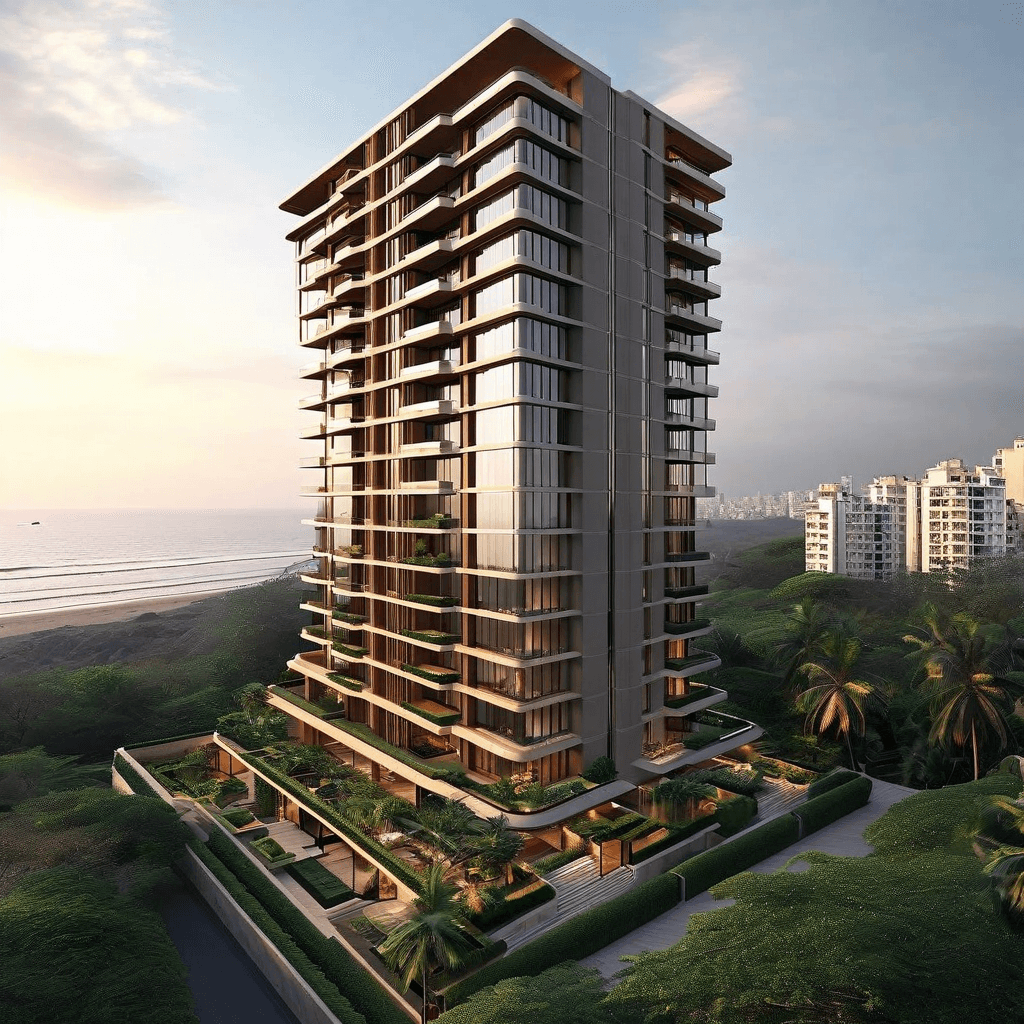
The Peddar Road Premium
Oberoi Realty has signed a development agreement for two housing societies on Peddar Road in South Mumbai, spanning approximately 4,800 square meters. The project offers an estimated sale potential of 1.40 lakh sq ft (RERA carpet area), and ICICI Direct projects gross sales of ₹1,500 crore. That translates to roughly ₹1,07,143 per square foot—an ultra-premium realization that positions this among Mumbai's most expensive residential developments .
Here's the thing: the prevailing average property rate on Peddar Road stands at ₹63,369 per sq ft. So how does Oberoi justify nearly double that? The answer lies in a combination of location scarcity, brand equity, and smart regulatory navigation.
Location Scarcity and the 25% Premium
Peddar Road isn't just another address in Mumbai. It's one of the city's most expensive residential micro-markets, home to high-net-worth individuals and business families. Limited redevelopment opportunities in established South Mumbai create natural supply constraints. When you add proximity to ultra-luxury addresses like Altamount Road (₹97,318 per sq ft), you get a spillover premium effect that's hard to replicate .
ICICI Direct's analysis assumes Oberoi can command a 25% premium over prevailing rates. But the math suggests something more nuanced. If you apply a 25% premium to the market average of ₹63,369 per sq ft, you get ₹79,211 per sq ft—still short of the ₹1.07 lakh target. This implies ICICI Direct is using a premium luxury base rate (approximately ₹85,714 per sq ft) rather than the overall market average, reflecting the ultra-luxury positioning of Oberoi's development .
The Regulatory Framework: DCPR 2034 as Enabler
The Development Control & Promotion Regulations (DCPR) 2034 serves as the primary regulatory framework governing this project. For cessed buildings in the island city, Regulation 33(7) allows an FSI of 3.0 or the FSI required for rehabilitation plus 50-70% incentive FSI, whichever is higher. Oberoi's project achieves an FSI utilization of 2.71, operating close to the maximum permissible limit of 3.0 for South Mumbai .
The statutory approval process under DCPR 2034 and Maharashtra Society Redevelopment Rules 2025 follows a structured timeline. Project approvals are expected within 6 months of application, with a Commencement Certificate issued within 60 days post-approval. The total estimated timeline from society consent to project completion is 36-48 months .
Portfolio Strategy: Volume Meets Value
The Peddar Road redevelopment is part of a broader portfolio strategy for Oberoi. The company has also acquired the MHADA Versova project (17.18 lakh sq ft) and the Bandra East RLDA lease (11 acres). This creates a balanced portfolio combining volume-based revenue generation with ultra-premium value capture.
Versova provides volume stability with 12.3x larger saleable area compared to Peddar Road, targeting the premium western suburbs market. Peddar Road delivers margin enhancement and brand prestige. Combined, these projects represent an estimated potential of ~₹2,286 crore, diversifying across geographic micro-markets .
The Bandra East acquisition represents a different capital deployment strategy—a ₹5,400 crore upfront payment for a 99-year lease with 19.50 lakh sq ft development potential. This long-term strategic bet trades near-term cash flow for potential BKC-adjacent appreciation, creating a balanced maturity profile across Oberoi's project pipeline .
Competitive Positioning in an Evolving Market
Oberoi Realty has established itself as a dominant player in Mumbai's ultra-luxury segment, with a focused strategy on premium South Mumbai redevelopments. The company's financial metrics reflect this positioning: a market cap of ₹51,595 crore, P/E ratio of 23.03, debt-to-equity of 0.2, and EBITDA margin of 60.12% .
Compare this to Arvind SmartSpaces, which is entering Mumbai with a Santacruz project (42,000 sq ft, ₹300 crore revenue potential at ~₹71,429 per sq ft). Arvind's diversified multi-city approach reduces geographic risk but lacks Oberoi's brand premium in Mumbai. Oberoi's market cap dominance (₹51,595 crore vs. ₹2,304 crore) reflects stronger market positioning .
A structural shift is occurring in Mumbai's real estate market, with western suburbs like Borivali, Goregaon, and Andheri increasingly approaching benchmarks traditionally associated with South Mumbai. Infrastructure projects like the Coastal Road, Metro Line 3, and MTHL are driving this convergence, reducing travel time from South Mumbai to western suburbs from 90+ minutes to under 30 minutes .
However, Oberoi's Peddar Road project maintains strong pricing power due to its ultra-luxury positioning beyond suburban reach, the scarcity value of South Mumbai addresses, and Oberoi's brand premium. While the price gap narrows from 3-4x to 1.5-2x, the absolute premium remains intact for the top tier .
The Financial Impact
The ₹1,500 crore potential from this single project represents approximately 100% of Oberoi Realty's Q3 FY26 sales (₹1,492.64 crore), highlighting the transformative impact of this redevelopment on the company's revenue profile .
The company's strong balance sheet (D/E ratio of 0.2) positions it well to execute premium redevelopment projects without significant financial strain. This financial strength provides unique advantages: the ability to wait for optimal timing, self-financing capabilities, risk tolerance for redevelopment delays, and the capacity to target highest-value segments.
What Lies Ahead
Oberoi Realty's Peddar Road project isn't just about building luxury apartments—it's about capturing value in a micro-market where supply is constrained and demand from high-net-worth individuals remains robust. The ₹1.07 lakh per sq ft realization is supported by location scarcity, regulatory incentives under DCPR 2034, and Oberoi's established brand equity as an ultra-luxury developer.
The company's balanced portfolio approach—combining volume-driven projects like Versova with value-capturing redevelopments like Peddar Road and long-term strategic assets like Bandra East—creates natural risk hedging across geography, product segments, and time horizons.
As infrastructure projects reshape Mumbai's connectivity dynamics, the question isn't whether western suburbs will catch up to South Mumbai—they already are. The real question is whether Oberoi can maintain its ultra-luxury premium in a converging market. Given the company's financial strength, execution track record, and strategic land bank in prime locations, they're well-positioned to do exactly that.