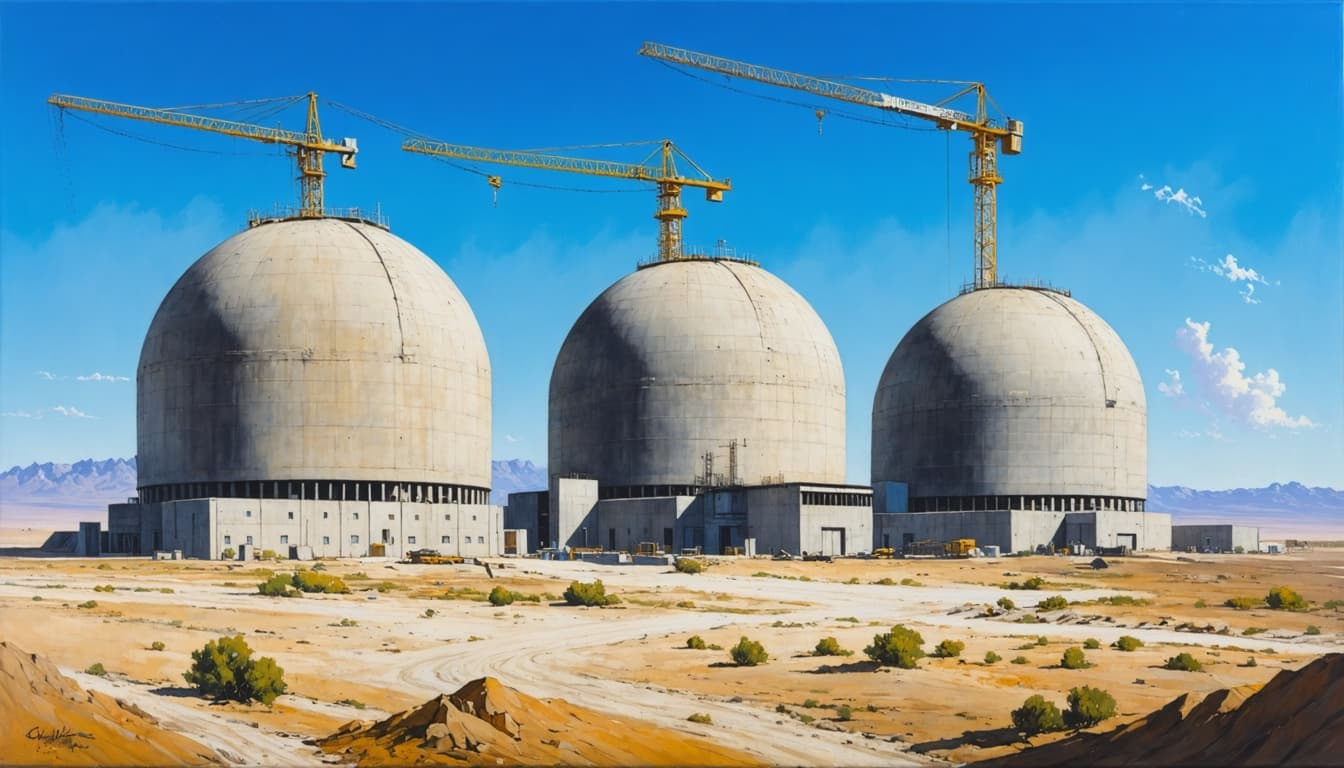
The ASHVINI Advantage: Why a Subsidiary?
Nuclear Power Corporation of India Limited didn’t randomly choose its subsidiary, Anushakti Vidhyut Nigam Limited (ASHVINI), to float the massive ₹28,000 crore Nuclear Island Mega EPC Package (NIMEP) for the Mahi Banswara Rajasthan Atomic Power Project (MBRAPP). The decision is rooted in legal necessity and financial strategy. Under Indian law, only NPCIL and Bhavini can own and operate nuclear plants, but a 2016 amendment to the Atomic Energy Act allows public sector joint ventures. ASHVINI, a 51:49 joint venture between NPCIL and NTPC Limited, was specifically approved in September 2024 to build, own, and operate nuclear power plants, with the Mahi Banswara project being the first transferred to it.
This structure unlocks significant financial muscle. The government granted exemptions allowing NPCIL to invest over ₹500 crore and NTPC over ₹5,000 crore in a single JV, enabling adequate financing for accelerated capacity addition. By pooling resources, ASHVINI combines NPCIL’s deep nuclear technical expertise with NTPC’s formidable financial strength and project execution experience. This risk-sharing model is crucial for a project of this magnitude, where high initial capital costs and long gestation periods are the norm.
Decoding the ₹28,000 Crore Price Tag
The ₹28,000 crore valuation for the nuclear island alone—covering four 700 MW Pressurised Heavy Water Reactors (PHWRs)—translates to roughly ₹10 crore per MW. This is the cost for the heart of the plant: the reactor systems, not the turbines or balance of plant. The primary cost drivers are substantial. Civil works, including nuclear-grade concrete containment structures and deep pile foundations, typically consume 35-40% of the budget. Reactor equipment, such as pressure vessels, steam generators, and primary heat transport systems, accounts for another 25-30%.
Indirect costs are equally heavy. Engineering services, construction management, and quality assurance for nuclear safety standards can represent roughly one-third of the total cost. Specialized labor is another major factor; nuclear construction demands highly skilled professionals, and historically, labor costs for such projects have climbed significantly faster than material costs. When viewed against the total project cost of approximately ₹50,000 crore for the complete plant, the nuclear island portion aligns with broader industry benchmarks, where 700 MW PHWRs are expected to cost around $1,700 per kW (about ₹14.2 crore per MW) for the entire facility.
Financial Engineering: Managing the Cash Flow
The EPC contract structure is a financial tool designed to manage the daunting capital expenditure profile of a nuclear project. Nuclear plants typically take 5-7 years to build, creating a front-loaded investment burden. The fixed-price, lump-sum EPC model transfers significant cost overrun risk to the contractor, providing NPCIL with greater price certainty. Payments are tied to construction milestones, which helps match cash outflows with project progress rather than requiring massive upfront capital deployment.
This structure also aids in financing. By securing performance guarantees and liquidated damages for delays, the contract makes the project more bankable. The expected return profile is compelling. The four units (2,800 MW total) operating at an 80% capacity factor could generate approximately 19,600 million units annually. Assuming a tariff of ₹3.5-4 per kWh, this translates to an estimated annual revenue of ₹6,800-7,800 crore. With operating costs around 30-40% of revenue, the project could generate an estimated annual return of ₹3,500-4,500 crore. Against the total project investment of ~₹50,000 crore, this suggests a return on capital employed in the range of 7-9%, which is attractive for infrastructure with a 60-year operational life.
Building an Industrial Powerhouse
The tender is a catalyst for India’s domestic nuclear manufacturing ecosystem. The NIMEP is part of a broader “fleet mode” initiative to build ten identical 700 MW PHWRs, a strategy expected to generate manufacturing orders worth ₹70,000 crore ($11 billion) for domestic industry. This scale creates unprecedented opportunities for Indian companies to move up the value chain.
Bharat Heavy Electricals Limited (BHEL), the sole Indian supplier of nuclear steam turbines, has already secured major orders for turbine islands and steam generators for these projects. Larsen & Toubro (L&T), through its joint venture heavy forge unit with NPCIL at Hazira, supplies critical forgings like reactor pressure vessels and steam generators. The comprehensive scope of the NIMEP tender—covering engineering, manufacturing, supply, civil construction, installation, and commissioning—creates a full spectrum of opportunities for the supply chain, from Tier-1 equipment manufacturers to specialized civil construction firms like Hindustan Construction Company.
The Fleet Mode: Managing Complexity and Risk
Executing four nuclear units simultaneously presents immense coordination challenges. ASHVINI will likely leverage advanced Integrated Project Management Systems (IPMS) for real-time monitoring, a strategy that has proven effective in arresting delays in other major infrastructure projects. The fleet mode approach itself is a risk mitigation tool. By standardizing the design across ten units, NPCIL enables bulk procurement of long-lead items, reducing costs and timelines through economies of scale.
However, risks remain. Historical projects like Kakrapar and Rajasthan faced delays due to supply chain issues and the Civil Liability for Nuclear Damage Act, which made suppliers reluctant to provide equipment without indemnity. Workforce shortages are another concern; India currently graduates only about 300 nuclear specialists annually but will need nearly 38,000 specialized personnel over the coming decades. To mitigate these, the EPC contract incorporates strict performance guarantees, liquidated damages for delays, and single-point responsibility, transferring substantial execution risk to the contractor.
A Cornerstone of India’s Clean Energy Future
Ultimately, the Mahi Banswara project is about more than just power generation; it is a strategic asset in India’s clean energy transition. Nuclear power provides dispatchable, low-carbon baseload power, complementing the intermittent nature of renewables like solar and wind. As of April 2025, India’s nuclear fleet has avoided approximately 798 million tonnes of CO2 equivalent emissions.
The project is a critical stepping stone toward India’s ambitious target of 100 GW nuclear capacity by 2047, a 12-fold increase from current levels. The four 700 MW units add 2,800 MW of capacity, contributing significantly to the intermediate goal of 22.48 GW by 2031-32. Furthermore, it aligns with India’s long-term energy security strategy. The country has limited uranium reserves but vast thorium resources. The PHWRs at Mahi Banswara are part of the first stage of India’s three-stage nuclear program, designed to produce plutonium that will eventually fuel Fast Breeder Reactors and thorium-based reactors, securing energy independence for centuries.
The ₹28,000 crore investment is not merely a construction contract; it is a down payment on India’s technological self-reliance and a commitment to a sustainable, low-carbon future.