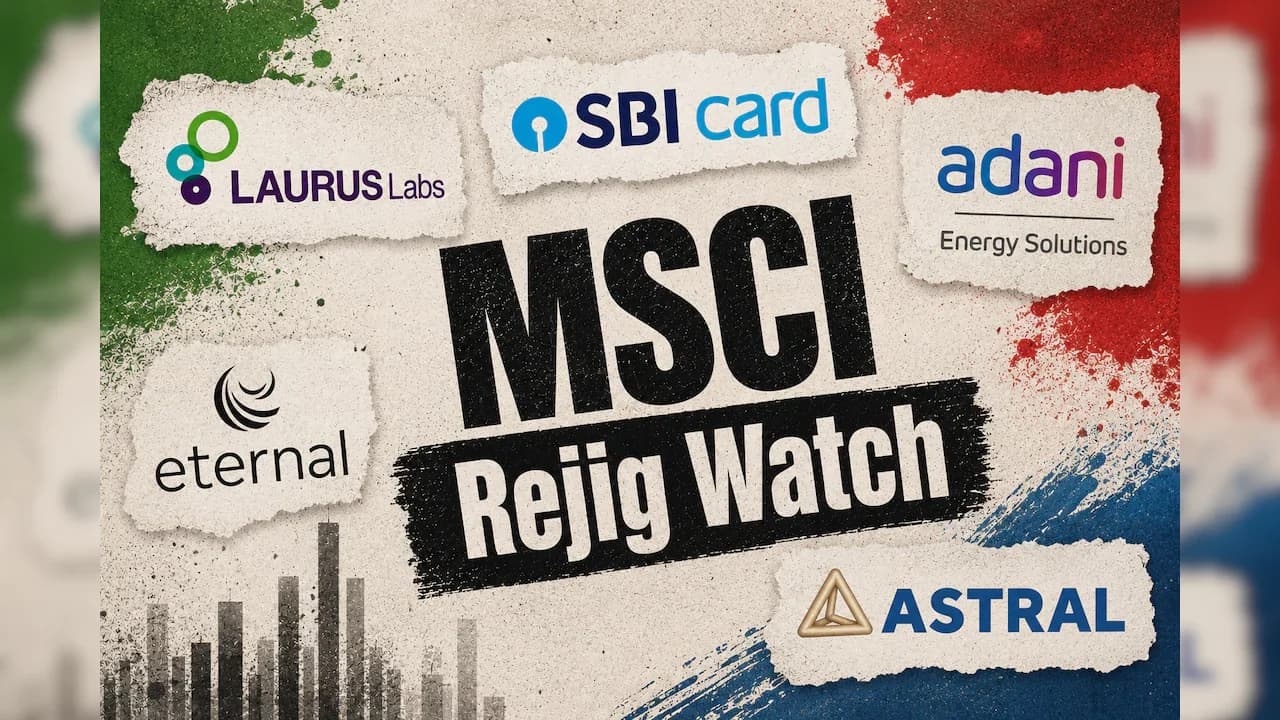
The MSCI India Standard Index is gearing up for its August 2026 rebalancing, and the stakes are substantial.
This matters because trillions of dollars globally track MSCI benchmarks through ETFs and index funds. When a stock enters or exits these indices, it triggers automatic buying or selling from passive funds, creating significant price movements around rebalancing dates.
High-Probability Inclusions: The Top Three
Three stocks have emerged as the strongest candidates for inclusion: Groww (operating as Billionbrains Garage Ventures), Adani Green Energy, and Adani Energy Solutions. If included, Groww is estimated to attract the largest passive inflows at around $821 million, followed by Adani Green at $773 million, and Adani Energy Solutions at $342 million. These aren't random picks—they've cleared MSCI's rigorous methodology hurdles.
Why These Three? The Methodology Behind the Selection
MSCI uses a free-float market capitalization method, meaning it only considers shares available for trading, not promoter holdings or locked-in shares. This methodology creates different inclusion probabilities for new listings versus established companies.
As a recent listing with clean documentation and strong institutional investor base, it faces fewer historical complications. The stock has already gained 78.23% over its issue price, with market cap crossing ₹1.10 lakh crore by November 2025.
However, it has historically faced some free-float limitations due to promoter concentration.
Adani Energy Solutions has a more complex history. It was previously excluded from the MSCI Global Standard Index in November 2024 due to a SEBI show-cause notice and free-float uncertainties. The company has been working to improve its position, recently completing a ₹10,000 crore Qualified Institutional Placement (QIP) to enhance free-float and capital base. Its inclusion now reflects these improvements and the lifting of previous embargoes on Adani Group stocks.
The Medium-Probability Candidate: Ather Energy
Ather Energy has been classified as a medium-probability candidate, with estimated passive inflows of $244 million if included. Its inclusion depends on "continued improvement in its free-float adjusted market capitalisation during the remaining observation period". Since listing in May 2025 at ₹321 per share, the stock has posted significant gains, driven by robust sales growth and an aggressive ₹2,500 crore fundraising roadmap. However, it remains "close to adequate free-float adjusted market cap above MSCI's minimum size threshold" rather than clearly above it, which explains the medium-probability classification.
Migration Candidates: Small Cap to Standard Index
Beyond fresh additions, several stocks are potential candidates for migration from the MSCI India Small Cap Index to the Standard Index. Laurus Labs and Biocon are identified as high-probability candidates, with estimated inflows of $554 million and $285 million respectively. Coforge is a medium-probability candidate with potential inflows of $567 million, while Glenmark Pharma ($330 million) and Uno Minda ($206 million) are classified as low-probability candidates.
The migration candidates need to demonstrate sustained market cap maintenance above Standard Index thresholds rather than temporary spikes. High-probability candidates like Laurus Labs and Biocon have already experienced significant market capitalization growth and improved liquidity metrics. Low-probability candidates face challenges such as market cap volatility, free-float constraints, or sector representation limits.
The Exclusion Risk: Who's on the Way Out?
While inflows grab headlines, exclusions matter too. Astral faces the highest probability of exclusion from the MSCI India Standard Index, with estimated passive outflows of $138 million. SBI Cards has medium-probability exclusion risk with potential outflows of $146 million, while Balkrishna Industries has low-probability exclusion risk but faces the largest estimated outflow at $167 million.
Astral's high-probability exclusion stems from persistent market capitalization deterioration and free-float reduction factors that have pushed it below MSCI's minimum size threshold. SBI Cards faces "persistent deterioration in free-float market cap owing to fundamental pressures and structurally low free-float", reflecting challenges in credit quality, competitive pressures, and regulatory changes affecting the credit card business.
The Pre-Announcement Game: Feedback Loops in Action
The period leading up to the August 12 announcement creates powerful feedback loops between passive inflow expectations and stock price movements.
This happens through anticipatory positioning by active managers who front-run expected passive fund buying, creating self-reinforcing price appreciation. As prices rise on inclusion expectations, market cap increases, potentially improving free-float adjusted market cap metrics, which in turn supports inclusion probability. For Adani Green and Groww, this dynamic is already playing out, with both stocks seeing heightened investor interest and trading volume expansion ahead of the official announcement.
How This $2.3 Billion Compares Historically
The estimated $2.3 billion aggregate passive inflows represent a significant event, though not unprecedented. For context, the May 2026 rebalancing saw Federal Bank attract $491 million, MCX $373 million, NALCO $308 million, and Indian Bank $209 million in inflows, totaling approximately $1.4 billion across four inclusions. The August 2026 projection of $2.3 billion across 12 potential inclusions represents roughly 64% larger scale.
Several factors explain this variation.
Additionally, the overall market capitalization of the MSCI India Standard Index has expanded to nearly $3.2 trillion across 165 constituents, while passive fund AUM continues to grow globally.
What This Means for Investors
For active managers, the pre-announcement period presents opportunities for early positioning, though managing the expectation-reality gap risk is crucial. Historical patterns show that "buy the rumor, sell the news" dynamics can emerge if stocks run up too aggressively ahead of announcements.
For retail investors, the key is understanding that MSCI inclusion or exclusion doesn't change a company's fundamental business prospects. While inclusion can generate localized liquidity spikes and short-term price excitement, sustainable wealth creation depends on corporate governance, solid earnings visibility, and competitive moats. Similarly, structural deletion from an index doesn't automatically mean weak long-term growth prospects.
The August 31 effective date will see the actual rebalancing trades execute, likely creating significant volume spikes and potential price dislocations, particularly for stocks with lower liquidity profiles. But beyond the one-day trading event, the lasting impact will be on the liquidity, institutional ownership, and global visibility of the affected companies.