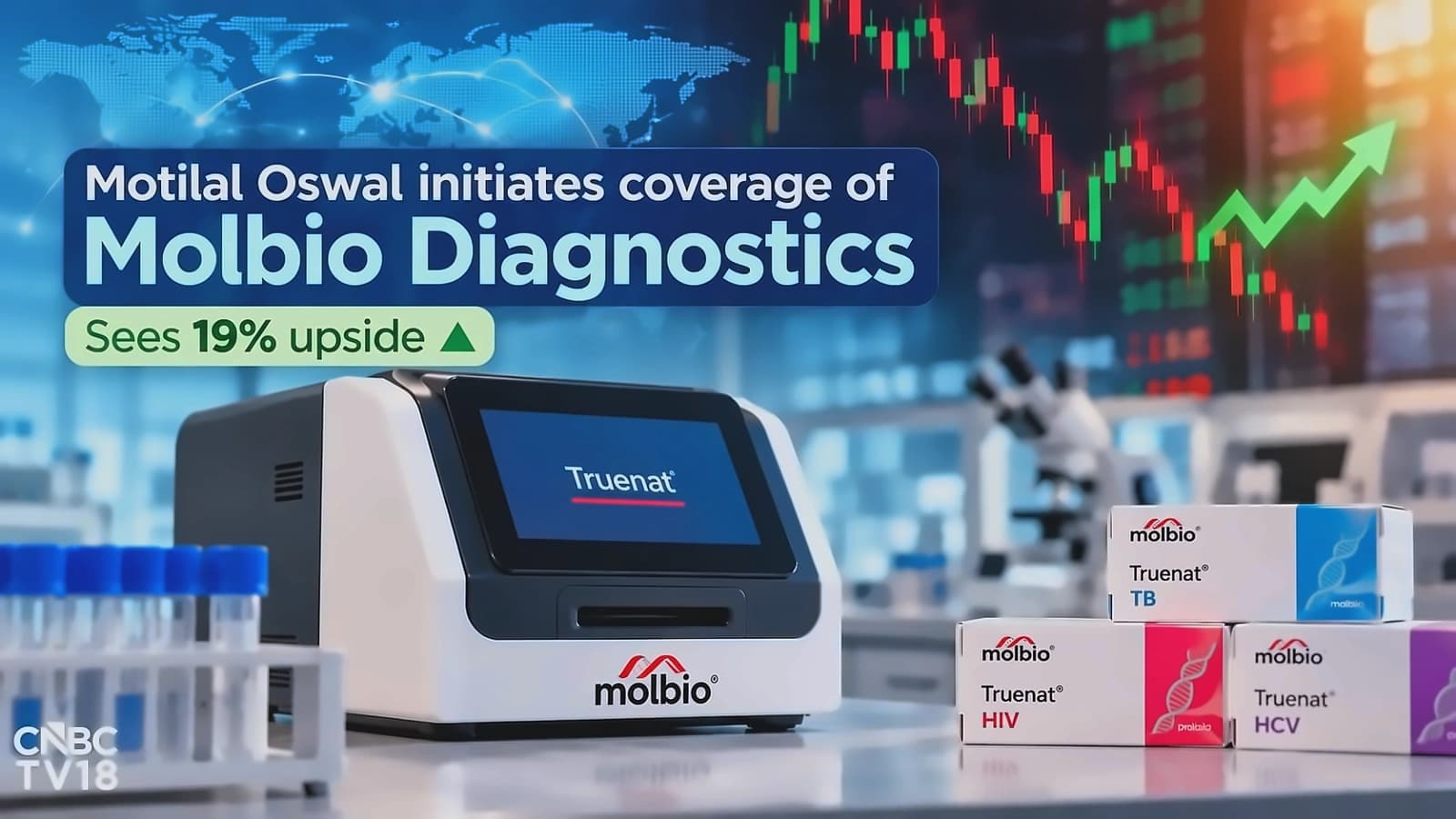
Molbio Diagnostics hit the ground running in August 2026. The IPO priced at ₹807, but the stock didn't just list—it flew. On day one, it closed at ₹1,041.70, a tidy 29% gain. Within a month, the rally accelerated to 57% above the issue price, eventually touching an all-time high of ₹1,686.80 by September 11, 2026. That's a 109% gain from the IPO price in under a month. The current price sits at ₹1,312, still 62% above the IPO level but 22% off those heady September highs.
What fueled this rocket? Institutional demand was off the charts. The IPO was subscribed 70.18x overall, with Qualified Institutional Buyers (QIBs) bidding 186.39x their allotted portion. When big money piles in like that, listing gains are almost guaranteed. But the sustained momentum came from the fundamentals—revenue grew 40.6% to ₹1,445 crore in FY26, with PAT at ₹164.14 crore. The business model is compelling: 12,500+ devices installed globally, with 74% of product revenue coming from recurring test kit sales. That's the kind of razor-and-blade model investors love.
The Jefferies Thesis: Why ₹1,600?
Their bull case goes even higher, to ₹1,970. The math rests on aggressive growth projections: 36% EBITDA CAGR and a staggering 47% PAT CAGR from FY26 to FY29. If Molbio delivers, earnings nearly triple in four years. That kind of growth justifies a premium multiple, even in a richly valued market.
The valuation gap between current price and target comes down to three drivers. First, operating leverage. Molbio's test kit capacity utilization sits at 58% in FY26. Jefferies projects this rises to 77% by FY29. More volume through existing facilities means better absorption of fixed costs, driving margin expansion. Second, product diversification. The flagship Truenat platform currently dominates, but Prognosys (portable X-ray) and OptraScan (digital pathology) are scaling up.
Third, geographic expansion. With presence in 90+ countries and a pipeline of 34 assays across 22 diseases, Molbio is pushing beyond its current concentration in TB testing. RHP
The Moat: 13 Years in the Making
The Truenat platform is a closed, proprietary system. Once a device is installed, customers are locked into buying Molbio's test kits. That's 74% of product revenue recurring year after year. Compare this to Cepheid's GeneXpert, owned by Danaher with ~$3 billion in revenue. GeneXpert is the incumbent globally, but it requires laboratory infrastructure, stable power, and skilled technicians. Truenat is battery-operated, works in remote areas, and delivers results in 60 minutes without batching. In India, Molbio has captured 90%+ of the molecular diagnostics installation base by going where GeneXpert can't—primary healthcare centers, not just district hospitals. RHP
The causal mechanism for market share capture is straightforward: infrastructure-light deployment enables access to 25,000+ primary health centers in India versus ~800 district hospitals where GeneXpert typically operates. That's a 30x larger addressable market. Add to this lower total cost of ownership—no infrastructure investment, minimal training, competitive pricing—and government procurement in price-sensitive markets naturally favors Truenat. The WHO endorsement for TB diagnosis (one of only two technologies globally) seals the deal, creating high switching costs once deployed. RHP
Beyond Truenat: The Diversification Play
Molbio isn't putting all eggs in one basket. Prognosys, acquired in 2023 and now 70% owned, brings portable X-ray systems under the PRORAD brand. These are US FDA-approved and EU MDR-certified, designed for TB screening. The integration creates an end-to-end workflow: PRORAD screens large populations with X-rays, Truenat confirms with molecular testing. This is particularly powerful for mass screening in areas like Dharavi. Prognosys contributed ₹154 crore in FY26 revenue with ~19% EBITDA margins—already profitable and scaling. RHP
OptraScan is the wild card. Molbio increased its stake to 60% in October 2025, investing ~$30 million. The US FDA 510(k) clearance came through in July 2026 for the OptraSCAN System, covering whole slide scanners and HER2 image analysis software for breast cancer. This is significant—the US accounts for 60% of the global pathology market and is rapidly adopting digital solutions. OptraScan enables telepathology (scanners in smaller cities, expert pathologists in urban centers), second opinions, and real estate optimization (digital storage vs physical slide storage). FY26 revenue was minimal (₹9 crore loss), but the US market entry is just beginning. Jefferies projects OptraScan reaches 11% of consolidated sales by FY29 with 35%+ margins. If this plays out, it transforms Molbio from a single-product story to a multi-platform diagnostics player. RHP
The Margin Expansion Story
Where does this come from? Capacity utilization is key. Test kit capacity is 39 million annually; FY26 utilization was 58%. Rising to 77% utilization by FY29 means spreading fixed costs over larger volume. Manufacturing automation across Goa and Visakhapatnam facilities should improve efficiency and reduce wastage. Employee costs are projected to decline from 10% to 8% of sales as revenue scales faster than headcount. Other operating expenses should fall from ~22% to ~18% of sales through operational efficiencies. RHP
The mix shift matters too. OptraScan and Prognosys, as they scale, bring higher-margin revenue. OptraScan's 35%+ EBITDA margins (once profitable) will lift the consolidated profile. Even within Truenat, the recurring consumables model (74% of product revenue) carries better margins than device sales. The closed-system architecture means customers keep buying kits—17.6 million sold in FY26—creating a predictable, high-margin revenue stream that compounds as the installed base grows. RHP
The Profit-Booking Puzzle
Here's the thing that makes you scratch your head. Molbio hit ₹1,686.80 on September 11, 2026—then profit-booking kicked in, pulling the stock down 22% to current levels despite broader bear market conditions. Why sell a winner in a down market? Valuation, plain and simple.
Even for a high-growth company, that stretches investor comfort. A 109% gain in less than a month created strong incentives to lock in profits.
Concentration risks also weighed on minds. Jefferies flags that 80% of FY26 revenue came from the B2G (business-to-government) segment, and 70% from TB testing alone. That's concentration. Government budget cycles, policy shifts, or competitive tender processes could disrupt revenue. The large OFS component (₹740 crore of ₹940 crore IPO) indicated significant promoter/investor selling intent upfront. Lock-in expiries may have added selling pressure. Technical factors mattered too—such a sharp rally creates overbought conditions, and corrections are natural. The decline appears more stock-specific than market-driven, driven by valuation concerns rather than broad weakness.
The Risks Behind the Rally
No investment thesis is complete without the risks. Valuation is the elephant in the room. At 88x P/E currently, there's little room for execution missteps. The 47% PAT CAGR projection is aggressive—any miss on revenue growth or margin expansion could trigger multiple compression. Concentration risk is real: 84.6% of finished goods revenue comes from government and aid agencies. Top 10 customers account for 83.3% of revenue. Policy shifts, reduced NTEP funding, or changes to procurement norms would hit hard.
Regulatory and execution risks loom over international expansion. The US and EU market entry strategy is early-stage—no US FDA clearance for the Truenat platform yet. Export revenue actually fell from ₹197 crore in FY25 to ₹139 crore in FY26 despite domestic revenue growing 59%. International procurement from aid agencies is inherently lumpy and project-based. Competition isn't standing still—Cepheid (Danaher), Abbott, bioMérieux, and Roche all have deeper pockets and global distribution. CRISPR-based and isothermal amplification platforms are emerging threats. Integration risks for OptraScan and Prognosys exist—these are distinct businesses stretching management bandwidth. Goodwill plus intangibles jumped from ₹57 crore to ₹233 crore in FY26 (17.8% of equity), and OptraScan contributed ₹22 crore loss in FY26. If these businesses fail to scale or require further capital, impairment risk emerges.
The Verdict
Molbio Diagnostics has the ingredients of a compounding machine: proprietary technology, recurring revenue model, expanding product portfolio, and massive market opportunity. The 57% post-IPO rally wasn't fluff—it was recognition of these fundamentals. Jefferies' ₹1,600 target price isn't unreasonable if the company delivers on its projections. The 22% upside from current levels reflects confidence in the 47% PAT CAGR story.
But the current 88x P/E demands flawless execution. Capacity utilization must rise to 77%. OptraScan must successfully crack the US market. The product pipeline of 34 assays must commercialize on time. Government dependence must reduce. Any stumble, and the premium multiple compresses hard. The profit-booking at ₹1,686.80 showed investors understand this risk-reward balance.
For investors, the question isn't whether Molbio is a good business—it clearly is. The question is whether the current price already prices in perfection. At ₹1,312, you're paying for growth that hasn't happened yet. The upside to ₹1,600 is real, but so is the downside if execution falters. This is a high-conviction, high-risk story. The next 12 months will tell us whether the 47% PAT CAGR is conservative or crazy.