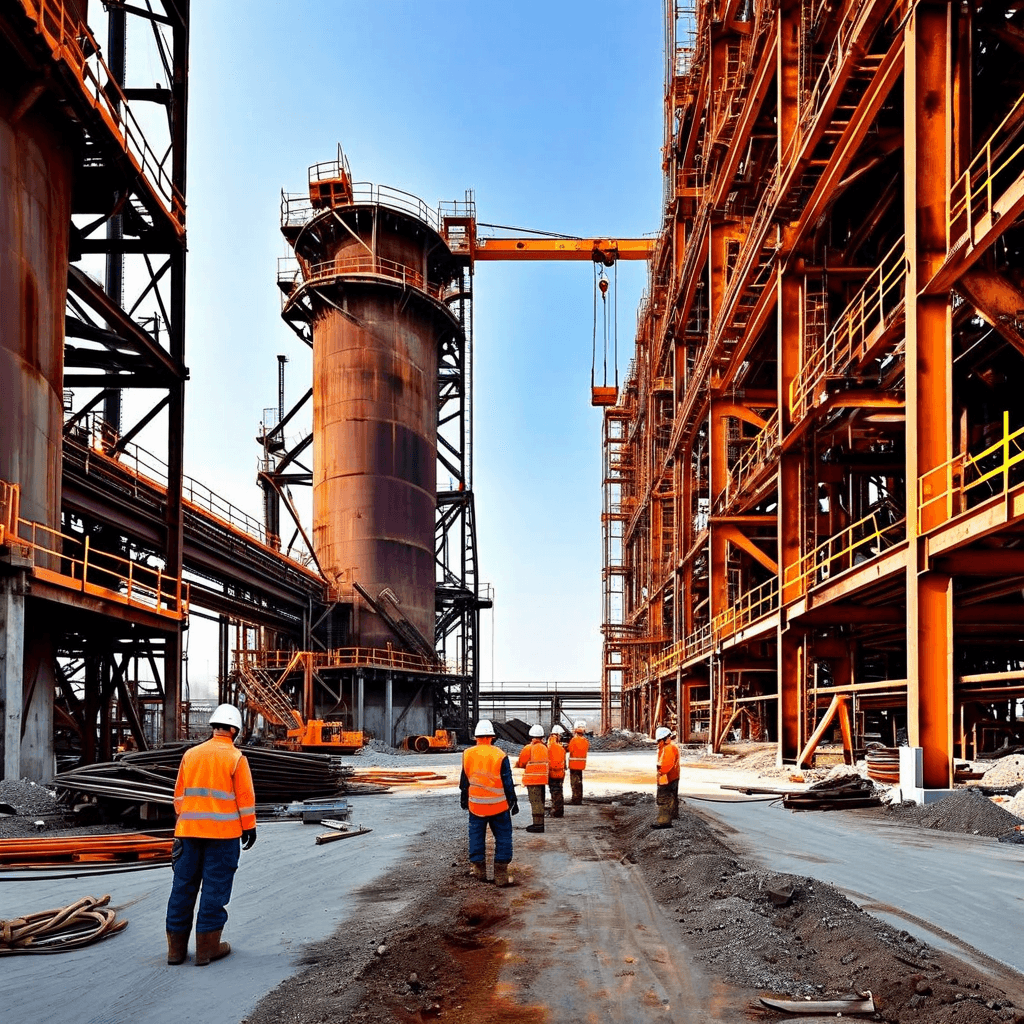
On May 6, 2026, Larsen & Toubro announced what it calls a "Mega" order from JSW Steel—a contract valued between ₹10,000 and ₹15,000 crore for comprehensive engineering, procurement, and installation of blast furnaces and steel melt shops. This isn't just another contract. It's the largest-ever domestic metals order in L&T's history, and it arrives at a pivotal moment as JSW Steel races to expand its crude steel capacity from 35 million tonnes per annum (MTPA) to over 50 MTPA by 2031 Others +1.
The "Mega" classification itself carries weight. In L&T's internal framework, this designation signals projects valued between ₹10,000-15,000 crore—orders that don't just bump up quarterly numbers but fundamentally reshape business trajectories. For L&T's Minerals & Metals vertical, this single order represents a substantial portion of what the broader Infrastructure Projects segment (which houses Minerals & Metals) generated in FY26: ₹135,345 crore AnnualReports. The revenue recognition will follow the percentage of completion method under Ind AS 11, spreading across multiple years and providing medium-to-long-term visibility that investors crave Others.
Three Decades of Trust: The Competitive Moat Nobody Can Copy
What makes this order particularly significant isn't just its size—it's the relationship behind it. L&T and JSW Steel have been collaborating for over three decades on complex metallurgical projects. This isn't a transactional partnership; it's embedded trust built through successful execution of everything from steel melt shops to the country's highest capacity stacker-cum-reclaimer (11,000 TPH) commissioned at JSW Jaigarh Others +1.
This longevity creates formidable switching costs for JSW Steel. Consider what a competitor would face: L&T has developed deep, JSW-specific process knowledge across blast furnace operations, steel melt shop configurations, and material handling systems. New entrants would need to invest years understanding JSW's operational requirements, site conditions, and integration challenges. The performance risk premium associated with switching contractors creates a substantial barrier—especially for mission-critical assets like blast furnaces where downtime costs are enormous.
The pattern of repeat business tells the story. From individual equipment orders (torpedo ladle cars, stackers) to integrated facility orders (blast furnaces, steel melt shops), the relationship has deepened over time. The May 2026 mega order represents the natural progression of this trust-based partnership. While L&T doesn't publicly disclose bid success rates by client type, the progression to larger strategic orders suggests that established relationships like JSW Steel likely enjoy higher conversion rates and potentially better risk-adjusted pricing compared to new client relationships where credibility must be proven from scratch.
Brownfield vs. Greenfield: The Execution Balancing Act
JSW Steel's expansion strategy presents L&T with a sophisticated mix of brownfield and greenfield challenges. At Ballari (Vijayanagar), Karnataka—the company's largest single-location steel-producing facility at 17.5 MTPA—the work is primarily brownfield: expanding and upgrading existing infrastructure Others +1. At Paradip (Odisha), the focus shifts to greenfield development, including the JSW Utkal Steel Plant (5 MTPA Phase-I, expandable to 13.2 MTPA) and a joint venture with POSCO (6 MTPA) Others +2.
The economics differ significantly. Brownfield expansions typically cost 30-50% of equivalent greenfield projects since land, utilities, rail sidings, coke ovens, and logistics infrastructure already exist . They're also faster—months to a few years versus 4-7 years for greenfield commissioning . But brownfield projects come with their own headaches: space constraints, aging utility lines, outdated IT/OT systems, and the critical challenge of executing upgrades while the plant continues producing steel. Furnace shutdowns must be managed with surgical precision to minimize production losses.
Greenfield projects offer clean-slate advantages—optimized layouts, state-of-the-art technology from day one, and the ability to design for decarbonization pathways like hydrogen-ready direct reduction units. But they demand billions in upfront investment, multi-year permitting processes, and carry higher financing risks.
For L&T's margins, this mix creates both opportunities and pressures. Brownfield projects may command premium pricing for integration complexity but carry higher change-order risks. Greenfield projects offer economies of scale and technology premiums but require longer working capital commitment. The ability to execute both types simultaneously positions L&T as a full-spectrum partner capable of supporting JSW Steel's entire expansion roadmap.
Technology Integration: Where Efficiency Meets the Bottom Line
The modern steel plant is as much about digital systems as it is about molten metal. L&T's ability to integrate advanced technology directly impacts JSW Steel's operational efficiency and cost per tonne. Consider what's at stake: smart melt shop implementations have demonstrated energy savings of 4,500 MWh annually in facilities with 4 MTPA capacity, 4% higher casting speeds, and additional output of 24,000 tons per year .
These aren't marginal improvements. JSW Steel expects smart factory solutions to increase EBITDA profit by approximately $2 million (₹16-17 crore) annually from a single facility . The technology stack includes ladle and crane tracking systems, thermal loss prediction models, automated scheduling modules, and advanced process control systems that maintain temperature precision within ±2°C of thermal model predictions .
L&T's execution capability directly influences JSW Steel's ability to hit its aggressive 2031 timeline. The company employs sophisticated project management systems—IPMS (Integrated Project Management System), WRENCH for real-time progress tracking, Procube for milestone management, and PCIS for micro-level progress monitoring AnnualReports. Digital execution technologies like 3D laser scanning for brownfield integration, digital twin technology for CAPEX forecasting, and drone-based monitoring for live progress feeds all contribute to timeline optimization.
The contract structure itself creates powerful incentives. While specific terms aren't disclosed, industry-standard EPC contracts typically include liquidated damages for delay (often 0.5% per week of contract price) and performance liquidated damages for quality shortfalls . These penalties, combined with potential early completion bonuses, align L&T's incentives tightly with JSW Steel's timeline.
The Competitive Landscape and Cross-Selling Opportunity
This mega order fundamentally reshapes L&T's competitive positioning within India's steel infrastructure ecosystem. The Indian EPC market exhibits moderate to high concentration, with key players like L&T, Tata Group, BHEL, and Reliance Infrastructure dominating significant market share . In the metallurgical segment specifically, L&T faces competition from international technology leaders like Primetals Technologies (Austria), SMS Demag (Germany), Danieli (USA/Italy), and Mitsubishi-Hitachi (Japan)—all of whom supply specialized equipment to JSW Steel .
What differentiates L&T is its integrated EPC capability. While international competitors excel in specific equipment supply, L&T offers complete end-to-end solutions from mineral processing to finished metals AnnualReports. This comprehensive capability positions L&T as a single-point solution provider rather than a component vendor. Combined with domestic cost advantages and state-of-the-art manufacturing capabilities, L&T can deliver global technology at competitive price points.
The strategic implications extend far beyond this single order. JSW Steel's expansion creates a cascade of adjacent opportunities across the metals and mining value chain. The company is developing two pellet plants (8 MTPA each), a 30 MTPA slurry pipeline spanning 302 km, and the 30 MTPA Jatadhar Port InvestorPresentations. L&T's comprehensive portfolio—mineral crushing equipment, surface miners, stacker reclaimers, port cranes, material handling systems—positions it to capture these infrastructure contracts.
The causal link is straightforward: L&T's proven capability on critical steel-making facilities creates natural adjacency for upstream mining and mineral processing contracts, midstream material handling and logistics, and downstream specialized equipment. The three-decade relationship reduces transaction costs for follow-on orders, while deep technical understanding of JSW's operations gives L&T competitive advantages in proposing optimized solutions for adjacent needs.
The Road Ahead
As India accelerates its steel production capacity to meet infrastructure and industrial demand, L&T's Minerals & Metals business finds itself at the center of a multi-year expansion cycle. The ₹10,000-15,000 crore mega order from JSW Steel isn't just a revenue event—it's a strategic beachhead that positions L&T to capture disproportionate share of India's steel infrastructure opportunity.
The combination of market leadership, comprehensive capabilities across the value chain, and deep client relationships creates sustainable competitive advantages that are difficult for competitors to replicate. For investors, this order provides visibility into L&T's medium-term revenue trajectory while signaling the company's ability to secure and execute the most complex metallurgical projects in India.
For JSW Steel, the partnership ensures access to a proven EPC partner capable of delivering the capacity expansion needed to achieve its 50 MTPA target by 2031. For L&T, it reinforces its position as the dominant domestic EPC contractor in India's steel infrastructure ecosystem—one that's increasingly well-positioned to cross-sell services across the entire metals and mining value chain.
The steel plants being built today will operate for decades. The partnerships forged to build them will likely last just as long.