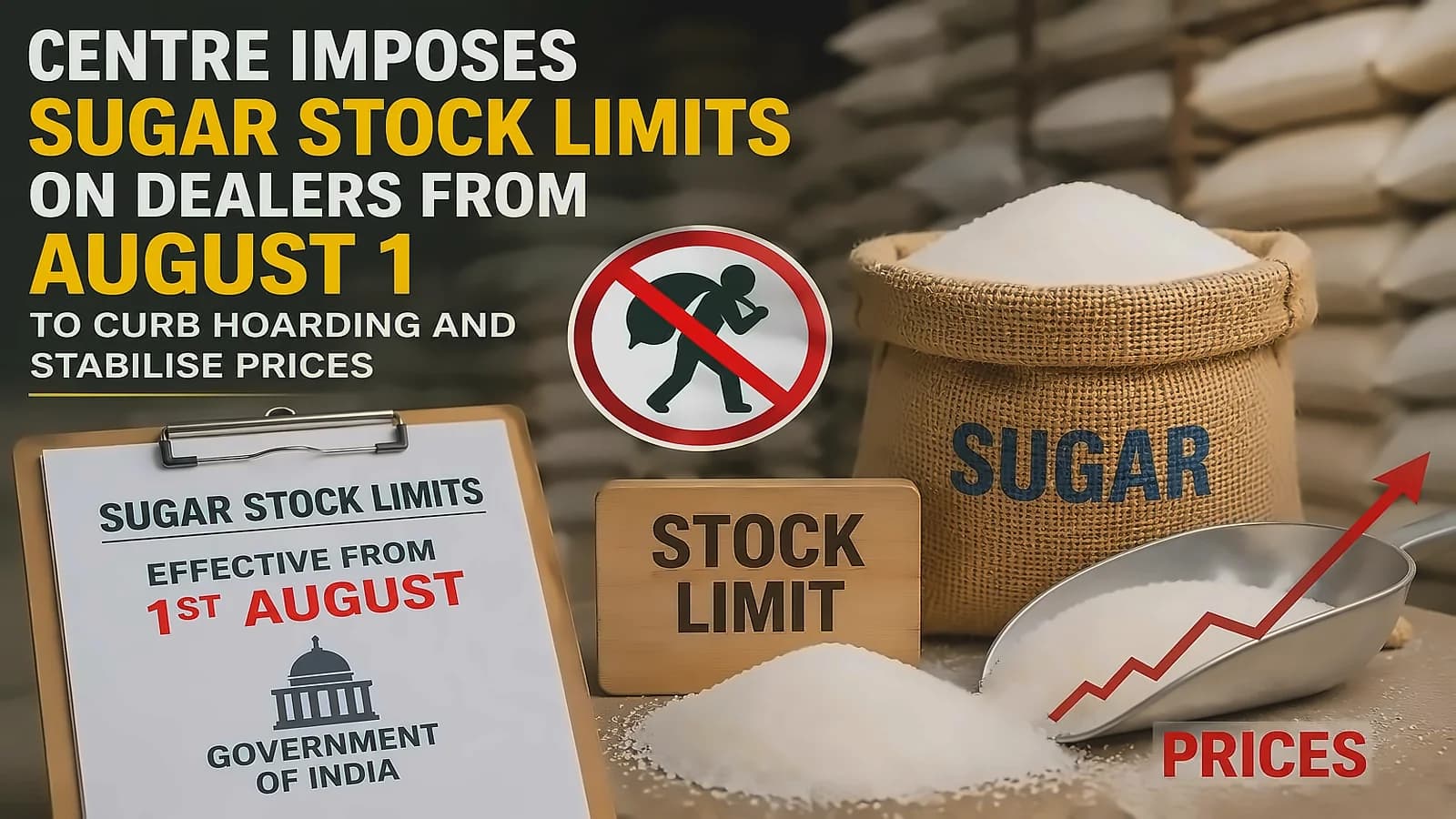
India's sugar market is facing a perfect storm. Wholesale prices in key trading hubs like Kolhapur have surged nearly 20% in August 2026, hitting record highs of Rs 5,350 per 100 kg. This spike comes just ahead of the critical festival season—Ganesh Chaturthi, Dussehra, and Diwali—when demand for sweets and confectionery typically explodes. In response, the government has unleashed a regulatory barrage, imposing strict stockholding limits and actively considering duty-free imports for the first time in nearly a decade. These interventions are reshaping the economics for everyone from bulk industrial buyers to sugar mill owners, creating a complex landscape of trade-offs between immediate price control and long-term industry viability.
The Squeeze on Bulk Consumers
For bulk consumers—beverage makers, confectioneries, and food processors—the new regulatory environment is a double-edged sword. The government has slashed stockholding limits for these large users from 30 days to just 15 days, effective from September 1 to November 30, 2026. This forces a fundamental shift in inventory strategy. Instead of maintaining a month-long buffer to smooth out supply hiccups, these businesses must now operate on a hand-to-mouth basis, procuring sugar twice as frequently.
The immediate impact is on procurement costs. Smaller, more frequent orders mean losing bulk-purchase discounts and facing higher transaction costs. Logistics expenses rise as trucks make more runs carrying smaller loads. But the deeper strategic shift is in risk management. With a 15-day inventory cap, bulk consumers have zero buffer against supply disruptions. If a mill faces a production issue or transportation delays during the peak festival rush, these manufacturers face the very real prospect of halting production lines. The causal chain is direct: tighter limits → reduced inventory buffer → higher vulnerability to supply shocks → operational disruption risk. While storage costs may drop due to lower inventory levels, the net effect on total supply chain costs is likely an increase, driven by higher logistics, handling, and administrative burdens.
The Ethanol Diversion Dilemma
At the heart of India's sugar price surge lies a strategic policy choice: the diversion of sugarcane to ethanol production for the E20 blending program. India achieved its 20% ethanol blending target in 2025, five years ahead of schedule. This success, however, has come at a cost to the sugar market. In the current season ending September 2026, approximately 3 million metric tonnes of sugar equivalent—about 10% of total production—was diverted to ethanol manufacturing.
This diversion has been a significant contributor to record prices. Agricultural experts point out that market forecasts weren't pessimistic enough to justify such sharp price spikes based on production fundamentals alone. The diversion creates an artificial supply constraint. The causal mechanism is clear: E20 policy drives ethanol demand → mills divert cane to ethanol → reduced sugar availability → supply tightness → price inflation. This structural tightness leaves the domestic market with minimal buffer, as net sugar availability (27.5-28.5 million tonnes) barely matches annual consumption (~28.5 million tonnes).
For sugar mills, this creates a complex profit optimization problem. Current market conditions actually favor sugar production over ethanol. With ex-mill sugar prices around Rs 4,520-4,525 per quintal, mills earn more selling sugar than routing cane to ethanol.
However, the integrated business model—producing sugar, ethanol, and power—provides a natural hedge. When sugar prices face pressure, ethanol and power sales can support cash flows. The long-term trend, however, is concerning. OECD-FAO projections suggest ethanol production could consume 22% of India's sugar by 2034, up from 9% currently, potentially structurally tightening supply and supporting higher price floors.
The Import Option and Its Trade-offs
With domestic measures proving insufficient—the initial stock limit announcement only briefly cooled prices before the rally resumed—the government is actively considering allowing duty-free sugar imports. A proposal under discussion would permit mills to import around 1 million metric tonnes of sugar before the end of October 2026. This would mark a significant policy shift for the world's largest sugar consumer, which hasn't relied on major imports in nearly a decade.
The impact on the supply-demand balance would be immediate. Adding 1 million tonnes to the available supply would transform the market from barely balanced to having a moderate surplus, potentially moderating prices by 10-15% from current record levels. This would provide crucial relief during the festival season and break the momentum of speculative hoarding.
However, this comes with significant trade-offs for domestic manufacturers. Duty-free imports would compress domestic prices toward international parity levels, eroding the high margins mills currently enjoy. Coastal mills in Maharashtra and Gujarat, which historically relied on export arbitrage, have already seen that revenue stream vanish due to export bans. Imports would further reduce their competitive advantage. Pure-play sugar mills, lacking the diversification of integrated players, would be most vulnerable to margin compression and financial stress.
From a competitive positioning perspective, India's cost structure is middling globally. White sugar production costs in Maharashtra are around USD 430/tonne, higher than Brazil (USD 345/tonne for raw sugar) and Thailand (USD 360/tonne), but lower than the EU (USD 625-675/tonne). Duty-free imports would expose this cost structure to international competition, pressuring the industry toward greater efficiency, quality improvement, and consolidation.
Regulatory Effectiveness and Market Feedback
The effectiveness of stockholding limits in curbing prices is determined by a complex interplay of factors. The initial response was positive—prices in Maharashtra softened by Rs 100 per quintal immediately after the July 28 announcement. But the relief was short-lived. The fundamental constraint is that stock limits cannot create supply; they can only redistribute existing stocks. With structural tightness from ethanol diversion and weather-related production concerns, limits alone cannot sustainably lower prices.
These regulations operate within a broader framework including the Sugar (Control) Order, 2025, monthly release quotas for mills, and export bans. While this multi-layered approach creates synergies in price control, it also risks disrupting traditional price discovery mechanisms. The removal of physical supply flexibility and interference with market signals can create information asymmetry and increase risk premiums.
Perhaps most concerning are the potential feedback loops between regulation and market behavior. Strict limits can trigger adaptive responses—regulatory arbitrage through multiple entities, geographic dispersion of stocks, or a shift to informal markets. More dangerously, they can create a market psychology loop: intervention → perceived scarcity → panic buying → price pressure → further intervention. Behavioral economics research shows that stockpiling is driven by perceived threat severity, social normative cues, and self-efficacy beliefs. If market participants perceive that regulations signal deeper scarcity, it can paradoxically intensify the hoarding behavior the measures aim to prevent.
The Path Forward
India's sugar crisis requires a nuanced policy response. Stockholding limits and potential imports are necessary short-term tools to protect consumers during the festival season. But they are insufficient to address the structural challenges. The long-term solution lies in rebalancing the food-fuel trade-off, potentially by shifting ethanol feedstock toward grains like corn and rice to ease pressure on sugarcane. For the industry, the path forward involves operational efficiency improvements, technological upgrades, and strategic adaptation to a more globally integrated competitive environment. The current regulatory turmoil is not just a temporary market fluctuation—it signals the beginning of a structural transformation in India's sugar sector.