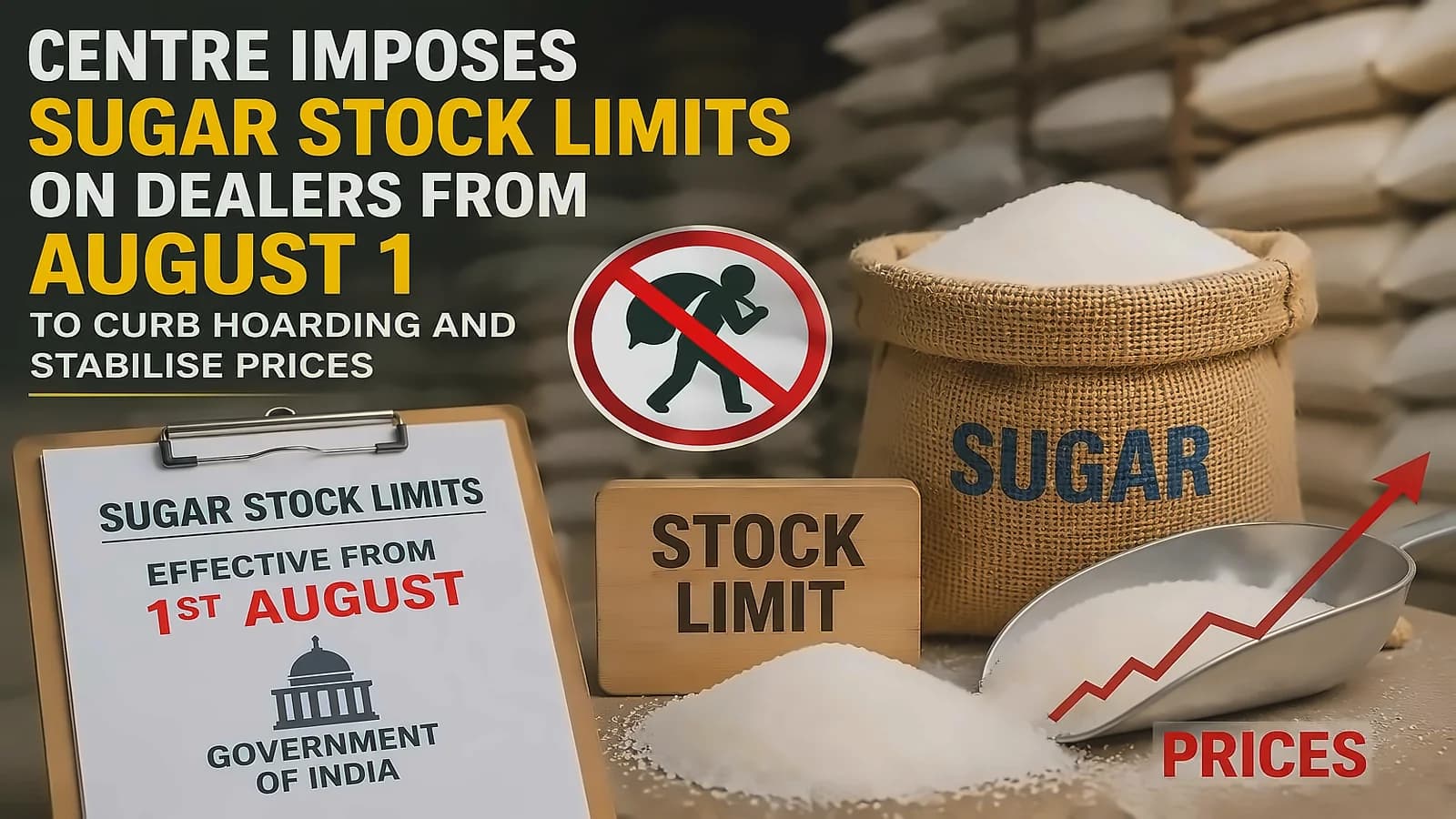
The Government of India has announced the implementation of stock holding limits on sugar dealers across the country, effective August 1, 2026. According to the latest gazette notification issued on July 28, 2026, the regulatory measure will remain in force until November 30, 2026, covering a period of approximately four months. Under the new order issued under the Essential Commodities Act, 1955 and the Sugar (Control) Order, 2025, sugar dealers can hold a maximum of 4,000 quintals of sugar at any point in time. Additionally, dealers cannot retain sugar stocks for more than 30 days from the date of receipt, a move aimed at preventing traders from sitting on inventories in anticipation of higher prices. This decision represents a significant intervention in the sugar trade sector to address market stability concerns, as announced by the government on Tuesday.
The government has outlined specific objectives for implementing these stock holding limits, as reported by the Ministry. The measure is designed to curb hoarding practices in the sugar market and discourage speculative trading activities. According to the Ministry, the recent rise in ex-mill sugar prices is not supported by prevailing demand-supply fundamentals. The government noted that hoarding by certain traders, dealers and market intermediaries, along with speculative transactions and paper trading without the actual physical movement of sugar from mills, has created an artificial perception of scarcity in the market. These practices have resulted in avoidable price volatility and an increase in both ex-mill and retail sugar prices despite adequate domestic availability. The Centre believes that some traders have been holding back sugar or repeatedly buying and selling it on paper, creating the impression that supplies are tighter than they really are, which can push prices higher even when there is enough sugar available. The government emphasized that the measure is intended to maintain orderly supplies in the domestic market, protect consumer interests and ensure that genuine trade and distribution activities continue without disruption. The move is specifically aimed at preventing hoarding during the festive season, ensuring adequate sugar supplies in the market, and helping maintain price stability.
To strengthen market monitoring, all sugar dealers will be required to declare their sugar stocks and update their stock positions every week through the Department of Food and Public Distribution's online portal at https://foodstock.dfpd.gov.in/. As per the Ministry, weekly disclosures will allow the government to monitor inventory levels across the country in near real time, making it easier to identify unusual stock accumulation or supply bottlenecks. The government has said dealers must keep their stock position updated on the portal throughout the period the order remains in force. The Centre has also clarified that stocks meant for the Public Distribution System (PDS) and other government-held sugar stocks are exempt from these limits. State governments have been given the flexibility to prescribe even lower stock limits than the Centre's ceiling of 4,000 quintals if local market conditions warrant stricter controls. The Ministry reiterated that sufficient quantities of sugar are available in the country to meet domestic consumption requirements and said it will continue to closely monitor the market and take necessary measures to ensure adequate availability and price stability throughout the period of the stock holding restrictions.
Industry estimates indicate that India's sugar production in the 2025-26 sugar season is likely to be around 29.3 million tonnes after ethanol diversion, up from 26.12 million tonnes in 2024-25, as projected by industry body ISMA. Despite the revised production estimates, domestic consumption is projected at approximately 28.5 million tonnes, marking the second consecutive year in which production will fall short of demand. At the beginning of the season, the industry had estimated production at nearly 30.9 million tonnes, but output declined due to a weak monsoon and lower sugarcane productivity. Uttar Pradesh recorded its lowest sugar production in nearly a decade, while Maharashtra also produced less than initially anticipated. Despite the expected production shortfall, the Centre had permitted exports of 1.6 million tonnes of sugar in February 2026, followed by an additional 0.5 million tonnes in February 2026. Although exports were halted in May 2026, nearly 0.8 million tonnes had already been shipped. Lower production, exports and diversion of sugarcane towards ethanol production have significantly reduced sugar inventories, particularly in Maharashtra and Karnataka, increasing upward pressure on domestic prices.
The Central Government has directed State Governments and Union Territory Administrations to prescribe stock holding and turnover limits within their respective jurisdictions. However, these limits cannot exceed the maximum limit of 4,000 quintals or the 30-day holding period prescribed by the Centre. For the purpose of calculating the holding period, the date on which the sugar stock is received will also be counted. The order also makes it mandatory for all sugar dealers to declare and regularly update their sugar stock position on the Department of Food and Public Distribution's online portal. The government has emphasized that these measures are intended to ensure adequate sugar availability across the country and maintain price stability during the implementation period. The department said it will continue to closely monitor the sugar market and take further measures if necessary to ensure adequate sugar availability at reasonable prices. The government has also threatened mills to stop their domestic sales quota if they are found to sell excess quantity or keep more stock than what has been declared by them, as part of the physical checking of sugar stock held by mills during August 1-14.
According to the government announcement, the stock holding limits are specifically aimed at safeguarding consumer interests in the sugar market and ensuring price stability for consumers. The regulatory framework is designed to ensure that genuine trade and distribution activities continue without disruption, maintaining the integrity of legitimate business operations while addressing market stability concerns. The measure is intended to maintain orderly supplies in the domestic market and protect consumer interests during the implementation period, allowing genuine trade and distribution activities to continue smoothly. The Centre has also sought to reassure consumers that there is enough sugar available in the country to meet domestic demand, emphasizing that the objective is to maintain orderly supplies while allowing genuine trade and distribution activities to continue without disruption. The government noted that it will continue to closely monitor the sugar market and take further measures if necessary to ensure adequate availability and stable prices throughout the period of the stock holding restrictions. Industry bodies ISMA and NFCSF have also asserted that there is adequate stock of sweetener in the country and asked institutional buyers and traders to refrain from speculative buying amid the recent price rise.
According to government data, all India average retail sugar price has increased to ₹47.9/Kg on July 17 from ₹47.01/Kg a month ago, ₹46.48/Kg three months back, and ₹46.34/Kg six months ago. In wholesale market, prices have shot up to ₹4,447.57/quintal as on July 17 from ₹4,294.70/quintal in the past six months. The All India Sugar Trade Association (AISTA) on Monday claimed reports of sugar shortage in the country unfounded and asked its members to ensure steady availability of the sweetener across the country. The government has also banned export of sugar till September 30 this year with immediate effect to enhance domestic availability and contain prices, following the earlier decision to halt exports in May 2026. The government has observed that the recent increase in ex-mill prices of sugar is not supported by the prevailing demand-supply fundamentals, with the Centre assuring consumers that adequate quantities of sugar are available in the country to meet domestic consumption requirements.