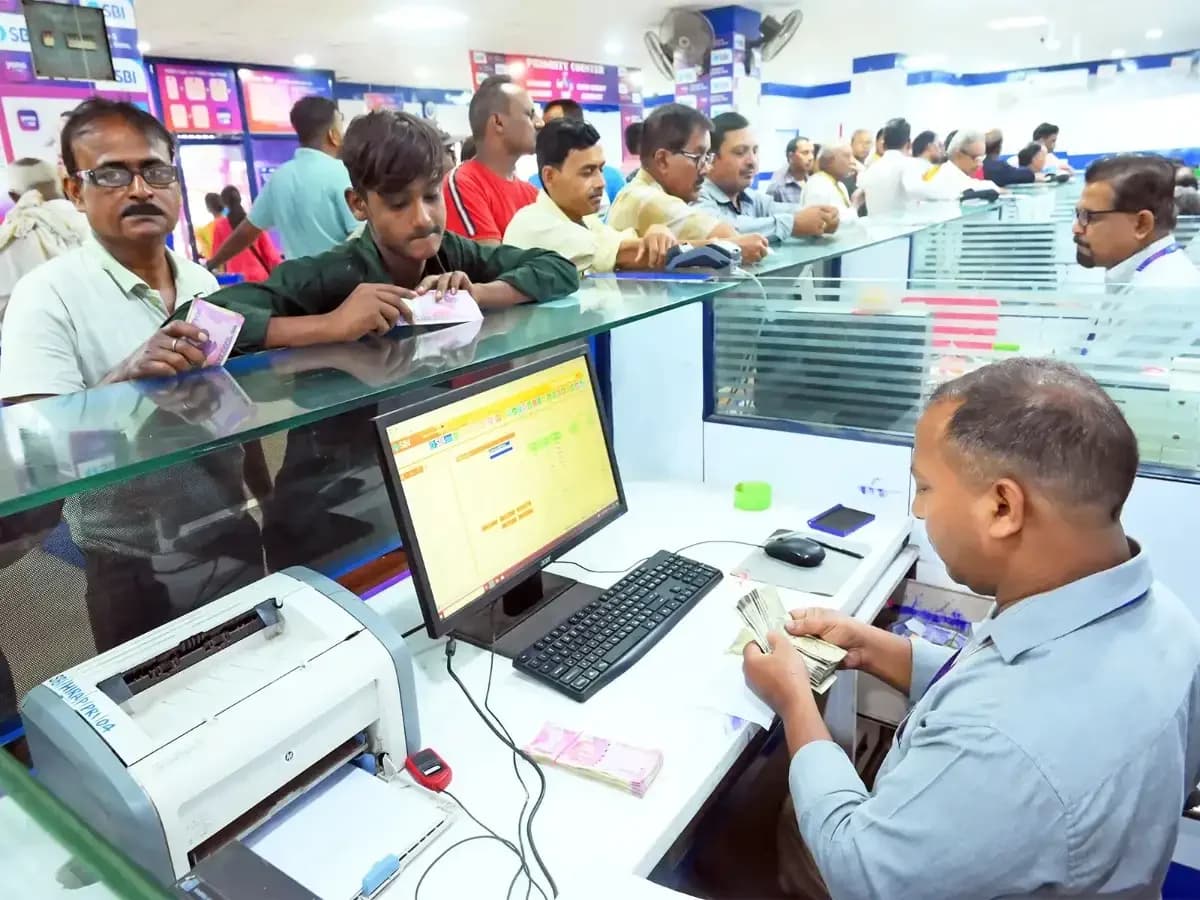
India's largest private banks are undergoing a remarkable transformation. In FY26, HDFC Bank, Axis Bank, and Kotak Mahindra Bank collectively reduced their workforce by over 7,700 employees. This isn't a retrenchment story—it's a strategic reallocation driven by artificial intelligence and automation. These banks are simultaneously cutting operational roles while expanding management positions, investing billions in technology, and adding branches. The shift represents a fundamental change in how banking operates, with profound implications for costs, competition, and the future of work in financial services.
HDFC Bank's Strategic Workforce Reallocation
HDFC Bank leads this transformation with the most dramatic workforce restructuring. The bank reduced overall headcount by 3,343 employees in FY26, but the real story lies in the composition change. Non-supervisory staff—clerical and subordinate employees responsible for operational work—declined by 8,153, falling from 1,70,950 to 1,62,797. Meanwhile, management expanded across all levels: senior management grew by 15, middle management by 1,252, and junior management by 3,543 employees.
This dual approach reflects a deliberate strategy to redeploy talent from backend functions to customer-facing roles.
The bank emphasizes that technology is designed to "elevate, not replace" human capabilities.
The AI Platform Driving Change
Central to HDFC Bank's transformation is Neev, an in-house enterprise GenAI platform. Neev serves as a full-stack AI development platform, enabling business teams to build AI-driven solutions while maintaining enterprise-wide consistency, governance, and controls. The platform currently has 5 use cases in production and 14 more in development, aimed at improving turnaround times, freeing up mid-office and back-office capacity, and enabling staff to focus on customer-facing roles. Transcripts
The automation capabilities are impressive. Neev powers operations across customer engagement, card processing, trade operations, and risk monitoring. The bank processes 35-36% of the country's merchant acquiring volume, handles 21-22% of system credit card issuances, and manages 26-28% of market card spends. Digital adoption has reached 97% for payments and service transactions, and 92% for acquisition journeys. This scale of automation is what enables the dramatic reduction in operational staff. Transcripts
Axis Bank's Productivity-First Approach
This decoupling of branch expansion from headcount growth demonstrates the power of technology-led productivity gains. The bank's total headcount fell to approximately 1,01,300 from 1,04,400, even as the branch network expanded to 6,275 from 5,879.
The productivity improvements come from sustained technology investments. Axis Bank has consistently spent 9-10% of operating expenses on technology over the past 3-4 years, irrespective of the business cycle. The bank has 2,600+ people dedicated to its technology agenda and an in-house digital banking team of approximately 800. Employee enablement tools like Adi (a GenAI-powered frontline assistant) and Siddhi (an employee super app) are helping staff deliver faster, consistent resolutions while reducing dependency on manual support. Transcripts
Kotak Mahindra Bank's Specialized Talent Strategy
Kotak Mahindra Bank has taken a different approach. While the bank reduced its workforce by 1,269 employees to 74,054, it simultaneously hired 28,846 new employees—42% more than FY25 hiring. The focus was on specialized talent in software engineering, DevOps, cloud infrastructure, and AI & data engineering. This isn't about reducing headcount indiscriminately; it's about upgrading talent quality.
The bank has centralized more than 200 branch processes into operations hubs, enabling frontline employees to spend more time on customer engagement. Headcount optimization is being achieved through process simplifications and technology adoption rather than large-scale workforce reductions. The bank also facilitated approximately 6,500 internal role movements through its AI-powered "My Kareer" platform, emphasizing internal mobility and skill development over external hiring.
Financial Impact and Operating Leverage
The workforce reduction is expected to deliver significant operating leverage improvements in FY27. HDFC Bank's cost-to-income ratio has already improved to 39.5% on a core basis, with cost-to-assets at approximately 1.9%—considered best-in-class. The bank's $1 billion technology investment over 5-6 years is expected to provide substantial operating leverage in coming years. Transcripts
The productivity gains are measurable. Axis Bank's per-branch productivity improved by approximately 9.1%, with employees per branch falling from 177.6 to 161.4 despite network expansion. HDFC Bank's massive operational scale—processing 18-20% of the country's exports and 13-15% of imports—demonstrates how automation can handle increased volumes without proportional headcount increases. Transcripts
Regulatory Challenges and the AI Kill Switch
The rapid AI adoption faces significant regulatory headwinds.
The framework requires robust human oversight of all AI-driven decision-making and introduces a risk-based tiering structure for models.
For HDFC Bank, this creates implementation challenges. Neev's deployment across critical operations—customer engagement, card processing, trade operations, and risk monitoring—requires comprehensive retrofitting with kill switch capabilities. The bank's 97% digital adoption means service disruption risks are substantially higher. High-risk models require approval from the Risk Management Committee of the Board before deployment, adding governance complexity. Transcripts
Operational Risks and Service Quality Concerns
The rapid transition to technology-led processes introduces operational risks. High digital adoption rates create vulnerability to system outages. The complexity of integrating multiple AI systems increases potential failure points. There's also the risk of reduced personalization—automated systems may lack the nuanced understanding that human relationship managers provide.
The workforce reduction strategy must align with regulatory expectations for maintaining adequate human oversight. The RBI framework explicitly requires that all AI-driven decision-making remain subject to human oversight. This creates potential tension with workforce reduction strategies, particularly in risk management functions like credit underwriting, fraud detection, and compliance monitoring.
Competitive Dynamics: Private vs. PSU Banks
The aggressive automation strategies create competitive advantages relative to PSU banks.
They offer better digital experiences with 24/7 availability and faster service delivery. Their AI platforms enable rapid product development and personalized offerings. Transcripts
However, there are disadvantages. The regulatory compliance burden is higher—complex AI systems require more sophisticated risk management infrastructure. There's systemic risk exposure from heavy reliance on similar AI platforms. Some customer segments, particularly those less comfortable with technology, may prefer PSU banks with more traditional service models.
The Future of Banking Work
The workforce transformation across India's private banks represents not merely a cost optimization exercise, but a fundamental strategic repositioning for the digital age. The simultaneous reduction of operational roles and expansion of advisory positions reflects a sophisticated understanding of how technology can augment rather than replace human capabilities in creating customer value.
The shift from routine operational skills to advisory competencies—financial advisory capabilities, relationship management skills, cross-selling expertise, digital literacy, and analytical capabilities—reflects broader global banking trends. As international lenders like JPMorgan Chase, Citigroup, and Standard Chartered have indicated, AI will automate repetitive processes while increasing demand for technology specialists and customer advisory functions.
For investors, the leaner workforces could help improve operating leverage and contain costs even as banks continue expanding branch networks. For employees, the shift signals changing skill requirements, with demand gradually moving away from routine operational roles toward technology-enabled and customer-centric functions. For customers, the transformation promises better digital experiences but requires adaptation to more automated service models.
The 7,700+ job reduction across these three banks marks a significant departure from the industry's traditional expansion model and signals the beginning of a new era in Indian banking. The winners will be those institutions that balance innovation with robust risk management, maintain adequate human oversight while leveraging AI capabilities, and navigate the evolving regulatory landscape effectively.