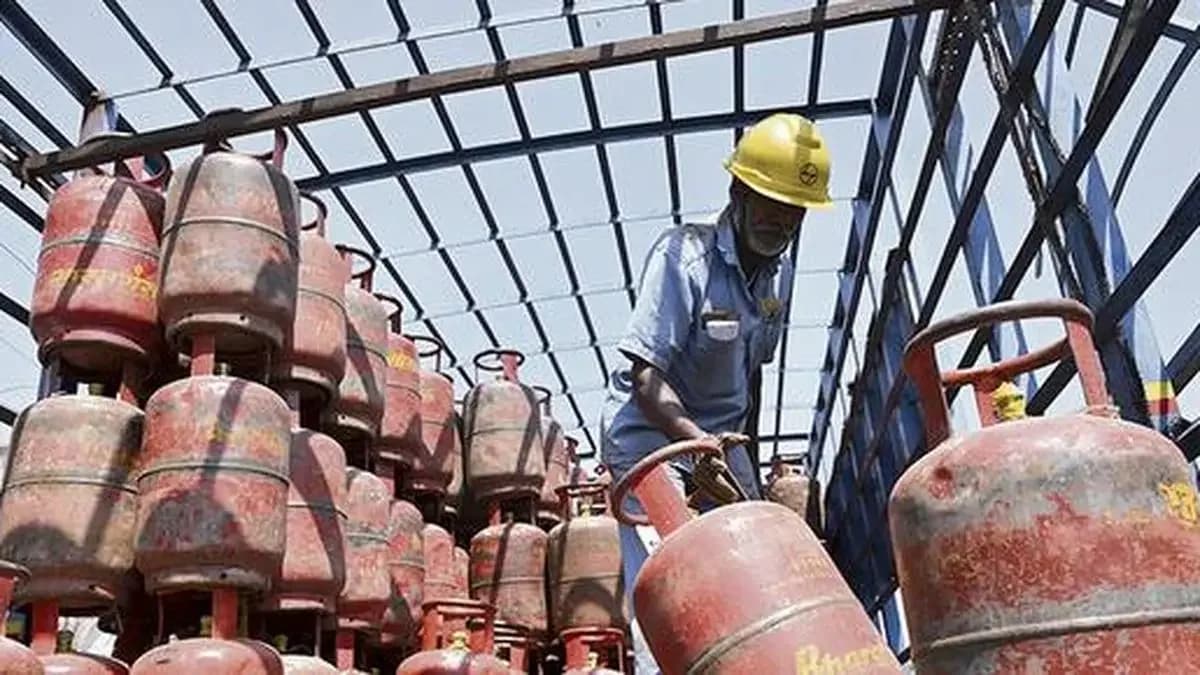
India has established its first facility-wise LPG production targets through a Petroleum and Natural Gas Ministry order dated August 13, 2026. The framework assigns maximum production levels to 21 refineries and upstream companies, with combined potential of 63,810 tonnes per day—equivalent to 70% of India's daily consumption and more than double normal domestic output. These targets activate specifically during supply constraints, creating a standing mechanism rather than permanent quotas.
Reliance Industries' domestic-tariff-area refinery at Jamnagar received the largest individual target of 18,000 tonnes per day. Eighteen public sector refineries collectively must produce 31,470 tonnes daily. Russia-backed Nayara Energy's Vadinar refinery faces a 4,480-tonne target, while upstream producers ONGC and GAIL share a combined 6,460-tonne requirement. Notably, Reliance's 35.2 million-tonne export-only refinery at Jamnagar has no target, preserving its international market flexibility.
Why Reliance Leads the Pack
Reliance's dominant position reflects the Jamnagar complex's unparalleled capabilities. The refinery boasts a complexity index of 21.1—the highest globally—enabling it to process over 216 different crude grades. Its configuration includes the world's largest Fluid Catalytic Cracker, Coker, Alkylation units, and Refinery Off-Gas Cracker, providing exceptional operational flexibility for LPG optimization. InvestorPresentations
During the West Asia crisis, Reliance demonstrated this capability by increasing LPG production almost fourfold from February to March levels. The government directed refineries to divert streams normally used for petrochemicals toward LPG, and Reliance's integrated structure allowed rapid response. However, this came at a cost—propylene and propane streams that would have generated higher-value ethylene and propylene were redirected to LPG, creating margin pressure. Transcripts +1
The 18,000-tonne target represents 28.2% of total mandated capacity, giving Reliance significant market power in domestic LPG supply. Yet this dominance comes with constraints. The government's LPG control orders restrict alternative uses of input streams, limiting Reliance's ability to freely allocate feedstocks based on market economics. When gas had to be diverted to priority sectors, Reliance was forced to use more expensive liquid fuels to run refinery operations, increasing costs. Transcripts +1
Public Sector Refineries: Scale and Strain
Public sector refineries face different challenges. Their combined 31,470-tonne target represents 49.3% of total capacity, but this must be achieved across 18 facilities with varying configurations. Indian Oil Corporation, Bharat Petroleum, and Hindustan Petroleum operate at high capacity utilization—IOC at 109.4%, BPCL maintaining 10.15 MMT throughput, HPCL at 106.7%. This aggressive utilization limits flexibility to adjust product slate for LPG optimization. InvestorPresentations +2
The financial burden is substantial. IOC carries a cumulative negative buffer of ₹23,101.56 crore from LPG under-recoveries, BPCL ₹12,318.52 crore, and HPCL ₹12,798.67 crore. While government compensation helps offset some losses, the persistent negative buffers indicate the trade-off between social obligations and financial performance remains significant. AnnualReports +2
To meet targets, public sector refineries are investing heavily in technology upgrades. IOC's INDMAX technology produces 2-3 times more LPG than conventional processes. BPCL is investing ₹14,200 crore in a Petro Resid FCC Unit, while HPCL has developed proprietary catalysts for FCC optimization. Major expansion projects at Panipat, Gujarat, and Barauni refineries, collectively costing over ₹75,000 crore, aim to increase processing capacity and flexibility. AnnualReports +2
Nayara Energy: The Private Sector Challenge
Nayara Energy's 4,480-tonne target reflects its specific configuration. The Vadinar refinery, with 20 MMTPA capacity and complexity index of 11.8, is India's second-largest single-location refinery. Its configuration includes a 405 thousand barrels per day Crude Distillation Unit, 218 mbd Vacuum Distillation Unit, 150 mbd Delayed Coking Unit, and 78 mbd Fluid Catalytic Cracker.
However, Nayara faces competitive disadvantages. Unlike public sector refineries with access to government-developed infrastructure spanning thousands of kilometers, Nayara must develop LPG storage, evacuation, and transport infrastructure independently or through partnerships. The government mandate requires companies to maintain adequate infrastructure for specified LPG quantities, creating substantial capital expenditure requirements for private players. AnnualReports +1
Rosneft's 49.13% stake provides financial backing and technical expertise, but Nayara's 7% market share offers limited influence on domestic LPG dynamics. The company must meet the same regulatory requirements without government infrastructure support, resulting in higher per-unit infrastructure costs due to smaller scale.
Upstream Producers: Different Economics
ONGC and GAIL' combined 6,460-tonne target reflects their different production economics. As upstream gas processors, LPG is a byproduct rather than primary output. GAIL operates five gas processing units with total LPG and liquid hydrocarbon production capacity of 1,425 KTA, achieving 813 TMT production in FY 2026 with 61% capacity utilization. AnnualReports +1
The six-monthly production schedule reviews on January 1 and July 1 create planning uncertainty. ONGC faces natural annual decline of 7-7.5% in gas production, requiring continuous investment. GAIL provides quarterly guidance updates due to "continued volatility," acknowledging that pricing or demand changes would require forecast revisions. This uncertainty complicates long-term investment decisions in gas processing infrastructure. Transcripts +1
The Centre for High Technology plays a crucial role in monitoring and approving LPG production upgrades. Companies must provide intimation to CHT whenever undertaking naphtha-to-LPG conversion or FCC unit upgrades. During supply disruptions, the government has permitted supply of C3 & C4 streams to critical sectors "as per CHT Allocation," demonstrating the agency's role in allocating critical feedstock streams.
Strategic Implications
The supply-constraint activation mechanism rather than permanent quotas reflects a strategic balance. During normal conditions, refineries can optimize product slate based on market economics. During supply disruptions, the government can direct production ramp-ups within stipulated timeframes. This approach minimizes permanent economic distortions while maintaining energy security flexibility.
For Reliance, the framework leverages its existing complexity and operational flexibility. The company's ability to rapidly adjust feedstock sourcing and optimize product mix proved crucial during the West Asia crisis. However, the exclusion of its export-only refinery from targets preserves strategic flexibility for international markets. InvestorPresentations
Public sector refineries benefit from government infrastructure support and policy alignment but face bureaucratic constraints and social welfare obligations. Their collaborative infrastructure development approach helps share investment burdens.
Nayara Energy must develop competitive strategies around its Rosneft partnership and modern refinery configuration while overcoming infrastructure development challenges.
For ONGC and GAIL, the focus remains on optimizing gas processing for flexible LPG extraction while managing the uncertainty created by biannual production schedule reviews.
The framework creates a two-tier market structure: normal competitive conditions during stability, and government-directed production during crises. Infrastructure readiness, operational flexibility, and government relationships become key competitive advantages. All entities must develop adaptive strategies that balance market optimization with national security compliance, requiring sophisticated planning and risk management in this evolving landscape.