The first half of CY2026 saw 9.70 lakh units sold, growing 53% YoY. Yet this expansion masks a tale of divergent fortunes: legacy manufacturers are consolidating power, some startups are thriving, and others are stumbling badly.
TVS Motor: Distribution Strength Defends Leadership
TVS Motor Company maintains its market leadership with 46,999 units sold in June 2026, capturing 24% market share. The company's advantage stems from its extensive distribution network—commanding approximately 38% share in the overall scooter segment, expected to exceed 40%. This existing infrastructure provides immediate scale that newer players struggle to replicate. Transcripts +1
TVS's product portfolio strategy focuses on family-oriented mass market appeal. The iQube family has reached over 900,000 Indian customers, with the iQube S variant offering a 4.7 kW motor and approximately 175 km range. The Orbiter series (V1 with 1.8 kW battery and V2 with 3.1 kW) caters to different segments. Crucially, TVS introduced Battery-as-a-Service (BaaS) across its EV portfolio, lowering upfront costs and improving affordability. Transcripts +3
Financial strength underpins TVS's competitive position. The company achieved its highest ever revenue of INR 47,270 crores and net profit of INR 3,615 crores in FY25-26. This supports a substantial INR 3,500 crore capex plan for the next year, targeting R&D, capacity expansion, and infrastructure. TVS also signed a joint development agreement with Hyundai Motor Company for electric 3-wheelers, leveraging Hyundai's design and mobility technology alongside TVS's electric platform expertise. Transcripts +3
Bajaj Auto has narrowed the gap to just 3,800 units behind TVS, selling 43,234 units in June 2026 with 22% market share and posting 80% YoY growth. The Chetak portfolio's success stems from strategic product innovation and aggressive network expansion.
The C25 variant targets youth seeking lighter, faster last-mile mobility, while the highly successful 35 series platform launched in December significantly boosted performance. The entire portfolio shifted to a new floorboard battery platform, offering superior functionality and improved unit economics. Bajaj's retail presence expanded dramatically to 500-plus exclusive Chetak stores, combined with almost 3,000-plus motorcycle stores, spanning over 850 cities. Transcripts +2
Production capacity reached 50,000 units per month, with management maximizing this capacity while planning substantive expansion. In FY26, Chetak crossed the 5-lakh unit mark, generating INR 4,000 crores in revenue. Unit economics improved significantly, reaching EBITDA-neutral as a portfolio. Bajaj's electric business (2-wheelers + 3-wheelers combined) is now the largest in the auto industry, with the overall EV portfolio reaching near double-digit EBITDA margins. Transcripts +4
Ather Energy: Premium Segment Dominance
Ather Energy strengthened its third position with 31,188 units and 16% market share, posting 95.5% YoY growth. The company's strategy centers on premium segment dominance through technological leadership and charging infrastructure.
Ather operates predominantly in mass-premium (INR 1.25–1.5 lakh) and premium (above INR 1.5 lakh) categories, following an inverted pyramid strategy: six variants in premium, three in mass-premium. The company runs the largest fast-charging network for electric two-wheelers, with 5,000 charging points as of December 31, 2025, successfully monetizing them. Transcripts +3
Geographic expansion drives growth, with rapid expansion into Tier 3 and Tier 2 cities where Ather's market share growth is currently higher in Tier 3 than Tier 2. Middle India focus yielded 17.4% market share in Q3 FY26, with strong performance in Gujarat (25%), Maharashtra (18.6%), Madhya Pradesh, Rajasthan, Punjab, and Odisha. South India retained leadership with 24.4% market share in Q3. Transcripts +3
Ather's new EL platform, designed with cost efficiency in mind—moving from aluminum to steel frames and simplifying transmission—targets the mass segment (INR 1–1.25 lakh ex-showroom) while improving margins in premium segments. The company achieved remarkable progress in FY26, with AGM improving from 19% to 24%, and EBITDA losses improving dramatically from 23% to approximately -2% in Q4 FY26. Transcripts +6
Hero Vida: Explosive Growth Through Distribution Leverage
Hero MotoCorp Limited's Vida brand delivered exceptional 176.2% YoY growth, reaching 21,792 units in June 2026 and capturing 11% market share. The company leveraged Hero's extensive distribution infrastructure as its primary competitive advantage.
Hero maintains presence in 93% of talukas across the country, ensuring customers can purchase vehicles and access service virtually anywhere. In the premium segment specifically, Hero rapidly scaled its Premia store network to 106 locations by December 2025, covering more than 50% of the premium industry footprint. VIDA now holds over 20% market share in 28 towns, 10% share in 79 towns, and ranks among the top 2 players in 37 towns. Transcripts +1
Product differentiation centers on removable battery technology—Hero Vida is the only player in the country offering removable batteries, directly addressing range anxiety and enabling EV ownership for consumers without access to fixed parking and charging infrastructure. The innovative BaaS offering improves affordability and allows consumers to enter the EV ownership lifecycle with lower initial investment. Transcripts +3
However, this rapid scale-up creates significant near-term margin pressure. In Q3 FY26, the business incurred INR 208 crore in EBITDA investment on revenue of INR 450 crore.
Ola Electric: Service Failures Drive Decline
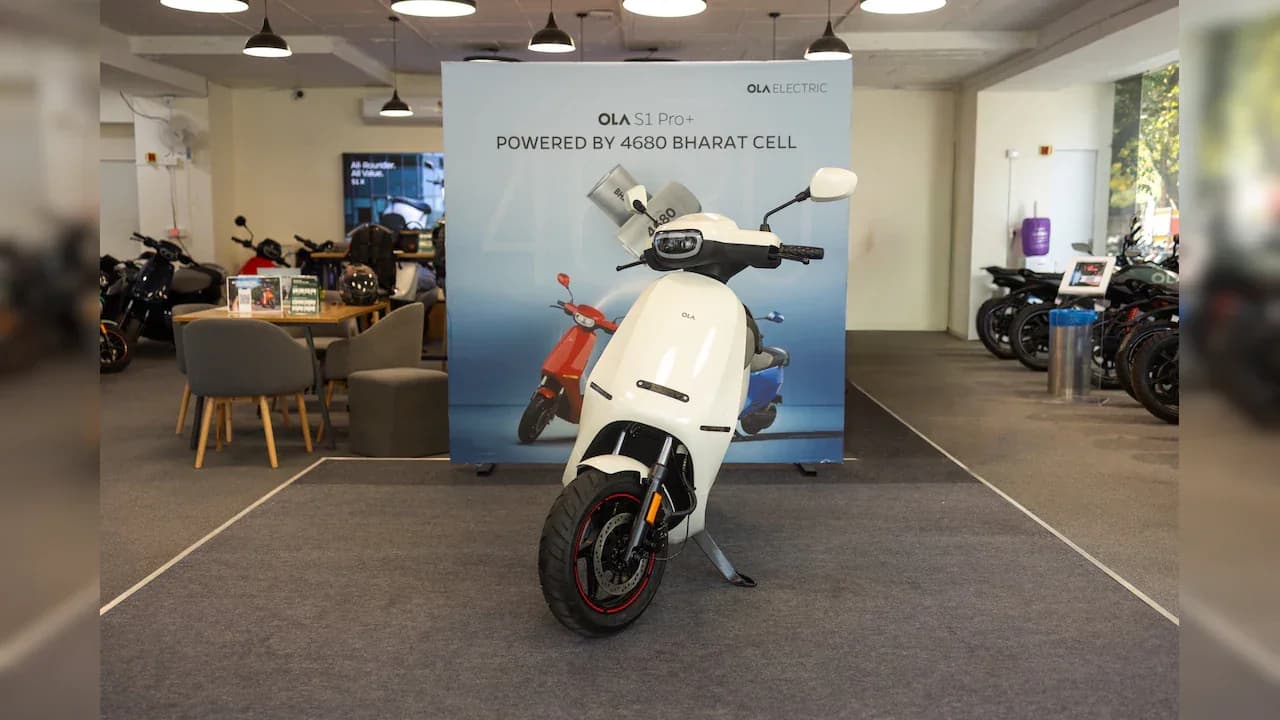
Ola Electric Mobility experienced a dramatic 21.8% YoY decline, with market share eroding 10.4 percentage points to 8.3%. The company slipped from segment leadership in FY25 with 3.44 lakh units to fourth position in FY26 with 1.64 lakh units, representing 52.28% YoY de-growth.
The most critical factor was service execution problems that directly impacted brand trust. Management acknowledged service gaps had "meaningfully improved" but still required significant work, with store experience deteriorating from earlier high standards. Service turnaround times spiked to 2.5-3 days during peak issues, though improved to 1.1 days by October 2024. These operational challenges caused a "negative impact on brand trust among prospective customers". Transcripts +3
Strategic missteps included overexpansion—the company expanded stores to 2,000+ but then "came back to the same level of stores as we were in the first couple of quarters post-IPO," indicating premature aggressive expansion. The company underwent a major operational reset, reducing consolidated OpEx from INR 844 crores to INR 428 crores and targeting further reduction to INR 350 crores. Transcripts +2
Despite these challenges, Ola maintains structural advantages. The company achieved industry-leading gross margins of 38.5% (33.5% excluding PLI), with per-unit gross margin of approximately INR 50,000.
The company targets 40,000-45,000 units in Q1 FY27, which would approach breakeven levels. Transcripts +4
Newer Entrants and Market Consolidation
Smaller players are capturing market share through focused strategies. Greaves Cotton's Ampere brand delivered 153.7% YoY growth through a "Built for Bharat" approach—developing products specifically designed for Indian terrain and weather conditions. River Mobility posted explosive 216% YoY growth through utility-focused positioning, with the River Indie featuring 43 litres underseat storage space and practical advantages. Transcripts +1
The electric two-wheeler market is undergoing fundamental consolidation.
This consolidation demonstrates increasing consumer preference for established brands with proven track records.
Rising fuel prices and expanding charging infrastructure are creating powerful tailwinds. On May 15, 2026, India experienced its first fuel price hike in over four years, with petrol and diesel prices increasing by INR 3 per litre. Bajaj Auto analysis shows customers commuting 40 km daily can save INR 18,000-20,000 annually by switching from ICE to electric scooters. The government's PM E-DRIVE Scheme allocates INR 2,000 crore for 72,300 charging stations across 50 national highway corridors. Transcripts
Legacy OEMs are exceptionally well-positioned to leverage these trends due to manufacturing excellence, distribution networks, and financial strength. The market is evolving from early adopter enthusiasm to mainstream adoption, where reliability, service quality, and total cost of ownership are becoming the primary decision factors for consumers. As fuel prices remain elevated and charging infrastructure expands, the competitive dynamics will likely further favor established players with the financial resources, distribution networks, and operational excellence to scale profitably.