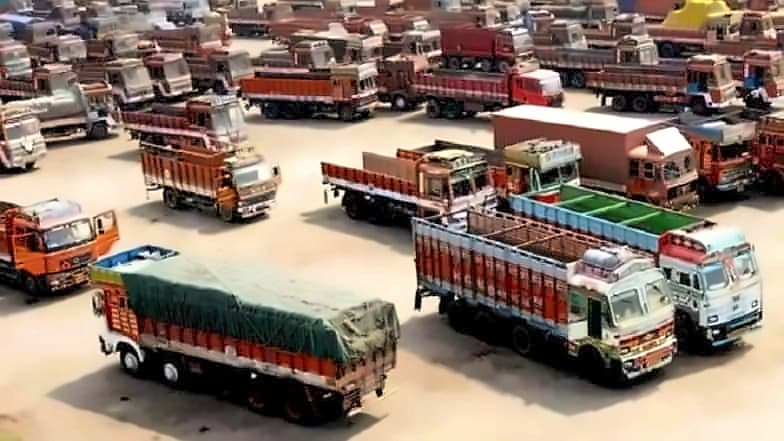
India's trucking sector, the backbone of the country's logistics network, is facing its most severe test in years.
In Delhi, diesel now costs Rs 95.20 per litre, an 8.6% jump from pre-crisis levels. For an industry where fuel accounts for 40-47% of operating costs, this represents a massive margin squeeze.
The price hikes alone would be challenging enough, but they coincide with severe supply constraints.
This has caused demand at some petrol pumps to surge 20-30%, leading to dry-out situations and serpentine queues at fuel stations on national highways.
The Fleet Contraction
The impact on truck operations has been immediate and dramatic.
This isn't just about higher fuel costs—it's a perfect storm of supply shortages, working capital crises, and operational cost escalations beyond fuel. DEF/AdBlue prices have nearly doubled in two months, tyre costs are up 5%, and toll charges have been revised upward.
Most critically, fuel pumps have stopped extending credit to transporters, forcing them to make advance payments. For small operators who typically relied on 15-30 day credit periods, this has created a severe cash flow crunch. The All India Transporters Welfare Association (AITWA) has appealed to customers to accept higher freight rates to prevent loan defaults across the sector.
Freight Rate Inflation
The supply-demand imbalance has driven freight rates sharply higher. On key corridors like West to North India, rates have risen 10-15%. Local hauls within 30 km have seen even sharper spikes. The AITWA has introduced a Fuel Adjustment Factor (FAF) mechanism: for every Rs 1 increase in diesel price per litre over the base rate, freight rates increase by 0.65%. With the cumulative Rs 7.5-8 per litre increase, this alone contributes roughly 5% to freight rate hikes.
These increases are beginning to transmit inflationary pressures through the economy. Food and agricultural products, where freight costs typically represent 8-12% of retail prices, are particularly vulnerable. Analysts estimate the fuel price increases could add 15-25 basis points to headline inflation directly, with another 20-40 basis points through freight cost pass-through.
The Great Divide: Organized vs. Small Operators
The crisis is exposing the stark divide between India's organized logistics players and the fragmented small operator segment that accounts for over 70% of the trucking fleet.
VRL Logistics, with its 6,000-truck fleet, reports vehicles facing idling times of 6-8 hours despite using OMC-owned pumps—but no trucks have halted beyond that timeframe. The company's scale enables better fuel procurement arrangements and stronger banking relationships. Allcargo Logistics has navigated the crisis through predictive analytics, route optimization, and a dedicated fleet operations model, avoiding major disruptions altogether.
In contrast, mid-sized operators have curtailed operations by nearly 20%. Small operators lack pricing power, fuel contracts, and financial buffers. They feel the impact fastest because they have thinner margins and less negotiating leverage. When fuel pumps stopped extending credit, small operators were hit hardest—they don't have the corporate treasury functions or banking relationships that organized players rely on.
The Systemic Risk
This isn't hyperbole—it reflects the interconnected nature of India's logistics ecosystem.
Small operators provide critical last-mile connectivity to remote areas, serve SME shippers who can't access large logistics companies, and employ a significant portion of the country's truck drivers. Their collapse would create coverage gaps, reduce capacity flexibility during peak periods, and potentially trigger cascading failures across the supply chain. The financial system would also feel the pain through loan defaults and asset devaluation.
Acceleration of Consolidation
The diesel crisis is likely to accelerate a structural consolidation that was already underway in India's trucking sector. Small operators facing existential threats have three options: forced asset sales at distressed prices, business model transitions (becoming contractors for larger players), or permanent market exit.
Organized players stand to gain significantly. As customers shift to more reliable operators amid supply uncertainty, companies like VRL Logistics and Allcargo Logistics can expand market share. Their technology investments, scale advantages, and financial resilience create sustainable competitive moats. The market may reward this resilience with higher valuation multiples.
However, this consolidation comes with risks. A more concentrated sector could lead to oligopolistic pricing power, service gaps in underserved markets, and the dislocation of the traditional owner-operator model that has characterized Indian trucking for decades.
The Path Forward
The issue is distributional, not fundamental. The 18% surge in diesel sales during May 1-22 compared to the year-earlier period reflects the bulk-to-retail migration and precautionary buying, not a permanent demand shift.
Seasonal factors including harvesting activity, school holidays, and summer tourism have exacerbated demand pressures. The monsoon onset, typically beginning in early June, should provide some relief as agricultural and construction activity moderates.
But the structural challenges won't disappear with the monsoon. The Rs 40-42 per litre bulk-retail price differential needs policy attention. The working capital crisis facing small operators requires financial sector intervention. And the technology gap between organized and small operators needs to be bridged through digital platforms and capacity-sharing models.
India's trucking sector stands at a crossroads. The current crisis could either catalyze necessary modernization and consolidation, or it could trigger systemic disruptions that ripple through the entire economy. The outcome depends on how policymakers, industry participants, and financial institutions respond in the coming months.