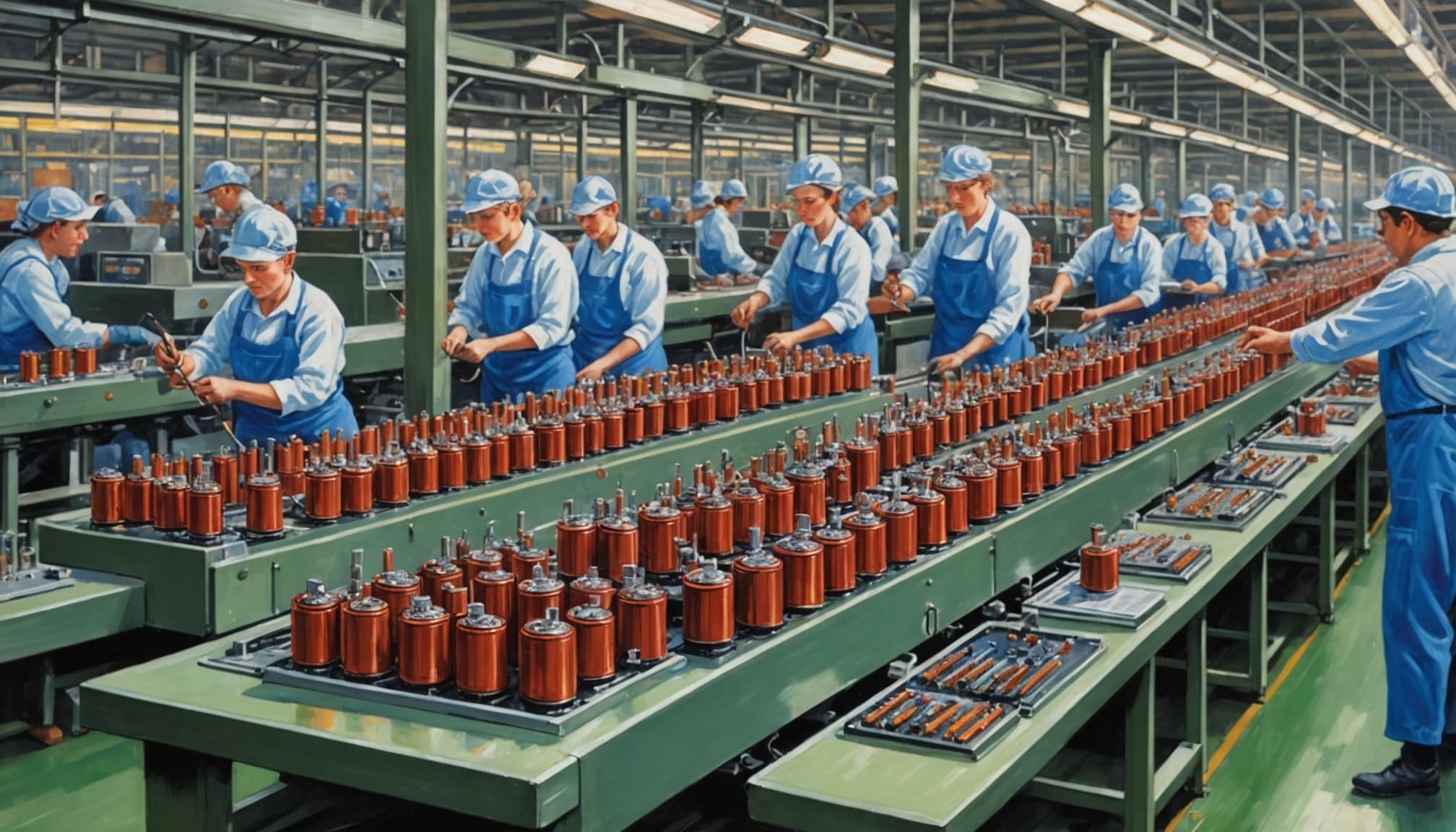
The scheme's requirement that beneficiaries achieve 60% domestic value addition within five years is forcing cell manufacturers to source materials locally, creating structural demand for companies like Neogen Chemicals (electrolytes), HEG Limited (synthetic graphite anodes), and Himadri Specialty Chemicals (LFP cathode materials). A separate proposed ₹12,000 crore scheme for battery components will further strengthen this ecosystem by directly incentivizing upstream manufacturing.
The demand opportunity is substantial. India will require over 400,000 tonnes of cathode active material and 200,000 tonnes of anode active material by 2030 to support approximately 223 GWh of announced battery manufacturing capacity. This creates a multi-billion dollar annual opportunity for domestic component manufacturers, with the PLI scheme's domestic value addition requirements serving as the primary demand driver.
Divergent Investment Strategies
The three companies are pursuing markedly different capital allocation strategies.
This represents a moderate-risk approach with the shortest time-to-market, leveraging a technology licensing agreement with Japan's MUIS—a Mitsubishi Chemical Group company. This first-ever global license provides competitive barriers and quality differentiation that justify premium pricing. InvestorPresentations +1
This high-risk, high-return strategy aims to establish the first commercial LFP plant outside China, positioning the company to capture 2-3% of the global LFP market. However, the company faces significant execution challenges, including in-house technology development without established partnerships and the absence of binding offtake agreements. Transcripts +2
HEG Limited has adopted a disciplined phased approach, expanding from 20,000 MT to 60,000 MT of synthetic graphite anodes by FY32. This strategy aligns with India's projected battery demand growth from 65-70 GWh in 2027 to 120-140 GWh by 2030. The company's 50 years of graphitization experience and operational excellence provide competitive advantages, though it faces the challenge of achieving optimal capacity utilization in a market dominated by Chinese producers who control 90-95% of global anode supply. InvestorPresentations +2
Customer Validation and Revenue Trajectories
Customer validation milestones are creating inflection points for all three companies. Neogen Chemicals has secured provisional approvals from four major international customers and completed site audits for three US-based electrolyte manufacturers. These validations are critical for revenue acceleration—the company projects battery chemicals revenue of ₹400-500 crore in FY27, up from ₹36 crore in FY26, with potential to reach ₹2,500-2,900 crore by FY29. The non-FEOC (Foreign Entity of Concern) compliant positioning, driven by US 45X tax credit requirements, provides additional pricing power. InvestorPresentations +2
HEG Limited's subsidiary TACC is in advanced off-take discussions for quantities exceeding 30,000 MT, with one customer negotiating for 8,000 TPA minimum over three years. These volume commitments are crucial for achieving the projected 25-30% EBITDA margins for the anode business. The company has also validated its technology through a 200-tonne pilot plant operational for 12 months, with material tested by over 20 leading global cell OEMs. InvestorPresentations +2
Himadri Specialty Chemicals is pursuing a partnership ecosystem approach to accelerate customer validation. Strategic investments in International Battery Company (16.24% stake), Sicona Battery Technologies (~15% stake), and Invati Creations (40% stake) create an integrated validation infrastructure. These partnerships provide access to operational cell manufacturing facilities, advanced silicon-carbon anode technology, and nanotech-enabled formulation platforms, potentially compressing commercialization timelines by 22-29 months compared to traditional approaches. InvestorPresentations +2
Financial Performance and Valuation Dynamics
The financial profiles of these companies reflect their different strategic positions.
The market is pricing in transformative growth potential—4-5x revenue expansion by FY29—driven by non-FEOC positioning, international customer validations, and technology partnerships. However, the company faces working capital constraints, with finance costs rising 64% year-on-year to ₹20.8 crore in Q1FY27, which could impact its ability to achieve capacity targets on schedule. Transcripts +2
This disconnect reflects market skepticism about replicating these strong returns in capital-intensive battery materials with different competitive dynamics. The company's massive ₹4,800 crore capex requirement and execution risks in scaling from 2,000 MTPA to 200,000 MTPA create uncertainty around ROCE sustainability. Transcripts +2
HEG Limited's global positioning as one of the largest anode players outside China provides competitive advantages, but its valuation reflects cyclicality in its core graphite electrode business. The company reported a 22% operating margin expansion in Q1FY27, demonstrating operational resilience, though achieving the projected 35% EBITDA margin for its anode business will require optimal capacity utilization. The company faces significant risks if utilization falls below 40-50% in FY28, which could result in revenue shortfalls and margin compression. InvestorPresentations +2
Technology Competitive Advantages
Technology differentiation is creating sustainable competitive moats across all three companies. Neogen Chemicals' MUIS licensing agreement provides technology exclusivity in India, quality differentiation through Japanese manufacturing standards, and dramatically reduced customer approval times. This combination creates substantial pricing power in a market with only 2-3 active manufacturers of lithium electrolyte salts outside China. InvestorPresentations +2
HEG Limited's in-house graphene production process and silicon-doped synthetic graphite anodes enable premium pricing in fast-charging EV applications. The silicon doping delivers 20% higher energy density, while graphene enhancement improves both charging speed and battery longevity. The company targets 70% of sales toward premium EV applications, with cost leadership derived from 50+ years of graphite processing expertise and secured power rates better than Chinese, European, or American suppliers. Transcripts +2
Himadri Specialty Chemicals' indigenous development of carbon nanotubes (CNT) and performance additives creates cross-selling opportunities with its LFP cathode materials. The integrated approach—offering cathode materials, anode materials, CNT conductive additives, and specialty carbon blacks—positions the company as a one-stop solution provider. This bundling strategy reduces supply chain complexity for battery manufacturers while creating premium pricing opportunities for high-value-added products. Transcripts +2
Execution Risks and Working Capital Challenges
All three companies face significant execution risks that could impact their ambitious expansion plans. Neogen Chemicals' working capital constraints, evidenced by elevated finance costs and extended trade payables of approximately 365 days, pose moderate risks to achieving its FY27 capacity targets. The most likely impact will be on the pace of capacity utilization rather than the establishment of capacity itself. Transcripts +2
HEG Limited faces substantial utilization risks for its anode project. Market demand timing uncertainties, customer qualification delays (12-24 month processes), and competitive pressures from Chinese producers could result in under-utilization. Given the high fixed cost structure of the ₹2,250 crore investment, sub-optimal utilization could compress EBITDA margins well below the 25-30% target range. InvestorPresentations +2
Himadri Specialty Chemicals' aggressive 100x expansion from 2,000 MTPA to 200,000 MTPA over 5-6 years creates substantial execution risks across technology transfer, customer adoption, and capital allocation efficiency. The absence of binding offtake agreements, reliance on in-house technology development without established partnerships, and the need to coordinate multiple supply chain initiatives while scaling production create complexity that could delay value realization. InvestorPresentations +2
The Path Forward
The battery materials opportunity in India is substantial, but success will depend on execution excellence and risk management. Neogen Chemicals offers the most balanced risk-return profile with the shortest time-to-market, HEG Limited provides disciplined expansion with global positioning but faces utilization challenges, and Himadri Specialty Chemicals pursues the highest potential returns with the most significant execution risks.
The convergence of PLI scheme-driven demand, customer validation milestones, and capacity expansion timelines positions all three companies to capture opportunities in India's evolving battery materials ecosystem. However, their divergent strategies, risk profiles, and competitive advantages suggest that the market will reward execution excellence while penalizing missteps in this critical phase of industry development.