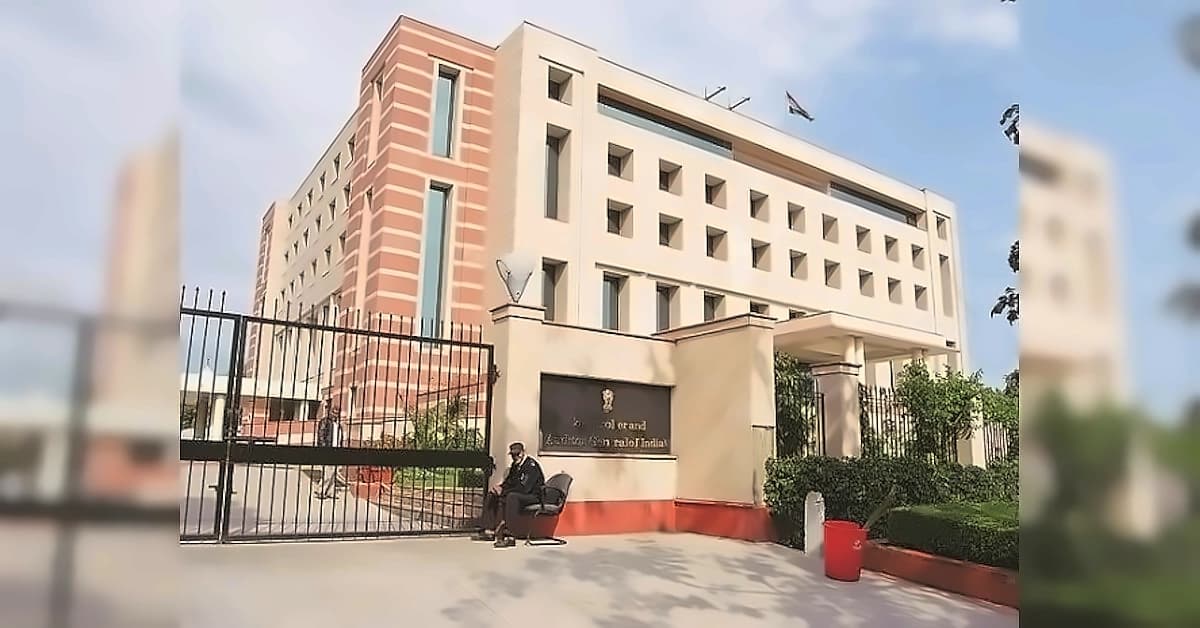
The Central Board of Indirect Taxes and Customs (CBIC) has strongly rejected former finance secretary Subhash Chandra Garg's claims about GST revenue overstatement, calling his approach "thoroughly misleading and mischievous." According to The Economic Times, Garg had questioned the Centre's claim of 14.8% growth in gross GST collections in August and 11% growth in the first five months, arguing that compensation cess collected in the year-earlier period was excluded from the comparison. However, the CBIC emphasized that compensation cess has ceased to exist from February 1, 2026, making it impossible to compare post-cess GST revenue with last year's figures. The board rejected Garg's suggestion that the cess had been "quietly" removed from calculations, noting that there was separate disclosure in monthly revenue statements. In its latest statement, the CBIC clarified that the GST Council took a decision to discontinue the compensation cess effective from September 22, 2025, on all items except tobacco and related products, with the cess levy on tobacco and related products also removed from February 1, 2026. The board emphasized that from November 2025 onwards, GST revenue figures published in the public domain transparently showed compensation cess separately in a table below, with year-on-year growth computed on the tax base consisting of CGST, SGST and IGST for the corresponding periods. The CBIC also rejected allegations that the figures amounted to data manipulation, stating that any attempt to cherry-pick figures from two different tax bases is thoroughly misleading and mischievous.
Prime Minister Narendra Modi has defended India's 7.8% GDP growth in Q1 FY27 while addressing criticism from opposition parties. Speaking at Shri Ram College of Commerce's centenary event, Modi highlighted India's position as the world's fastest-growing major economy amid global economic challenges. The Prime Minister contrasted the current situation with past pessimism and policy paralysis, noting improvements in manufacturing, defense, and internal security sectors. Modi's comments come as the 7.8% growth in Q1 FY27, released on August 31, has sparked an unexpected viral debate over economic credibility.
India's 7.8% GDP growth in Q1 FY27 has sparked an unexpected viral debate over economic credibility. According to reports from NDTV Profit, former finance secretary Subhash Chandra Garg argued that GDP should be judged in nominal terms before adjusting for inflation, claiming nominal growth works out to under 2.5% against the 10.3% nominal growth implied by revised numbers. However, Neelkanth Mishra, India's Executive Director at the World Bank, called Garg's comparison "ill-educated and egregiously wrong" in an interview with NDTV Profit, pointing out that Garg's figure mixes nominal, current-price comparison on the old base with the real, inflation-adjusted headline number on the new base. The controversy has intensified with Congress leader Jairam Ramesh describing the exercise as "statistical gymnastics," while Opposition leaders have alleged that upward revisions to historical data serve primarily to flatter present-day performance statistics.
Mishra's rebuttal has backing from Axis Bank's economics team, which he headed until moving to the World Bank in June. As reported by NDTV Profit, Axis Bank had already flagged the downward revision on March 1, attributing it to overestimation of the informal economy's post-Covid recovery in FY23 rather than current growth weakness. Mishra has reiterated Axis Bank's above-consensus FY27 growth forecast of 7.5%, while noting that the green shoots were already visible in high-frequency data like vehicle registrations and record power consumption. However, senior business journalist Alok Joshi has highlighted that Garg's calculation puts the growth at around 2.6% rather than 7.8%, suggesting the actual growth could be close to zero when accounting for base-year changes and data revisions.
Economist Jayati Ghosh from the University of Massachusetts Amherst argues that quarterly GDP data should not be treated as the final measure of India's economic performance. According to Zee News, she notes that GDP is important because it is commonly used to assess the direction of the economy and the financial condition of households, but warns that "there can be at least five or six changes to these numbers and nobody can say with certainty what the final GDP estimate will be." Ghosh highlights that India's GDP and per capita GDP have increased over the past 15 years, while employment has not risen at the same pace, with worker and agricultural incomes not increasing in line with overall economic output. She argues that income and wealth inequality play a major role, with gains not reaching ordinary people in the same proportion as wealthier sections, and criticizes the "trickle-down" theory as not working in practice.