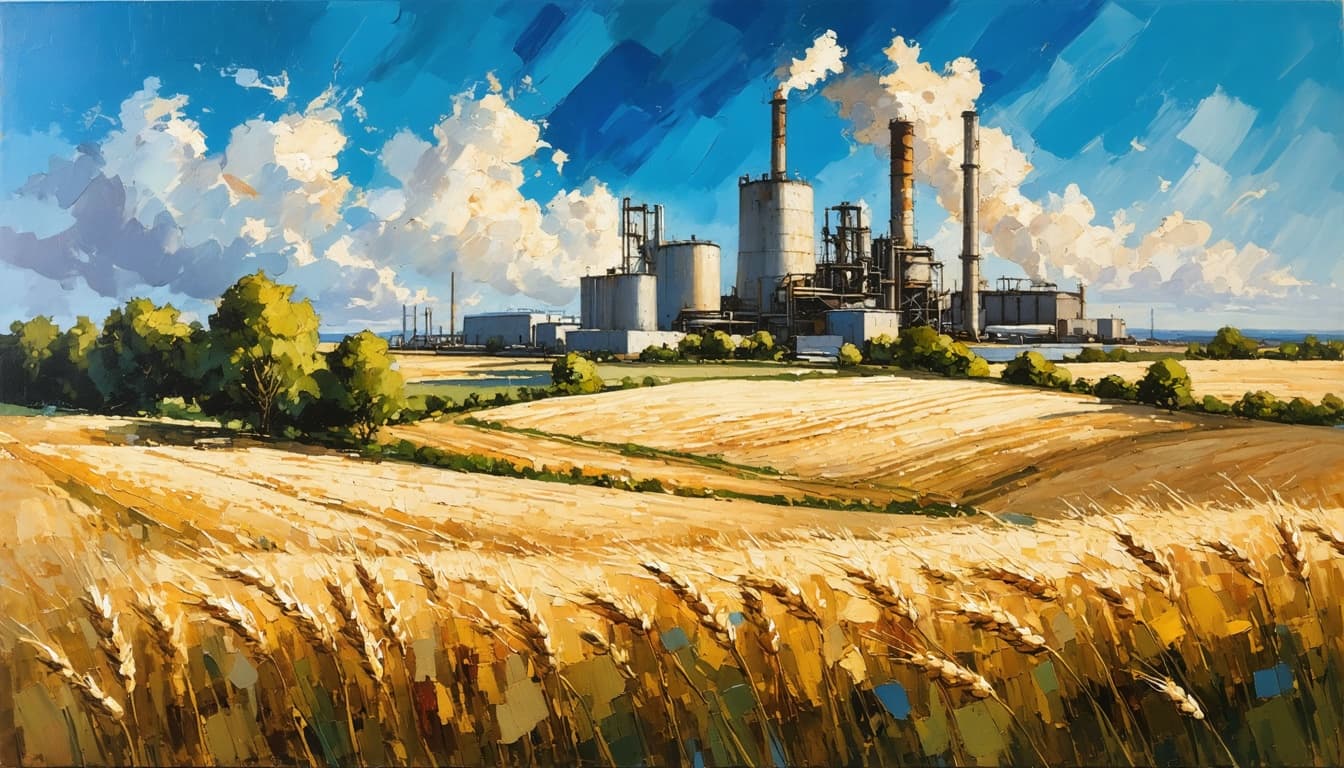
India is betting big on turning farm waste and sunshine into jet fuel. The country aims to transform its massive agricultural residue surplus and plummeting green hydrogen costs into a $9 billion sustainable aviation fuel (SAF) export opportunity by 2030, scaling up to $30 billion by 2040. This ambitious strategy relies on a technology called Power-and-Biomass-to-Liquids (PBtL), which combines agricultural waste with green hydrogen to produce fuel at costs projected to be 40% below global benchmarks. It is a bold play that could reshape global aviation fuel markets, but the path is lined with execution risks, supply chain challenges, and policy uncertainties.
The Green Hydrogen Engine
At the heart of India's cost advantage is green hydrogen. Prices have already fallen from $4.67 per kilogram in June 2025 to $3.23 in February 2026, driven by the country's booming solar power sector. Projections suggest costs could drop below $3 per kilogram by 2030. This cheap hydrogen is the secret sauce for PBtL technology.
This chemical boost allows India to produce roughly twice as much SAF from the same amount of biomass compared to traditional methods. The result is a projected production cost of around $1.41 per liter by 2030, significantly undercutting the global benchmark range of $1.60 to $2.40 per liter. To maintain this 40% cost edge, India needs continued solar capacity expansion and efficiency gains in electrolyzer technology to keep pushing hydrogen prices lower.
Farming Fuel, Not Food
India's feedstock advantage is staggering. The country generates an estimated 230 million tonnes of surplus agricultural residue annually. The math is simple yet striking: collecting just 4% of this waste could theoretically supply 25% of global SAF demand. This abundance allows India to rely on crop residues and forestry waste rather than food crops, neatly sidestepping the food-vs-fuel trade-off that constrains biofuel production in Europe and the United States. However, turning this theoretical potential into actual fuel at the refinery gate is a massive logistical challenge. Establishing collection infrastructure across millions of fragmented rural farms is expensive and complex. Seasonal variability adds another layer of risk—most residue is available only during narrow post-harvest windows, requiring massive storage solutions to keep plants running year-round. These logistical and infrastructure costs will directly impact the economics of the projected $30 billion export market.
Policy Guarantees and Market Caps
For investors, the Indian government is building a safety net. The 5% SAF blending mandate for international flights by 2030 creates a guaranteed domestic market, significantly reducing demand risk for producers like Aemetis Inc.. The government has also amended the Aviation Turbine Fuel Control Order to formally recognize SAF-blended fuel, aligning regulations with international standards like CORSIA. On the price side, a ₹10,000 crore ($1.05 billion) ATF Price Stabilization Fund aims to shield airlines from fuel price shocks. This fund supports a mechanism that effectively caps domestic jet fuel prices at around ₹115 per liter for participating carriers. While this provides cost certainty for airlines like IndiGo and Air India, it creates a complex dynamic for SAF. Since SAF typically costs 2-5 times more than conventional fuel, the price cap limits airlines' ability to pass through these higher costs to passengers, potentially squeezing margins and complicating the economic case for blending.
Aemetis: The First Mover Advantage
California-based Aemetis Inc. is already positioning itself to capitalize on this policy framework. The company operates an 80-million-gallon-per-year biodiesel facility in Kakinada on India's east coast, which provides significant operational synergies for its planned SAF expansion. The existing infrastructure, including port access for exports and a proprietary enzymatic process for handling low-cost waste feedstocks, lowers the barrier to entry for SAF production. Perhaps more importantly,
These long-term offtake agreements provide revenue visibility that makes the India expansion attractive to investors. The company is now preparing to list its Universal Biofuels subsidiary in India through an IPO, a move that signals strong investor confidence in the market and allows the parent to raise growth capital while retaining control.
The Global Export Opportunity
India's strategy is not just about domestic self-sufficiency; it is about capturing a slice of a massive global market. Currently, global SAF production meets less than 1% of jet fuel demand, creating a vast supply gap. India's PBtL approach offers distinct competitive advantages over the dominant HEFA pathway used in Europe and the US.
This feedstock abundance, combined with the 40% cost advantage, positions India to capture market share from traditional jet fuel exporters and higher-cost SAF producers. The plan is phased: targeting $500 million to $1 billion in early export revenues by 2027, scaling to $3-5 billion by 2030, and aiming for over $10 billion annually by 2035.
Navigating the Risks
Despite the compelling opportunity, the risks are substantial. Scaling PBtL from pilot to commercial scale is a formidable engineering challenge. Technology failures or efficiency losses during scale-up could quickly erode the projected cost advantage. The dependence on agricultural residue also exposes the industry to weather-related disruptions. A bad monsoon or labor shortages, as seen during the COVID-19 pandemic, can drastically reduce feedstock availability. On the policy front, the blending mandates are currently indicative rather than binding, and future governments could alter subsidies or face fiscal pressures that force policy rollbacks. International trade barriers, such as anti-dumping duties or divergent sustainability certification standards, could also block access to premium markets in Europe and elsewhere.
India's SAF ambition is a high-stakes gamble that combines industrial policy, energy security, and climate leadership. If successful, it will reduce crude oil import bills, create millions of rural jobs, and establish the country as a green fuel superpower. But realizing this potential will require more than just cheap hydrogen and farm waste—it will demand flawless execution of complex technology, robust supply chain logistics, and unwavering policy support over decades.