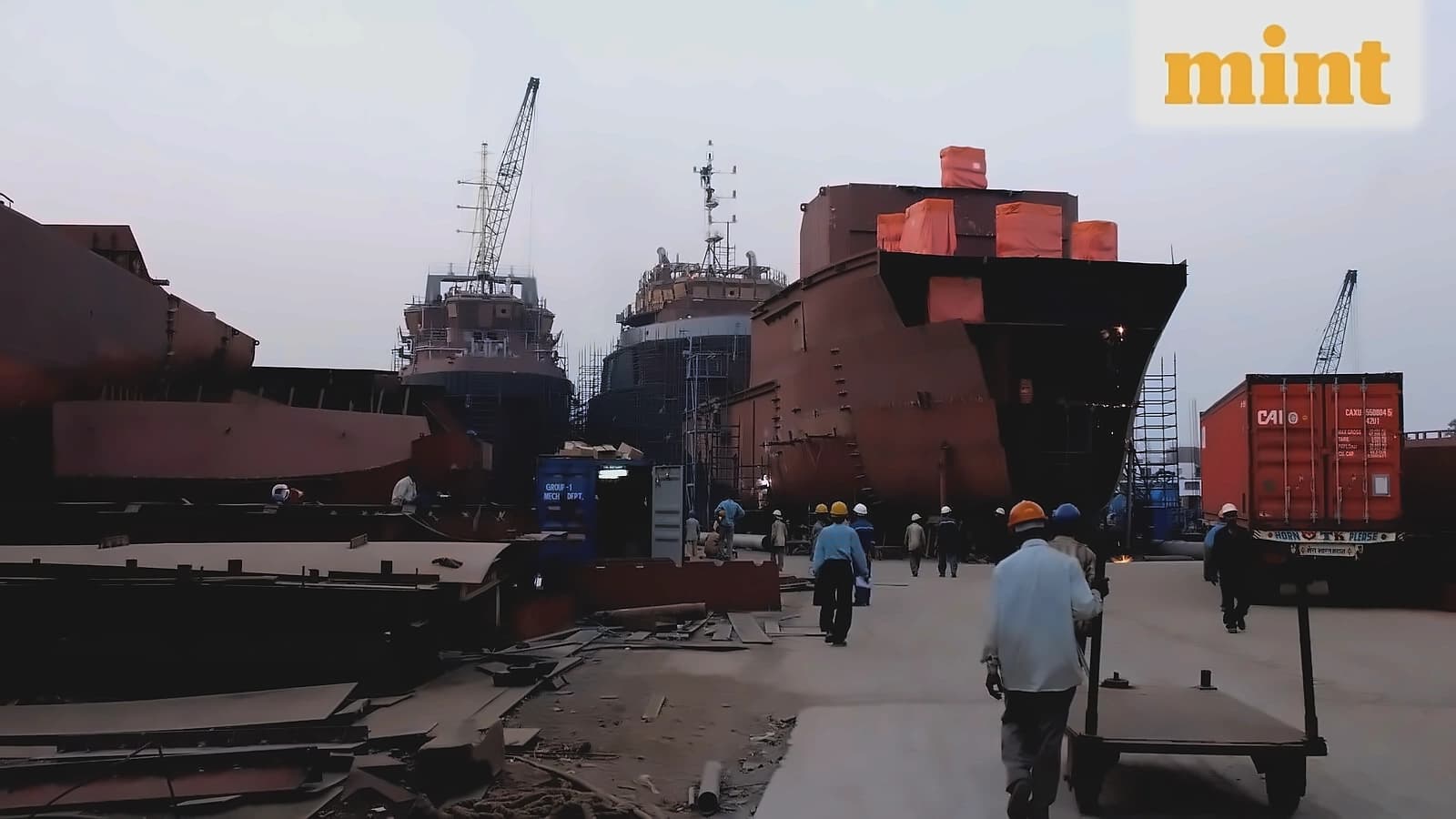
This comprehensive initiative addresses critical cost disadvantages, expands financing access, and boosts infrastructure to position India as a global shipbuilding power by 2047. The package adopts a four-pillar approach designed to strengthen domestic capacity, improve long-term financing, promote greenfield and brownfield shipyard development, and implement legal, taxation, and policy reforms to create a robust maritime infrastructure.
Bridging the Cost Gap
The Rs 24,736 crore Shipbuilding Financial Assistance Scheme directly targets the 25-35% cost disadvantage Indian shipyards face against global competitors like China, South Korea, and Japan. This disparity stems from multiple structural factors. Indian shipyards suffer from lower labor productivity due to outdated technologies and inadequate training, resulting in longer production times and higher labor costs per vessel. Material costs are also relatively high due to limited domestic production of essential raw materials such as high-grade steel, which must often be imported, adding to logistical expenses and import duties. Furthermore, Indian shipyards face higher financing costs, as interest rates for industrial loans in India are typically 300-500 basis points higher than those available to their competitors in East Asia.
The scheme provides tiered financial assistance to bridge this gap: 15% for vessels below Rs 100 crore, 20% for those above, and 25% for green or specialized vessels. Additionally, a Shipbreaking Credit Note offers 40% of scrap value when vessels are recycled domestically, creating a lifecycle incentive that can be redeemed against the cost of building new vessels. By offsetting these structural inefficiencies, the scheme aims to improve profit margins and enable Indian yards to compete effectively in international tenders. The financial assistance is valid until March 31, 2036, providing long-term certainty for shipyards to plan their investments and operations.
Transforming Capital Structure
The Rs 25,000 crore Maritime Development Fund is designed to overhaul the financial landscape for Indian shipbuilding companies. It comprises the Rs 20,000 crore Maritime Investment Fund (MIF) and the Rs 5,000 crore Interest Incentivisation Fund (IIF). The MIF operates as a blended finance model, with the government holding 49% equity through budgetary support and the private sector contributing the remaining 51%. Managed by SBI Ventures, which was appointed as the Fund Manager on May 26, 2026, the MIF will provide long-term equity and debt support, reducing reliance on expensive commercial loans.
This structure is expected to significantly improve the capital structure of shipbuilding companies. Currently, many Indian shipyards operate with high debt-to-equity ratios of 3:1 to 4:1 due to capital-intensive nature and limited access to equity capital. The MIF's patient capital approach aims to reduce these ratios to a healthier 2:1 to 2.5:1 by providing direct equity infusion and subordinated debt instruments that count as equity-like capital. Simultaneously, the IIF acts as an interest subvention mechanism, providing subsidies to financial institutions to reduce the effective cost of debt for maritime sector participants. This intervention is expected to reduce borrowing costs by up to 300 basis points, bringing financing rates down from the current 9-10% to a target of 5-6% by 2047. This reduction will significantly boost project Internal Rates of Return (IRR), with improvements of 250-500 basis points expected, making marginal projects viable and enhancing overall sector competitiveness.
Expanding Capacity and Infrastructure
The Rs 19,989 crore Shipbuilding Development Scheme targets an ambitious expansion of domestic output to 4.5 million gross tonnage annually. A major component is the development of three greenfield mega clusters in Andhra Pradesh, Gujarat, and Tamil Nadu, for which the government has accorded in-principle approval. Each cluster requires an estimated investment of Rs 9,300-11,200 crore, featuring 2,000 acres of land with approximately 1,000 acres for shipyards and the remaining area for ancillary industries. These clusters are designed with a manufacturing capacity of approximately 1.0 to 1.2 million gross tonnage per annum, with at least one Anchor Shipyard required to have a minimum design capacity of 0.5 million GT per annum within 10 years of commissioning.
While these projects have long gestation periods with full ROI expected 8-10 years after commercial operations, they are essential for scaling up India's shipbuilding capabilities from the current 0.072 million GT annually. Complementing this physical infrastructure expansion is the infrastructure status granted to large vessels (10,000+ GT for Indian-flagged, 1,500+ GT for India-built) on September 19, 2025. This classification allows shipowners to access cheaper long-term finance from specialized development banks, insurance companies, and pension funds. It also enables extended loan tenors of up to 25 years aligned with vessel lifecycles, and provides access to External Commercial Borrowing with relaxed norms. Furthermore, infrastructure status offers accelerated depreciation benefits, reducing vessel ownership costs by up to 45% over the asset lifecycle through improved tax shield mechanisms.
Securing Demand and Efficiency
A critical challenge for Indian shipyards has been the mismatch between high order books and low delivery efficiency. Despite order books averaging 128% of total capacity over the past nine years, actual deliveries have been a mere 10% of capacity, indicating that capturing orders is not the major problem but rather shipyard efficiency. The fleet acquisition plan of over 400 vessels addresses this by providing guaranteed long-term order visibility to Indian shipyards. This demand aggregation is supported by policies like the Right of First Refusal (RoFR), which gives priority to vessels that are Indian-built, Indian-flagged, and Indian-owned in government procurement.
Guaranteed volumes allow shipyards to optimize working capital requirements significantly. The predictable production schedules enable just-in-time inventory management, standardized specifications that reduce component variety, and long-term supplier relationships that yield favorable payment terms. This optimization is expected to reduce working capital requirements by 25-30% and accelerate cash conversion cycles by 30-45%. The cash conversion cycle, which measures the time between cash outflow for raw materials and cash inflow from sales, is currently extended at 270-450 days but is projected to improve to 180-240 days with guaranteed orders. This financial stability is crucial for improving the current delivery rate and scaling production to meet the targets of Maritime India Vision 2030, which aims to increase shipbuilding output to 0.33 million GT by 2030.
Strategic Vision and Synergies
These reforms are intricately aligned with the Maritime India Vision 2030 and Maritime Amrit Kaal Vision 2047, which aim to make India a top 10 shipbuilding nation by 2030 and top 5 by 2047. The Maritime India Vision 2030 charts 150+ initiatives with projected investments of Rs 3-3.5 lakh crore, while the Maritime Amrit Kaal Vision 2047 outlines more than 300 actionable initiatives with investments of nearly Rs 80 lakh crore earmarked for ports, coastal shipping, inland waterways, shipbuilding, and green shipping initiatives. Previous barriers, such as restricted access to infrastructure financing, fragmented domestic demand, and outdated regulatory frameworks, are being systematically dismantled through legal modernization and targeted financial support.
The integration of shipbuilding with broader maritime infrastructure development creates powerful synergies. The development of eight strategic maritime clusters combines port capacity with shipbuilding capabilities, fostering ancillary industries and generating significant employment. For instance, the Tamil Nadu cluster is expected to generate more than 55,000 direct and indirect employment opportunities across shipbuilding, ship repair, marine engineering, fabrication, logistics, and port services. The shipbuilding industry has a high employment multiplier of 6.4, meaning every direct job creates 6.4 indirect jobs. This holistic approach transforms the sector from a standalone industry into a pillar of the blue economy, driving cross-sector growth and enhancing India's strategic autonomy in trade. The government expects the overall package to generate nearly 30 lakh jobs and attract investments of approximately Rs 4.5 lakh crore into India's maritime sector.