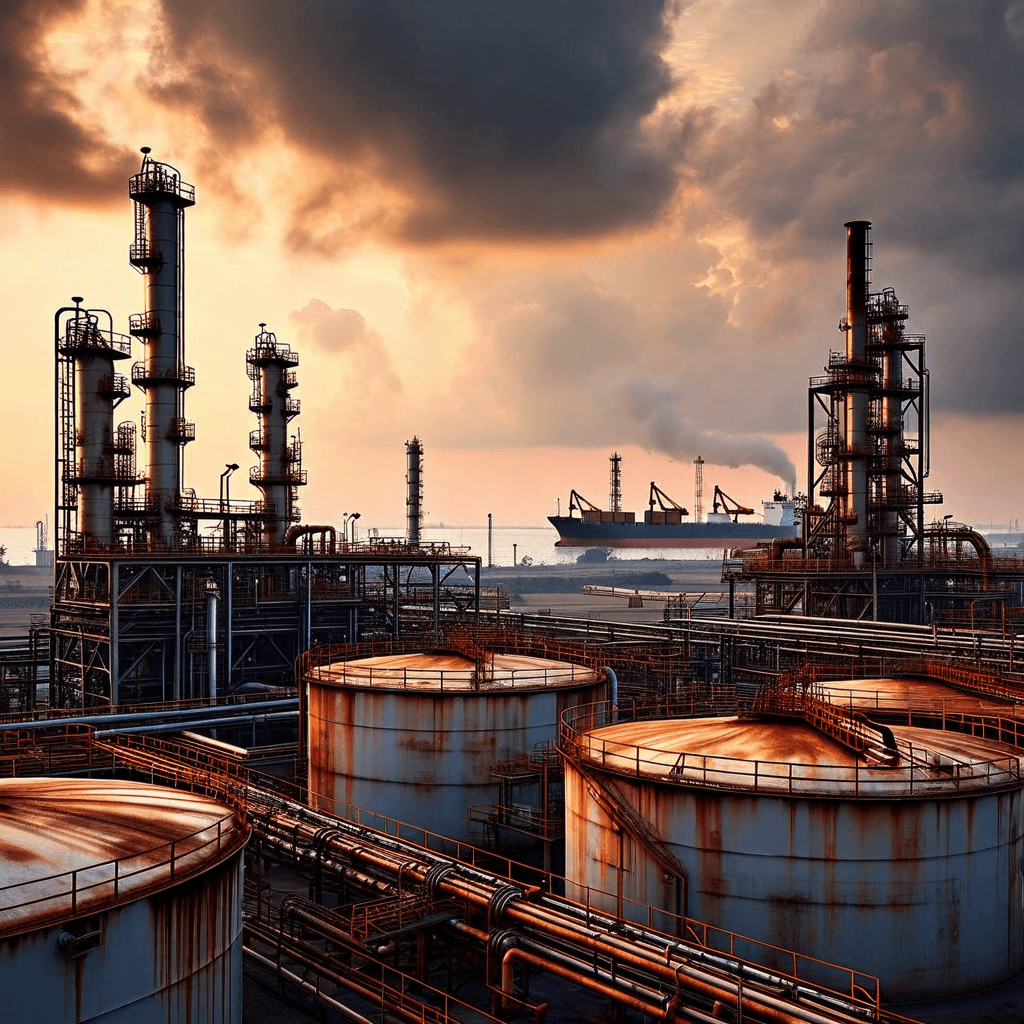
India’s crude oil import strategy is undergoing a severe stress test. The country is scrambling to secure supplies amid Middle Eastern disruptions, but this comes at a steep price. Indian refiners are locking in Russian crude at premiums of $5–15 per barrel above Brent benchmarks—a sharp reversal from the deep discounts seen previously . This surge in input costs, combined with a government-mandated freeze on retail fuel prices, is crushing refining margins and forcing state-run oil marketing companies (OMCs) to absorb massive losses.
The Hormuz Shock and Russian Pivot
The immediate trigger for this chaos is the conflict involving Iran, which has effectively choked the Strait of Hormuz. This narrow waterway handles about one-fifth of global oil consumption, and for India, the stakes are existential. Approximately 2.5 to 2.7 million barrels per day (bpd), or roughly half of India’s crude imports, typically transit this chokepoint . With that route severely constrained, India’s overall imports plunged from 5.2 million bpd in February to 4.5 million bpd in March . To fill the gap, India turned to Russia, which emerged as the dominant supplier with imports hitting 2.14 million bpd in March—nearly double the previous month’s share .
However, this diversification is not a simple fix. It is opportunistic rather than structural. Indian refineries are largely configured to process medium-to-heavy sour crude from the Middle East . Switching to alternative grades from Africa or the Americas requires complex operational adjustments and often results in lower yields of high-value fuels like diesel. Furthermore, sourcing from distant regions like West Africa or the US significantly increases freight costs and transit times, eroding the cost advantage . While African crude from Angola and Nigeria offers a partial substitute, it cannot fully replace the volume or quality of Middle Eastern barrels.
The Price Freeze and Fiscal Strain
The financial strain on the sector is severe. State-run OMCs like Indian Oil Corporation (IOC), Bharat Petroleum (BPCL), and Hindustan Petroleum (HPCL) are losing an estimated ₹18 per litre on petrol and ₹35 per litre on diesel because retail prices haven’t budged since April 2022 . To prevent these losses from bankrupting the OMCs ahead of key state elections, the government slashed the Special Additional Excise Duty (SAED) by ₹10 per litre in late March . Crucially, this tax cut did not lower pump prices; it merely reduced the losses the OMCs were absorbing on behalf of consumers .
This political timing is critical. With five states heading to the polls in April, the government effectively froze prices to avoid voter backlash. Analysts forecast that once elections conclude, petrol and diesel prices may need to rise by a staggering ₹25–28 per litre to reflect true costs . This delay creates a severe working capital crunch for OMCs, forcing them to borrow heavily to cover daily losses estimated at ₹1,600 crore . The government also imposed steep windfall taxes on diesel and aviation turbine fuel exports and capped refinery margins at $15 per barrel to ensure domestic supply, further distorting the market .
Strategic Reserves and Bargaining Power
Underlying these immediate pressures is a deeper, structural vulnerability: India’s lack of strategic petroleum reserves (SPR). Compared to its peers, India is dangerously exposed. China boasts reserves covering roughly 180 days of imports, while Japan and South Korea have buffers exceeding 200 days . India’s strategic reserves cover only about 45–74 days of demand . This thin buffer severely constrains India’s bargaining power with alternative suppliers like Russia, Iran, and Venezuela. Without the leverage of massive stockpiles, India is often forced to accept premium pricing and less favorable terms to secure immediate supplies .
The decline in crude imports has also hit refinery operations. The drop from 5.2 million bpd to 4.5 million bpd forces refineries to run below optimal capacity, reducing throughput utilization. Since fixed costs like depreciation and labor remain constant, lower output spreads these costs over fewer barrels, raising the per-barrel cost of production and squeezing margins further. Integrated refiners with retail networks can offset some of this pain, but standalone refiners like Mangalore Refinery (MRPL) are facing a sharper squeeze as discounted transfer prices from OMCs eat into their revenues .
Long-Term Challenges and the Path Forward
India’s long-term energy security strategy remains a work in progress. The current approach—opportunistic diversification combined with fiscal interventions like excise cuts and export taxes—is adequate for weathering a temporary shock but ill-suited for a prolonged crisis . The country is expanding its SPR capacity with new facilities in Odisha, Rajasthan, and Gujarat, but this will take years to reach the International Energy Agency’s recommended 90-day net import cover .
Ultimately, India faces a difficult trade-off. Securing supply access through higher-priced alternative sources protects the country from physical shortages but undermines the competitiveness of its refining sector. Maintaining competitive margins requires access to cheap, compliant crude, which is currently scarce. The government’s price controls, while politically expedient, mask the true cost of energy from consumers and distort market signals. As the geopolitical dust settles, India will need to move beyond stop-gap measures and invest in deeper structural reforms, including massive reserve expansion, refinery flexibility upgrades, and a faster transition to renewable energy, to reduce its chronic vulnerability to oil shocks.