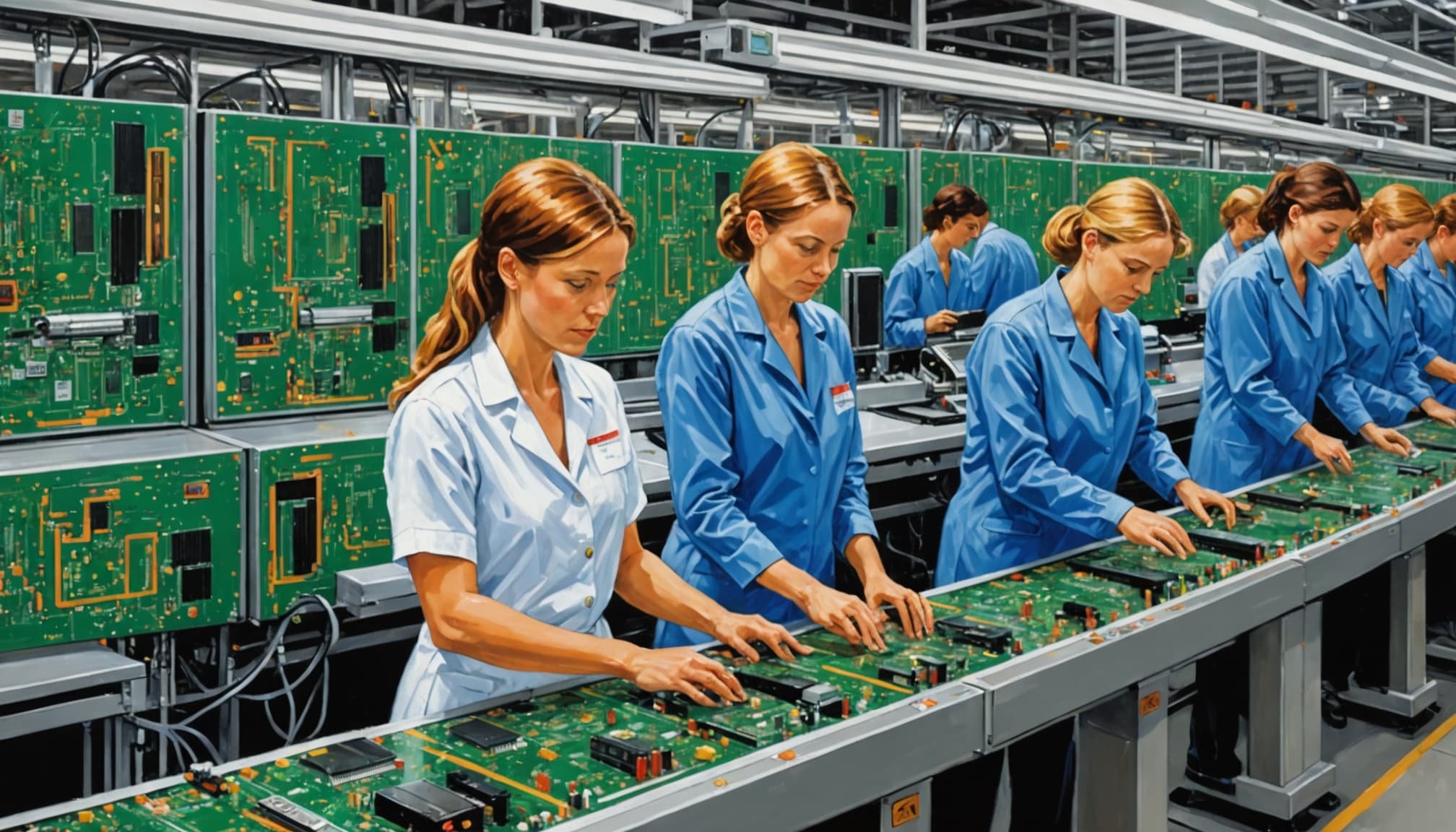
India’s electronics story is undergoing a fundamental rewrite. For years, the country celebrated becoming the world’s second-largest mobile phone manufacturer by volume, with 99.2% of phones used domestically now made within our borders. But here’s the uncomfortable truth: while we assemble the phones, we don’t build them.
This structural weakness is now driving a massive policy shift, and it’s creating clear winners and losers among listed electronics companies.
Two Schemes, Different Paths
The government has launched two major schemes to address this gap. The Electronics Components Manufacturing Scheme (ECMS) focuses on building the component ecosystem—printed circuit boards (PCBs), camera modules, and other critical parts. The Mobile Phone Manufacturing Scheme (MPMS) targets scaling up phone production and exports. Global brokerage Jefferies sees these schemes serving very different purposes. ECMS is about backward integration and building deep manufacturing capabilities. MPMS is about volume and exports. This distinction explains why Jefferies rates Kaynes Technology a ‘Buy’ at 55x forward earnings, while assigning ‘Hold’ ratings to Dixon Technologies at 67x and Syrma SGS Technology at 57x.
The $7 Billion PCB Opportunity
The numbers tell a compelling story. India’s PCB market is worth about $7 billion annually, but 85-90% of this demand is met through imports. That’s roughly $6-6.3 billion of import substitution up for grabs.
This is where Kaynes Technology has positioned itself strategically. The company has received government approval for approximately Rs 3,700 crore of capex for advanced PCB manufacturing, including capabilities to produce up to 76-layer boards and high-density interconnect (HDI) PCBs. Under ECMS, Kaynes gets a 25% subsidy on this capex and needs to bring only 30% as equity—the rest is supported through government incentives. This dramatically de-risks their expansion. Transcripts +1
Dixon’s Transition Challenge
Dixon Technologies, by contrast, built its empire on mobile phone assembly. It was the standout beneficiary of the earlier PLI scheme, achieving massive scale with 45 million units of smartphone capacity. But the MPMS expansion from roughly Rs 25 lakh crore to Rs 39 lakh crore in production targets brings more players into the game. Jefferies expects competition to intensify under MPMS compared to the earlier scheme. More manufacturers qualifying means pressure on market share and pricing. Dixon’s management recognizes this challenge and has stated they expect 70-80% of their business to integrate into the component landscape by FY28 to drive margin expansion. However, this transition requires massive capex and technology acquisition, putting them in catch-up mode against established component manufacturers.
Quality Over Quantity
The ECMS project approval process itself reveals the government’s quality-over-quantity approach. Out of 249 applications received, only 106 projects have been approved so far. This 42.6% approval rate reflects rigorous selection criteria focusing on technical capability, financial strength, and strategic alignment with national priorities. The approved projects entail Rs 69,548 crore of investment across 15 states, with 38 plants already operational and another 16 at advanced stages. This creates immediate domestic sourcing capabilities. Kaynes, with its strong ECMS participation and technology partnerships, is positioned to capture this demand. Dixon’s ECMS participation is more limited, focused on display modules and evaluating other components. Syrma SGS Technology is developing multi-layer PCB capabilities with a Rs 400 crore Phase 1 investment, but this is smaller in scale compared to Kaynes’s approved Rs 3,700 crore. Transcripts
Syrma’s Valuation Conundrum
Syrma SGS Technology presents an interesting case. The stock has rallied 105% year-to-date, leading Jefferies to recommend prudence at 57x forward earnings. The company has delivered strong operational performance—Q1 FY27 revenue grew 67% year-on-year, and net profit more than doubled. It has a diversified customer base across 270 customers in 20+ countries and holds certifications like TISAX for automotive electronics. However, its PCB capabilities are still developing compared to Kaynes’s established leadership. Syrma has a joint venture with Kaga Electronics and a Shinhyup PCB partnership that could strengthen domestic sourcing, but these create technology dependencies rather than indigenous capability development. Transcripts
The Valuation Paradox
The valuation paradox is striking.
This reflects Jefferies’ view that component manufacturers offer superior long-term growth prospects. Component manufacturing typically commands 15-25% margins compared to 2-6% for assembly operations.
The logic is simple—if you make the PCB, you win the contract to assemble the full product.
Partnership Strategies Diverge
Foreign technology partnerships highlight another differentiator. Dixon has a joint venture with HKC Overseas, a Chinese display technology company, requiring government approval under Press Note 3 rules. While this provides display manufacturing capabilities, it creates geopolitical risks and technology dependence. Syrma’s Shinhyup PCB partnership similarly builds capabilities through collaboration rather than indigenous development. Kaynes pursues partnerships for collaboration rather than dependence—working with Alpha & Omega Semiconductor and Mitsui & Company while maintaining technology independence through 50+ patents and indigenous OSAT capabilities. Transcripts
The Long Game
India’s stepwise indigenization approach favors companies with long-term vision. Phase 1 was about assembly scale—largely achieved. Phase 2, happening now, is about component development. Phase 3 will focus on deep technology like semiconductors. Kaynes is aligned across all phases, with OSAT capabilities already operational and PCB manufacturing scaling up. Dixon is trying to transition from Phase 1 success to Phase 2 requirements, facing execution risks and competitive disadvantages. The structural shift from assembly to component manufacturing isn’t just about government incentives—it’s about capturing more value from every device manufactured. For investors, this means looking beyond current assembly volumes to assess which companies are building sustainable competitive advantages in the components that power India’s electronics revolution.