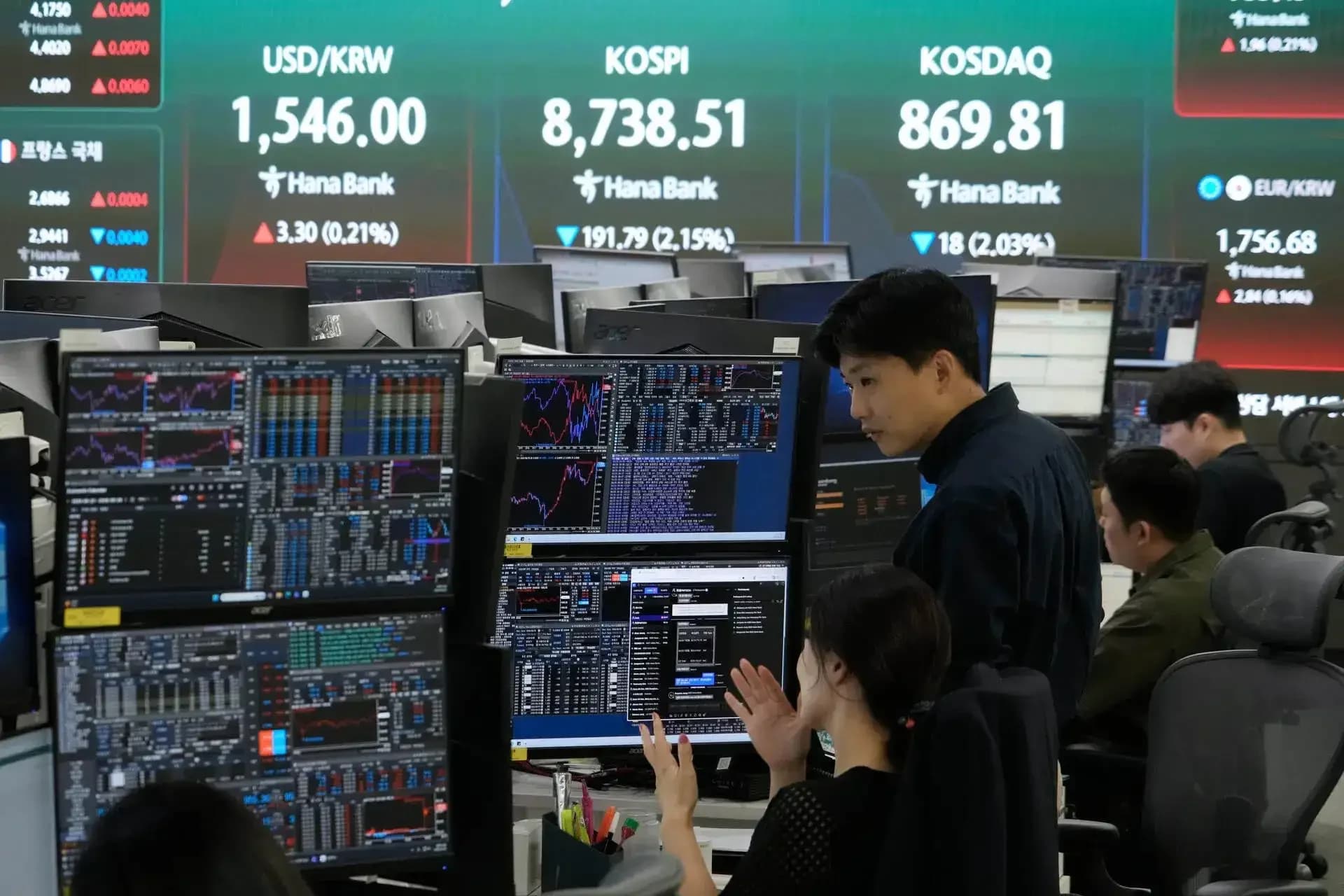
MSCI's index for Asian shares outside Japan fell 1.6%, snapping a four-day rally that had pushed it to an all-time high. South Korea's Kospi dropped 1.7%, while Japan's Nikkei 225 declined 1.36% to 67,470. The declines came as both Washington and Tehran reported exchanging fire, each attributing responsibility to the other side, undermining hopes for a peace agreement and pushing energy prices higher. This escalation revived concerns about energy supply disruptions and inflation, keeping interest rate worries at the forefront for investors.
The risk-off sentiment extended to U.S. markets, with S&P 500 futures retreating alongside Asian shares. Adding to the pressure was a weak outlook from Broadcom Inc., whose disappointing guidance dented momentum in the artificial-intelligence trade that had driven markets higher this year. The combination of geopolitical uncertainty and tech sector vulnerability created a perfect storm for equity markets, with investors fleeing to safe-haven assets while reassessing the durability of the AI-driven rally.
Broadcom's AI Chip Warning
Broadcom shares plunged more than 13% in extended trading after the company reported record revenue but missed expectations for its most critical metric: AI chip sales. While Broadcom beat Q2 earnings and revenue expectations, its third-quarter AI chip revenue guidance of $16 billion fell $1.2 billion short of the $17.2 billion consensus estimate. This shortfall, combined with slightly below-consensus performance in the company's software business, triggered a sharp market reaction that wiped out over $270 billion in market value.
The guidance miss has raised concerns about potential loss of momentum in the AI chip market. Broadcom's CEO Hock Tan indicated that AI network revenue would decline from 40% to 30% of total AI semiconductor revenue, suggesting that even within AI, growth may be becoming more selective. This normalization in the networking segment could signal that infrastructure build-out is reaching saturation faster than computing infrastructure. Despite the near-term disappointment, Tan maintained the company's 2027 AI semiconductor revenue guidance of over $100 billion unchanged, reflecting confidence in long-term demand from hyperscaler capital expenditures and the continued build-out of AI data centers.
Broadcom's performance reflects broader trends in the semiconductor industry, where growth is becoming increasingly polarized. The global semiconductor industry is expected to reach $975 billion in annual sales in 2026, a historic peak fueled by an intensifying AI infrastructure boom. However, this record growth masks a stark structural divergence, as high-value AI chips now drive roughly half of total revenue while representing less than 0.2% of total unit volume.
Bank of Japan Signals Policy Shift
Bank of Japan Governor Kazuo Ueda's hawkish remarks triggered a significant strengthening of the yen from weaker levels to 159.91 per dollar. Ueda emphasized that "upside risks to prices appear to be greater overall and are likely to emerge sooner" than downside risks to economic activity. This represented a significant shift in the BOJ's traditional risk assessment framework, which had historically prioritized economic growth concerns over inflation risks. The dollar fell 0.3% against the yen to 159.40 immediately following Ueda's comments.
Market expectations for a June rate hike have intensified, with traders assigning roughly an 85% probability of a quarter-point hike at the June 15-16 meeting. This shift is driven by several factors: the energy shock from the Middle East conflict creating complex policy challenges, domestic economic resilience despite external shocks, and evolving BOJ board dynamics with increasing hawkish sentiment. The coordination between monetary and fiscal policy appears to be functioning effectively, with the government implementing substantial fiscal measures to support households while the BOJ addresses inflation through monetary tightening.
The 160 yen-per-dollar level has emerged as a critical psychological and technical threshold. Japanese authorities have previously conducted currency intervention when the yen breached this level, spending ¥11.7 trillion in April-May. The approach to 160 triggers specific market behaviors, including speculative positioning, stop-loss orders, and increased volatility. As the yen approaches intervention zones, Japanese authorities typically escalate verbal warnings, with Finance Minister Satsuki Katayama repeatedly stating that authorities stand ready to take appropriate action in currency markets when necessary.
Bitcoin's Macro-Driven Decline
Bitcoin experienced a severe 17% decline over five consecutive days, reaching a four-month low as multiple bearish forces converged. The cryptocurrency fell to approximately $64,118 before recovering slightly, demonstrating the asset's continued vulnerability to traditional macroeconomic forces. The primary drivers included a stronger U.S. dollar, rising Treasury yields, and cautious risk sentiment. The 30-year Treasury yield rose to 5.13%, its highest close since 2007, while prediction markets showed overwhelming odds that the Fed would hold rates steady, raising the opportunity cost of holding non-yielding assets like Bitcoin.
The inverse relationship between Bitcoin and the U.S. dollar remains driven by several fundamental mechanisms. When the dollar strengthens, debts owed in dollars become harder to manage abroad, capital flows shift toward U.S. assets, and riskier markets tend to shrink. Bitcoin typically declines when these forces build. Additionally, Federal Reserve policy affects Bitcoin primarily through liquidity and opportunity cost. When the Fed raises interest rates, money moves more slowly through markets, cash gains stronger appeal when yields rise on government debt, and this shift often weakens demand for assets that pay no income, like Bitcoin.
Despite the severity of the decline, Bitcoin's recovery from its lows demonstrated important market resilience. The cryptocurrency tested and defended the critical $64,000-$65,000 support zone, which has historically triggered strong rebounds. On-chain data showed long-term holders accumulating at current levels, a pattern that has historically preceded local bottoms. Additionally, Bitcoin open interest had fallen from $34.45 billion to approximately $30.4 billion, suggesting that thinning leverage could prevent further downside without an outside catalyst.
Gold Holds Steady Amid Tensions
Gold prices advanced 0.9% to $4,473.61 per ounce, maintaining their established trading channel amid complex market dynamics. The precious metal demonstrated resilience despite headwinds from a steady U.S. dollar, continuing its pattern of consolidation around the $4,500 per ounce level. The primary catalyst for gold's advance was renewed geopolitical instability, particularly in the Middle East, where ongoing military exchanges between the United States and Iran created uncertainty and supported safe-haven demand.
The relationship between the steady U.S. dollar index at 99.45 and the flat 10-year Treasury yield at 4.489% reflected a market equilibrium where labor market strength, Fed policy expectations, and geopolitical risk premiums were balanced across asset classes. This stability suggested markets had successfully priced in the current economic and geopolitical environment. The combination of nominal yields around 4.49% and inflation expectations near 3.8% suggested stable real rates, which supported non-yielding assets like gold.
Australia's trade balance swung back to a surplus of A$1,791 million in April 2026, following a revised deficit of A$1,024 million in March. This marked a significant reversal from the first trade deficit since December 2017. The recovery was driven by export growth of 7.2% month-on-month to a three-year high of A$47.19 billion, primarily reflecting a sharp increase in metal ore and mineral prices amid supply concerns and rising energy costs. Initially, this positive data supported the Australian dollar, but the currency later pared gains to trade flat due to offsetting factors including global risk-off environment, U.S. dollar strength, and technical resistance levels.
Political Constraints on Iran Conflict
The Republican-led U.S. House of Representatives delivered a stunning bipartisan rebuke to President Donald Trump by approving a war powers resolution aimed at curbing his military campaign against Iran. The House voted 215-208 in favor of the measure, with four Republicans joining all Democrats in support. This vote marked the strongest congressional rebuke yet of a conflict that had stretched beyond three months and fueled concerns about its economic and geopolitical consequences.
The resolution is considered largely symbolic because it is a concurrent resolution that does not carry the force of law and does not need presidential signature. Even if approved by both chambers, Trump is expected to challenge efforts to limit his authority. The requirement for a two-thirds majority to override a presidential veto significantly affects market pricing of geopolitical risk. In the Senate, overriding a veto would require 67 votes, a threshold that would be extremely difficult to reach given current partisan divisions. This high bar for effective action means markets assign a low probability to successful congressional constraints on presidential war powers.
The lack of progress in Tehran-Washington talks has had significant impacts on oil prices and broader market risk appetite. Conflicting signals from both sides have created an environment of extreme uncertainty. President Trump stated he did not mind if the talks were over, only to later issue a social media post saying talks were continuing. Meanwhile, Tehran reported suspending indirect negotiations. Oil prices have experienced significant volatility, with Brent crude falling 2.68% to $96.91 on hopes for talks progress but rising sharply on renewed hostilities. The stalled negotiations continue to drive market volatility, particularly in oil markets, where the persistent risk premium reflects ongoing uncertainty about supply disruptions and the timeline for conflict resolution.