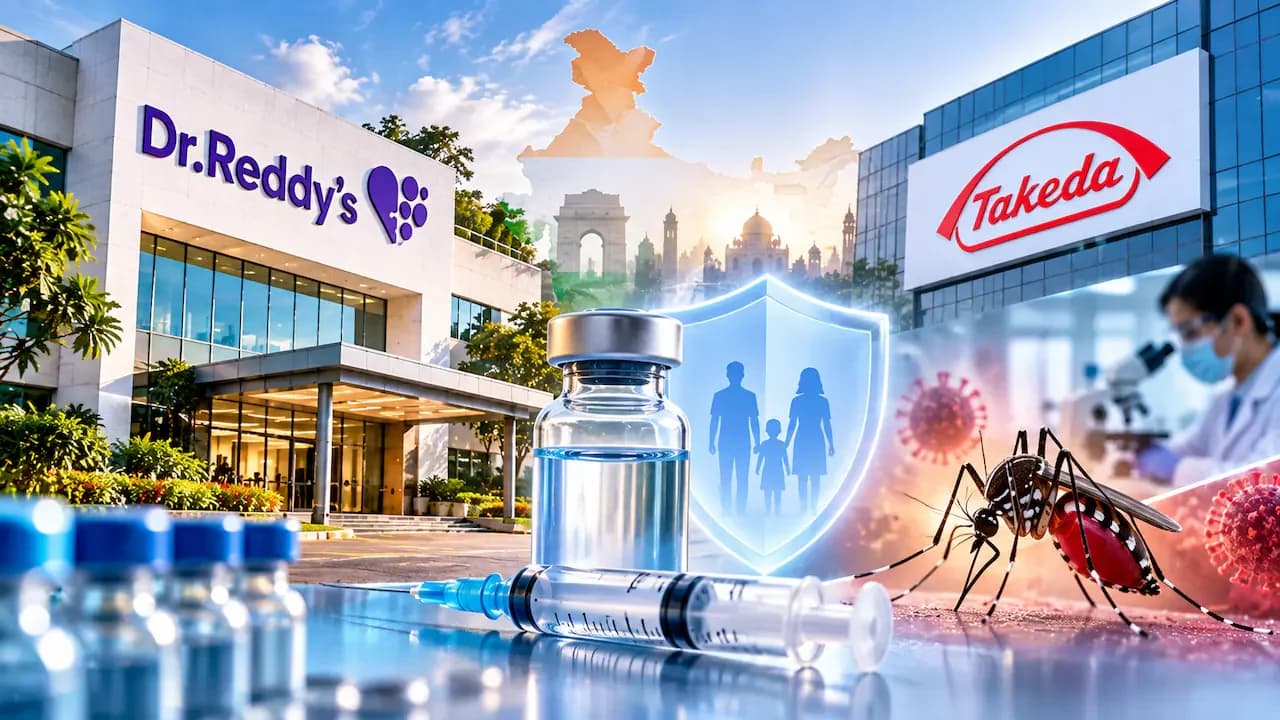
On September 18, 2026, Dr. Reddy's Laboratories announced an exclusive distribution and marketing agreement with Takeda Pharmaceutical for Qdenga (TAK-003), India's first approved dengue vaccine. The deal is straightforward: Dr. Reddy's handles promotion and distribution in India's private market, while Takeda retains manufacturing, import, brand ownership, and public sector rights. No upfront payments or milestone fees were disclosed, suggesting a distribution-margin based model rather than a traditional licensing arrangement. The vaccine received CDSCO approval in July 2026 for individuals aged 4-60 years and is expected to launch in the first half of 2027.
Revenue and Margin Impact
The financial terms remain undisclosed, but we can frame the potential impact. Dr. Reddy's current India branded generics business contributes approximately 17.1% of total revenue with gross margins well above 60%. The private vaccine market in India is worth over ₹2,200 crore and growing at 12-17% annually, driven by adult immunization and prophylaxis segments. As a first-in-class product in an underserved disease category, Qdenga could capture disproportionate market growth. However, margins will depend on the distribution fee structure negotiated with Takeda. If Dr. Reddy's earns a standard distribution margin of 15-25%, the contribution to overall profitability could be meaningful but not transformative initially. The real margin upside comes from volume scaling and cross-selling opportunities within Dr. Reddy's existing physician network.
Competitive Positioning Against Domestic Rivals
The competitive landscape features Panacea Biotec's DengiAll, currently in Phase 3 trials with over 10,000 participants across 19 sites in India. This timeline puts DengiAll approximately 2-3 years behind Qdenga's market entry. Dr. Reddy's gains significant advantages through this first-mover position: 18-24 months to establish market leadership, build physician awareness, and secure hospital chain partnerships before domestic competition emerges. Qdenga also brings extensive clinical validation—61.2% overall efficacy and 84.1% hospitalization prevention at 4.5 years, with 60,000+ participants globally and approvals in 43 countries. In contrast, DengiAll is still generating efficacy data. The operational advantage is equally compelling: Qdenga requires no pre-vaccination screening, simplifying rollout compared to vaccines requiring serological testing. Dr. Reddy's, already the second-largest vaccine player in India through its Sanofi partnership (₹426 crore annual sales), is well-positioned to convert these advantages into market share gains.
Capital Investment and Allocation
The cold chain requirements are manageable. Qdenga requires standard 2-8°C refrigeration, unlike ultra-cold vaccines needing -70°C storage. Dr. Reddy's can leverage existing infrastructure from its Sputnik V partnership with B Medical Systems, which included ultra-low temperature freezers capable of -25°C storage and deployment across major hospital chains. Estimated incremental investments range from ₹135-235 crores for additional refrigerated storage, temperature monitoring systems, cold chain transport vehicles, and backup power—representing only 7-13% of Dr. Reddy's FY27 capex guidance of ₹1,800 crores. This won't disrupt the company's commitment to R&D at 7-8% of revenues or its focus on biosimilars and peptides. Working capital requirements will fluctuate seasonally, with an estimated ₹315-485 crores needed to support base inventory plus peak monsoon season buildup, when dengue incidence is highest. Transcripts
Regulatory and Execution Risks
The regulatory pathway appears clear. CDSCO approval is secured, but commercial distribution requires completing several steps: obtaining Registration Certificate and Import License, manufacturing and supply from Takeda's Singen facility, and batch clearance from the Central Drugs Laboratory. Takeda targets H1 2027 availability, but any delays could postpone revenue recognition. The execution challenges are more substantial. India's cold chain logistics market faces significant gaps: only 8-10% of 3,500+ operators meet WHO-GDP standards, and the country operates approximately 10,000 reefer vehicles against an estimated requirement of 62,000. Rural last-mile delivery remains particularly vulnerable due to unreliable electricity and limited healthcare facility capacity. Dr. Reddy's will need a phased rollout strategy—starting with metros, expanding to Tier 2 cities, then selectively addressing Tier 3 markets—to mitigate these infrastructure constraints. Policy uncertainty also looms. While the Parliamentary Committee has recommended considering dengue vaccine inclusion in the Universal Immunization Programme, the base case scenario remains private market focus. UIP inclusion would bring volume but at government-negotiated prices, fundamentally altering the commercial model.
Strategic Alignment and Future Implications
The Qdenga partnership aligns perfectly with Dr. Reddy's strategic shift toward specialty and preventive care products. Management has identified three future growth drivers: consumer healthcare, innovative products, and biosimilars. The company already markets preventive care products including Beyfortus (RSV prevention) with Sanofi, Lenacapavir for HIV prevention, and Sensimmune allergy immunotherapy. Qdenga adds first-in-category positioning in dengue prevention, strengthening this portfolio transformation. Synergies with Dr. Reddy's existing distribution network are substantial. The India branded generics business generates 17.1% of company revenue with strong physician relationships and brands like Omez and Nise that command high loyalty. The vaccine business, elevated to second-largest player status through the Sanofi partnership, provides established cold chain infrastructure and hospital network access. Cross-selling opportunities exist across chronic disease patients—cardiovascular, gastrointestinal, and diabetic populations who may be at higher risk for dengue complications. AnnualReports +2
Perhaps most importantly, success with Qdenga will validate Dr. Reddy's as a preferred partner for global vaccine manufacturers seeking Indian market access. The company has already demonstrated partnership capabilities across multiple collaborations with Sanofi, Nestlé, Gilead Sciences, and others. A successful Qdenga launch—demonstrating regulatory navigation, cold chain management, and commercial execution—could open doors to partnerships with Pfizer, GSK, Merck, and Moderna for adult vaccination, travel vaccines, and oncology prevention opportunities. This positions Dr. Reddy's not just for immediate revenue from Qdenga, but for a broader role in India's evolving preventive care landscape. Transcripts +1
The Bottom Line
Dr. Reddy's Qdenga partnership represents a calculated strategic bet with manageable capital requirements and significant upside potential. The company gains an 18-24 month first-mover advantage against domestic competitors, leverages existing distribution infrastructure to minimize incremental investment, and aligns with its broader portfolio transformation toward specialty and preventive care. While execution risks in India's heterogeneous healthcare infrastructure are real, and policy uncertainty around potential UIP inclusion creates commercial variability, the partnership establishes Dr. Reddy's as a credible player in India's vaccine market. Success here could catalyze future partnerships and accelerate the company's evolution from generics-focused to innovation-led. The immediate financial impact may be modest, but the strategic positioning could prove transformative.