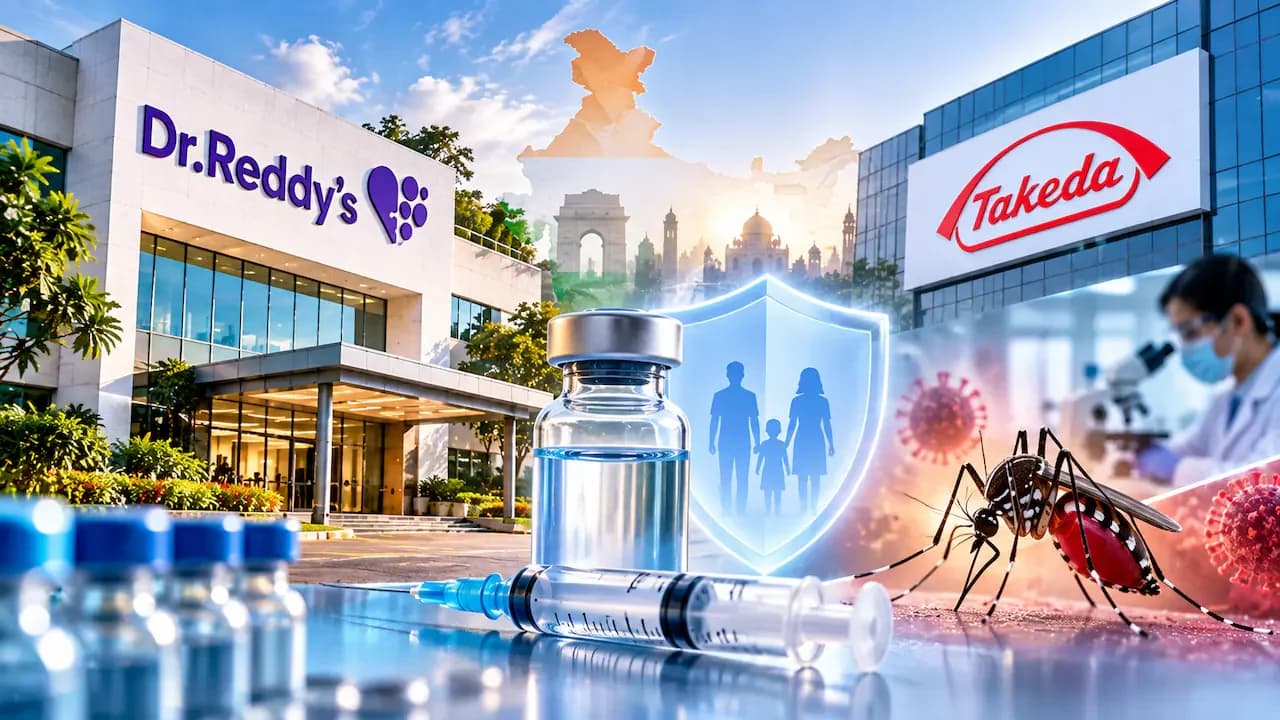
Dr Reddy's Laboratories and Takeda Biopharmaceuticals India Private Ltd have entered into an exclusive distribution and marketing agreement where Dr. Reddy's will have exclusive responsibility for distribution and marketing of QDENGA in the Indian private market, while Takeda will retain commercialization rights in the Indian public market and will be responsible for manufacturing and importation of the vaccine. According to a regulatory filing, the collaboration involves Takeda Biopharmaceuticals India Private Ltd, Takeda's Indian subsidiary, and is subject to completion of applicable processes with local authorities. Dr Mahender Nayak, Head of Intercontinental Markets, International Business Unit at Takeda, emphasized the company's commitment to supporting India's evolving healthcare needs and expanding access to dengue vaccination, welcoming the recent Parliamentary Committee on Health's recommendation to consider dengue vaccine for the Universal Immunization Program.
Takeda is targeting combined annual manufacturing capacity of 100 million doses of QDENGA with Biological E by 2029, as reported by Business Standard. Takeda currently has capacity to manufacture around 50 million doses annually at its Singen facility in Germany, while its partnership with Hyderabad-based Biological E is expected to add another 50 million doses. Mahender Nayak, head of Intercontinental Markets, International Business Unit at Takeda, told Business Standard that the company aims to scale Biological E's annual capacity to 50 million doses by 2029. The initial doses for India — both for the private market and any public-market procurement — will be supplied from Takeda's Singen facility, with Biological E's eventual production primarily aimed at meeting large-scale requirements from national immunisation programmes including in markets outside India.
Dr Reddy's Laboratories shares gained up to 3% following the announcement of the strategic agreement, with the stock trading 1.23% higher at ₹1,189.50 per equity share as of 2:13 PM on September 18, 2026. The stock has advanced 2% in the past week and nearly 1% over the month, though it has fallen 5% on a year-to-date basis. As per CNBC TV18, the stock performance reflects investor confidence in the company's expansion into the vaccines segment and the potential for increased market presence through this exclusive partnership. The collaboration is part of Dr Reddy's efforts to expand its vaccines business in India and improve access to dengue vaccination in the country, with the partnership aimed at expanding access to dengue vaccination in India where the disease remains a significant public health challenge.
The vaccine is anticipated to become available in India in the first half of 2027 following the completion of regulatory processes. As reported by CNBC TV18, QDENGA is administered as two 0.5 ml doses given three months apart and can be used regardless of whether an individual has previously been infected with dengue, eliminating the need for pre-vaccination screening for prior dengue infection. Dr M.V. Ramana, CEO - Global Generics at Dr. Reddy's Laboratories, stated that as the second-largest vaccine player in India, the introduction of India's first approved dengue vaccine is an important development for the country's healthcare landscape. Dr Reddy's plans a pan-India launch from the outset, rather than initially restricting the vaccine to states or regions with higher dengue incidence, using its network of vaccinators, corporate hospitals and paediatricians to engage healthcare professionals and communities ahead of the launch.
The collaboration follows the approval of QDENGA's marketing authorization by India's Central Drugs Standard Control Organization (CDSCO) in July 2026, making it India's first approved dengue vaccine. According to CNBC TV18, this approval covers individuals aged 4-60 years and the vaccine has demonstrated significant global impact, with more than 32 million doses distributed through public and private programmes in countries including Indonesia, Thailand, Malaysia, Vietnam, parts of Latin America and Europe. The World Health Organization has recommended QDENGA without pre-vaccination screening in high-endemic countries and the vaccine is included in the WHO List of Prequalified Vaccines. The World Health Organization has prequalified the vaccine and recommends its use without pre-vaccination screening in high-dengue-burden settings, with QDENGA approved in more than 40 countries globally.
QDENGA is a two-dose vaccine designed to protect against all four dengue virus serotypes, given in two doses three months apart. According to Takeda, the company's global clinical programme for QDENGA included more than 60,000 participants across eight dengue-endemic countries. Follow-up of clinical-trial participants showed an 84 per cent reduction in hospitalisation at four-and-a-half years and an 80 per cent reduction after seven years, with the seven-year data having so far not indicated a need for a booster dose. QDENGA is a live-attenuated tetravalent dengue vaccine designed to protect against all four dengue virus serotypes — DENV-1, DENV-2, DENV-3 and DENV-4. The seven-year Phase 3 TIDES study reported overall efficacy across all four dengue virus serotypes through seven years. The company cited that reported cases have risen 11-fold over 20 years, while a nationwide surveillance study by the Indian Council of Medical Research's Virus Research and Diagnostic Laboratory found all four dengue virus serotypes circulating across multiple parts of India.
Under the current agreement, Dr Reddy's will handle promotion and distribution of QDENGA for pediatric and adult vaccination in India's private market, while Takeda will retain the rights to promote and distribute the vaccine in the public market as a future objective. The companies have not yet disclosed the price of QDENGA in India, with Nayak stating pricing would take into account the country's affordability levels rather than being benchmarked against another market. Dr Ramana said the companies had conducted an "extensive study" to determine pricing that could ensure broad and sustainable reach and were working together on the final pricing. The entry of QDENGA into India's private market could increase competition in the country's emerging dengue vaccine space, with the timing being important for other developers like Panacea Biotech's DengiAll, which remains in Phase 3 trials and has not yet received regulatory approval. The availability of an approved vaccine backed by Takeda and distributed through Dr Reddy's network could alter the competitive landscape once competing products approach commercial launch.