Dhoot Transmission made a spectacular market debut on August 17, 2026, listing at ₹1,200 per share—a 38% premium over its upper IPO price band of ₹871. This strong opening valued the company at approximately $2.5 billion (₹23,630 crore), marking one of the strongest IPO debuts in India so far this year. The stock's performance reflects robust investor appetite, but it also raises questions about whether the fundamentals justify such a rich valuation.
What Drove the 38% Premium Listing?
Several factors converged to create this premium debut. Institutional interest was overwhelming, with Qualified Institutional Buyers (QIBs) subscribing 212.92 times the offer. This category included marquee anchor investors like BlackRock and the Abu Dhabi Investment Authority, who collectively invested $96 million ahead of the IPO. Their participation signaled strong confidence in the company's growth trajectory.
Bain's reputation for value creation in manufacturing businesses provided a credibility anchor that retail investors often seek in new listings.
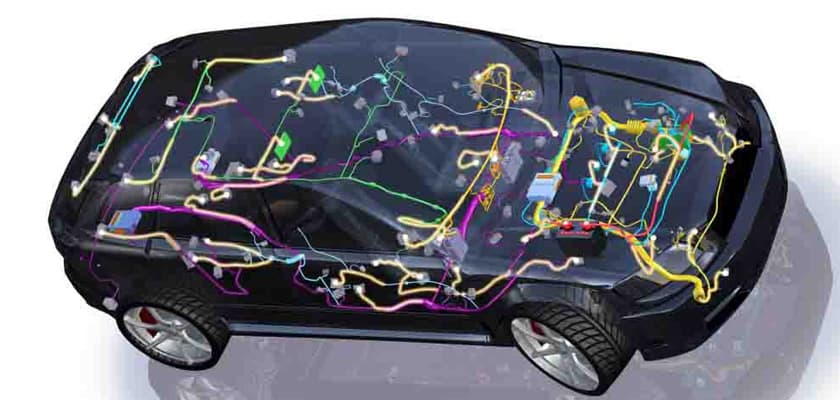
Beyond the backing, Dhoot's business fundamentals told a compelling growth story. The company commands a 70% market share in electric two-wheeler and three-wheeler wiring harnesses—a segment experiencing explosive growth in India. EV revenue contribution jumped from 16.19% in FY24 to 24.17% in FY26, reaching ₹1,093.56 crore. This positioning at the forefront of India's EV revolution resonated with investors looking for exposure to structural growth themes.
Valuation Metrics and Peer Comparison
At the IPO upper band of ₹871, Dhoot was valued at 44.89 times its FY26 earnings. This placed it broadly in line with established peers like Minda Corporation (46.49x) and Motherson Sumi Wiring India (43.24x), while below Uno Minda (56.87x) and Sona BLW (74.64x).
This premium valuation implies high growth expectations. Dhoot delivered strong revenue growth of 31.35% in FY26 to ₹4,525 crore, with profit after tax reaching ₹397 crore. However, profitability metrics showed concerning trends. EBITDA margins declined from 18.31% in FY24 to 15.71% in FY26, while PAT margins compressed from 10.67% to 8.70%. Return on capital employed also deteriorated sharply, falling from 33.56% to 19.14% over the same period.
Financial Health and Balance Sheet Strength
Despite margin pressure, Dhoot's balance sheet shows resilience. The company reported cash and cash equivalents of ₹1,084.28 crore in FY26, resulting in negative net debt of ₹177.56 crore. This cash-rich position provides financial flexibility for expansion initiatives and debt repayment. The IPO proceeds include ₹464.80 crore allocated for debt repayment and ₹301.77 crore for subsidiary debt reduction, which should further strengthen the balance sheet.
However, working capital management presents challenges. The net working capital cycle increased dramatically from 12 days in FY25 to 102 days in FY26, with inventory days at 76 and receivables at 64. This indicates significant cash being tied up in operations, which could pressure liquidity if not addressed.
Customer Concentration: The Elephant in the Room
The most significant risk factor is extreme customer concentration.
TVS Motor and Honda Motorcycle & Scooter India contributed another 19.62% and 10.40% respectively. This concentration creates dependency risk—any loss of a major customer or reduction in orders could materially impact financial performance.
Revenue mix also shows concentration. Two-wheelers contributed 65.47% of revenue, three-wheelers 12.86%, while wiring harnesses alone accounted for 77.08% of total revenue. This lack of diversification beyond the core product and primary vehicle segments increases vulnerability to cyclical downturns in the 2W/3W market.
Competitive Positioning vs. Motherson Sumi Wiring
Comparing Dhoot with Motherson Sumi Wiring India reveals different risk-return profiles. Motherson is substantially larger with FY26 revenue of ₹11,478 crore compared to Dhoot's ₹4,525 crore. However, Dhoot demonstrates superior profitability—EBITDA margins of 15.71% versus Motherson's approximately 9.2%, and PAT margins of 8.70% versus 5.4%.
On financial stability, Motherson has the clear advantage. It operates debt-free with ₹850 crore in cash reserves, exceptional return metrics (ROCE of 42.5%, ROE of 36.8%), and a working capital cycle of just 18 days. Dhoot, while cash-positive, carries some debt and faces working capital inefficiencies.
Geographically, Dhoot has greater diversification with manufacturing operations in the UK, Slovakia, Thailand, and Germany alongside its 19 Indian plants. Motherson operates 26 facilities but all within India, focusing primarily on the domestic passenger vehicle market. This gives Dhoot broader market exposure but also subjects it to global economic headwinds.
The EV Growth Tailwind
The long-term growth thesis for Dhoot hinges on India's EV revolution. The electric two-wheeler market reached 9.2% of monthly 2W sales in May 2026, up from 6.1% a year earlier. Electric three-wheelers achieved 58.9% market growth in FY26, with annual sales exceeding 835,000 units. Overall, India's EV market is projected to grow from approximately 3 million units in FY26 to 11.6 million units by FY2030.
This structural shift directly benefits wiring harness demand. Battery-electric vehicles require 40-60% more wiring by weight than internal combustion engine equivalents due to high-voltage battery interconnects, thermal management circuits, and onboard-charger harnesses. The global automotive wiring harness market is projected to grow from $90.40 billion in 2026 to $204.65 billion by 2035, registering a 9.50% CAGR.
Dhoot's 70% market share in EV 2W/3W wiring harnesses positions it to capture disproportionate benefits. If EV revenue grows from 24.17% to 40-45% of total revenue by FY30, the company could see substantial top-line expansion. However, executing this growth while managing customer concentration and improving operational efficiency remains the critical challenge.
Sustainability of Premium Valuation
The 38% listing premium was justified by growth prospects and market position, but sustaining this valuation requires execution.
The company's capacity expansion plans—new manufacturing plants in Jhajjar, Haryana, and Hosur, Tamil Nadu—will add 3.06 million units of annual capacity. This should support growth, but the benefits must translate into improved profitability and return metrics to justify the premium multiple.
Conclusion
Dhoot Transmission's market debut reflects strong investor confidence in its EV market leadership and growth potential. Bain Capital's backing, institutional support, and India's EV revolution created a compelling narrative that drove the premium listing. However, the post-listing valuation of 61.85x P/E demands exceptional execution. The company must address margin compression, customer concentration, and working capital inefficiencies to sustain this premium. For investors, the story remains one of high growth potential balanced against significant execution risks. The coming quarters will reveal whether Dhoot can convert its market leadership into sustainable financial performance that justifies its $2.5 billion valuation.