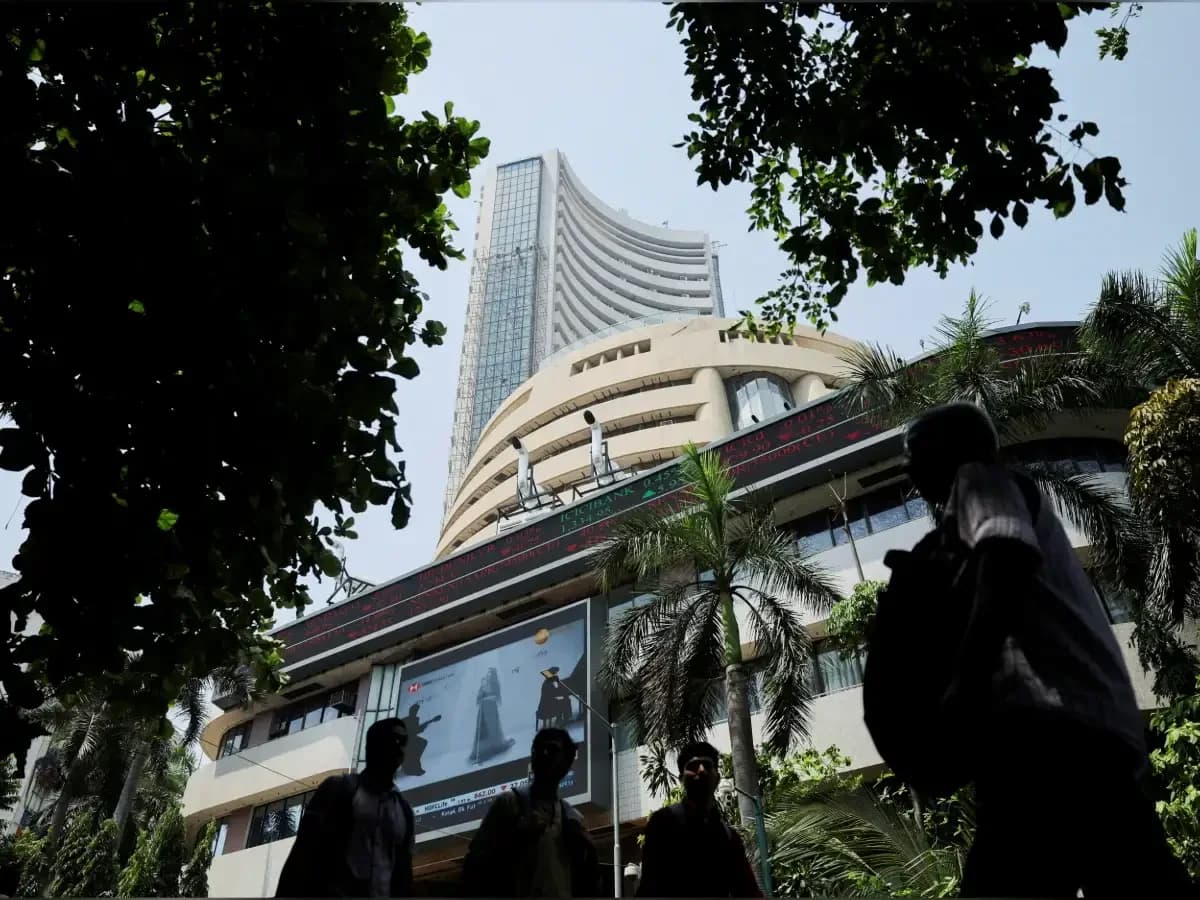
BSE Limited enters the Nifty 50 index today, replacing Wipro in a move that brings estimated passive inflows of $657 million according to Axis Capital. This inclusion follows BSE's six-month average free-float market capitalization of ₹1,40,879 crore, which is 2.5 times Wipro's ₹55,930 crore. The significant free-float advantage—BSE has 100% free-float versus Wipro's 27%—translates to a higher index weight and consequently larger passive fund allocations. Index funds tracking the Nifty 50 must purchase BSE shares according to its assigned weight, creating compulsory demand irrespective of individual fund managers' views on valuation.
However, the inclusion comes at a challenging time. BSE shares have fallen more than 30% from their May peak of ₹4,447 to around ₹3,200, suggesting much of the passive inflow impact may already be priced in. The stock experienced a classic "buy the rumor, sell the news" reaction, rising over 4% on August 10 when the inclusion was widely expected but declining 1.5% after the official announcement on August 11. While the Nifty 50 entry improves visibility and creates institutional ownership, it does not directly increase BSE's revenue, profit, or cash flow. After the rebalancing is completed, the share price will again depend more heavily on earnings growth, market share, and valuation.
Macquarie's Growth Projections
Macquarie projects 16% revenue CAGR for BSE over FY26-30, supported by India's capital markets growing at 12% CAGR in total addressable market. This growth is driven by rising household financial savings—Indians save around ₹44.19 lakh crore annually, with nearly half held in cash and deposits—creating significant conversion opportunity to market-linked products. Demat accounts have increased sharply from 21 million in FY13 to around 225 million in FY26, indicating stronger retail participation.
BSE's historical performance validates these projections. The company delivered 59% revenue CAGR from FY24 to FY26, with Q1 FY27 revenue increasing 64% year-on-year to ₹1,566 crore. Macquarie expects margins to expand toward 70% through operating leverage—approximately 53% of BSE's operating expenses are directly correlated to transaction volumes, creating powerful margin expansion as volumes grow. The company has already demonstrated this leverage, with operating EBITDA margin expanding to 67% in Q4 FY26 from 51% in FY25. Transcripts +1
Regulatory Headwinds Converge
Despite the growth narrative, BSE faces significant regulatory challenges. The Closing Auction Session (CAS), introduced on August 3, 2026, has created trader confusion and disrupted expiry-day dynamics. During August 2026, BSE's options premium average daily turnover fell 22% compared with a 14% decline at NSE. Nuvama highlighted that BSE's index option premium volumes (ADPTV) of ₹18,100 crore are the lowest since January 2025. The CAS mechanism has undermined the predictability of option premium decay, weakening theta-harvesting strategies and dampening both buyer and seller interest.
RBI's bank guarantee norms present another challenge. Proprietary traders account for approximately 50% of BSE's notional turnover, and the new norms requiring 100% collateral and prohibiting bank funding for proprietary trading could impact 12-15% of daily turnover. The cost of funding for proprietary traders has increased from around 1% using bank guarantees to approximately 11% using commercial paper, making several trading strategies unviable. Analysts expect this could lead to 8-10% moderation in volumes.
The Securities Transaction Tax (STT) hike, effective April 1, 2026, increased futures trading costs by 150% (from 0.02% to 0.05%) and options costs by 50% (from 0.10% to 0.15%). While BSE showed resilience in April 2026—gaining 11 percentage points in F&O market share to reach 55%—the higher costs disproportionately affect high-frequency and low-margin traders. For retail participants, particularly those engaged in frequent trading, the math simply does not work after the STT hike, leading to a filtration where weaker hands gradually step out.
Market Share Saturation Concerns
Nuvama identifies BSE's contract share of 51.5% as already high, noting that incremental levers are exhausted and limiting upside from further market share gains. The brokerage cut its rating to Hold from Buy and slashed its target price to ₹3,240 from ₹4,090, citing three major headwinds converging in FY27. More critically, BSE's ADPTV share remains lower at around 36% due to a lower mix of non-expiry-day contribution. This 15.5 percentage point gap between contract share and ADPTV share is structural, resulting from higher concentration near expiry—approximately 70% of BSE's premium turnover is concentrated in 0DTE/1DTE (same-day and next-day expiry) compared with NSE's 50%.
This concentration constrains BSE's ability to capture additional derivatives market share because non-expiry day participation remains weak. Short-dated options typically have lower premiums than longer-dated contracts, and the rapid time decay in 0DTE/1DTE contracts reduces premium value. While BSE has achieved impressive contract share gains through pricing advantages and weekly expiry volatility, the path forward requires shifting focus from contract share growth to ADPTV share improvement through non-expiry day development and institutional franchise building.
Divergent Analyst Views
The regulatory challenges have created sharp divergence in analyst views. Macquarie maintains an Outperform rating with a ₹4,000 target price, tagging BSE as a "Challenger" and expecting 16% revenue growth over FY26-30 with margins moving toward 70%. The brokerage sees BSE as a share gainer in a market with 12% total addressable market CAGR.
In contrast, Jefferies has an Underperform rating with a ₹2,940 target price, flagging risks to BSE's revenue from domestic proprietary traders who account for around 50% of notional turnover. Jefferies sees headwinds from the STT hike, RBI's bank guarantee norms, and CAS. Nuvama's downgrade reflects similar concerns, with EPS estimates cut by 6.3% for FY27 and 15% for FY28.
The fundamental difference in analysis lies in how brokerages weigh BSE's structural growth opportunities against near-term regulatory headwinds. Macquarie focuses on the long-term financialization story and BSE's ability to gain share in a growing market, while Jefferies and Nuvama emphasize the convergence of CAS, RBI norms, and STT headwinds that could moderate growth in FY27. Both sides acknowledge that after the initial passive inflows from Nifty 50 inclusion, BSE's performance will depend on navigating these regulatory challenges while maintaining its competitive position in India's evolving derivatives market.