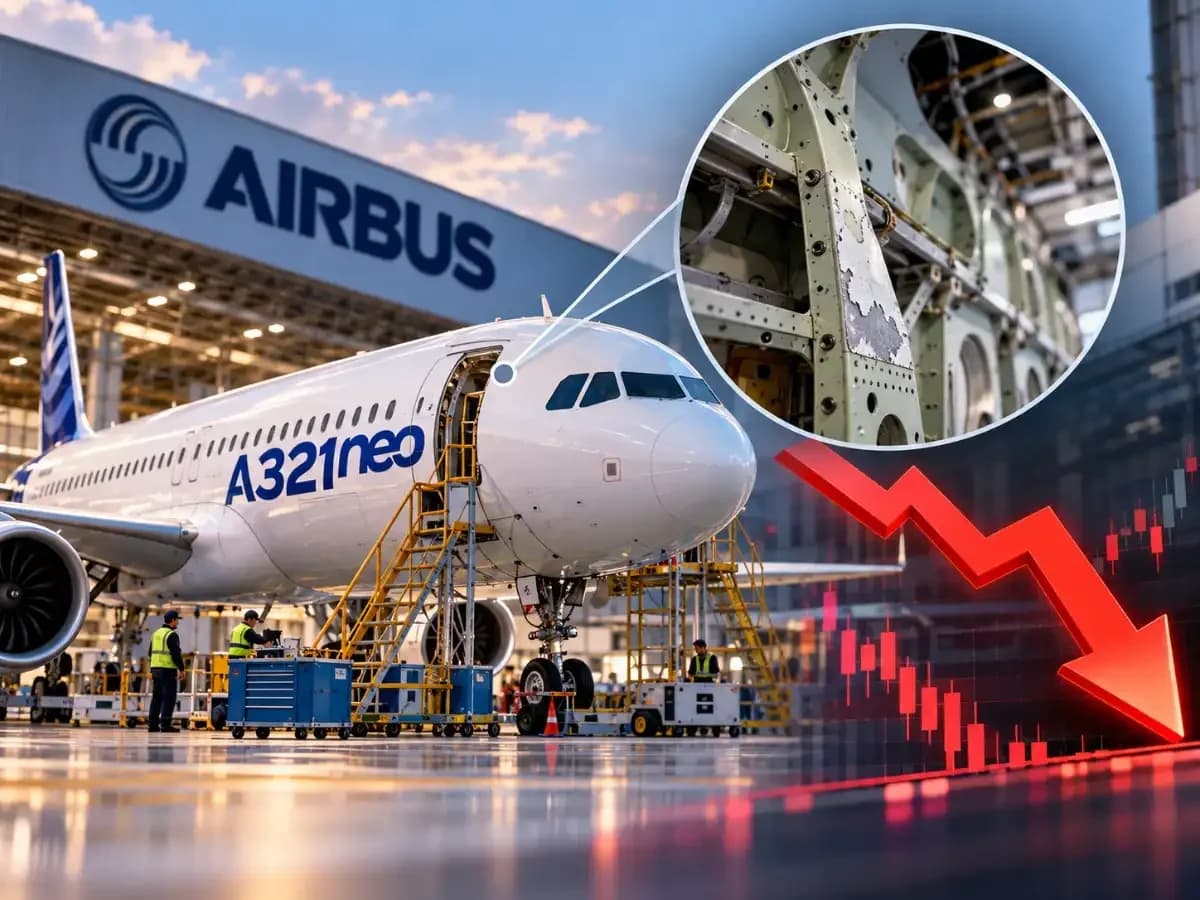
The problem traces back to a Tier 2 supplier—specifically TESI, a subcontractor to Italy's Leonardo. During production, an excessively thin layer of anti-corrosion primer was applied to stringers in the lower front section of the A321neo fuselage. Stringers are the longitudinal structural members that run along the fuselage, preventing the skin from buckling under load. The coating deviation reduces corrosion resistance, though Airbus emphasizes this is a quality issue, not a safety one, and aircraft can continue operating.
This delayed detection highlights a gap in Airbus's quality control framework for its supply chain, particularly at the Tier 2 level where direct oversight is more challenging.
Production Ramp-Up Pressures and Quality Risks
Airbus is aggressively ramping up narrow-body production from approximately 60 to 75 aircraft per month. This acceleration creates significant pressure on the entire supply chain to meet demanding delivery schedules. The A321neo defect marks the second fuselage-related quality issue in less than nine months, following December 2025 defects with fuselage panels from a Spanish supplier that caused several months of delivery delays.
The pattern suggests a correlation between production tempo and quality lapses. When a process drifts occurs at a Tier 2 supplier—whether it's a coating bath too cold, a coating applied too thinly, or inspections signed off too quickly—the error travels downstream inside parts that appear visually correct. By the time it's discovered, the defective components have proliferated across hundreds of aircraft. This creates a vicious cycle where production pressures may contribute to quality issues, and the resulting rework further strains production capacity precisely when Airbus needs it most.
Financial Impact: Share Price, Margins, and Revenue
The decline reflects investor concern about recurring quality issues and execution risk during a critical production ramp-up period. While the immediate reaction appears contained, the financial implications extend beyond the share price.
Warranty claims and repair costs will impact Airbus's margins. In 2024, Airbus paid €55 million in warranty claims across all programs and held €1.76 billion in warranty reserves. Historical precedents like the A380 wing crack issues, which cost over €200 million to repair, suggest structural quality issues can result in significant expenditures. For the A321neo defect, estimated costs range from €35-95 million across warranty claims, production rework, and customer concessions.
Revenue implications depend on delivery delays. Airbus maintains its 2026 delivery target of approximately 870 aircraft, having delivered 475 through August. However, rework on 250 in-production aircraft consumes capacity during the critical ramp-up phase.
More significant delays of 30-50 aircraft could defer €2.95 billion in revenue and reduce EBIT by €245 million, representing 3.3% of guidance.
IndiGo's Exposure and Operational Impact
This represents about 6.9% of its A321neo fleet. The airline also has 599 undelivered A321neos on order, making it highly exposed to any production delays.
Fortunately for IndiGo, the defect requires no immediate grounding. Aircraft can continue operating, and repairs will be completed during scheduled maintenance without requiring stringer disassembly. The rework must be completed within two years, providing flexibility to schedule repairs during routine maintenance windows. This minimizes operational disruption compared to the 2023-2024 Pratt & Whitney engine crisis that grounded 70-80 of IndiGo's aircraft.
However, IndiGo faces delivery schedule pressures. The airline is already experiencing delays for 9 A321XLRs due to Middle East conflict-related supply chain disruptions, which forced temporary suspension of six international routes. Additional A321neo quality-related delays could compound these challenges, particularly as IndiGo pursues its "FY26: Year of Internationalisation" strategy relying on A321neo/XLR aircraft for deeper European penetration.
Regulatory Scrutiny and Reputational Risks
Airbus's assertion that the defect poses no safety risk has significantly influenced the initial regulatory response. As of the latest reporting, no airworthiness directive has been issued by EASA or the FAA, contrasting sharply with safety-critical issues that typically trigger immediate regulatory action. However, European regulators may issue a directive requiring repairs within a certain period as they complete their technical assessment.
The reputational risk is elevated due to the pattern of quality issues. This is the second fuselage-related problem in nine months, raising questions about systemic quality control failures.
Customer confidence remains intact but could erode if issues recur. Airlines are continuing to take deliveries without insisting on advance repairs, and some are receiving concessions related to future maintenance. However, major operators like IndiGo, with 175 A321neos and 599 on order, have significant leverage. Repeated quality issues could prompt reconsideration of fleet strategies, particularly as Boeing's 737 MAX production recovers.
The Path Forward
Airbus has identified and contained the source of the problem, and a remedy is available. The company maintains its full-year delivery guidance, and the defect does not affect the longer-range A321XLR variant. However, the pressure falls on medium-term output as rework consumes capacity on A320-family lines during the ramp-up toward 75 aircraft per month.
The coming months will be critical in determining whether this defect represents an isolated quality lapse or the beginning of a more systemic challenge. For Airbus, the priority is clear: strengthen Tier 2 supplier oversight, maintain delivery momentum, and prevent recurrence. For customers like IndiGo, the focus is on integrating repairs into maintenance schedules while managing delivery expectations. For investors, the watchword is execution—can Airbus ramp production without compromising quality? The answer will define the next chapter of the A321neo program's success story.