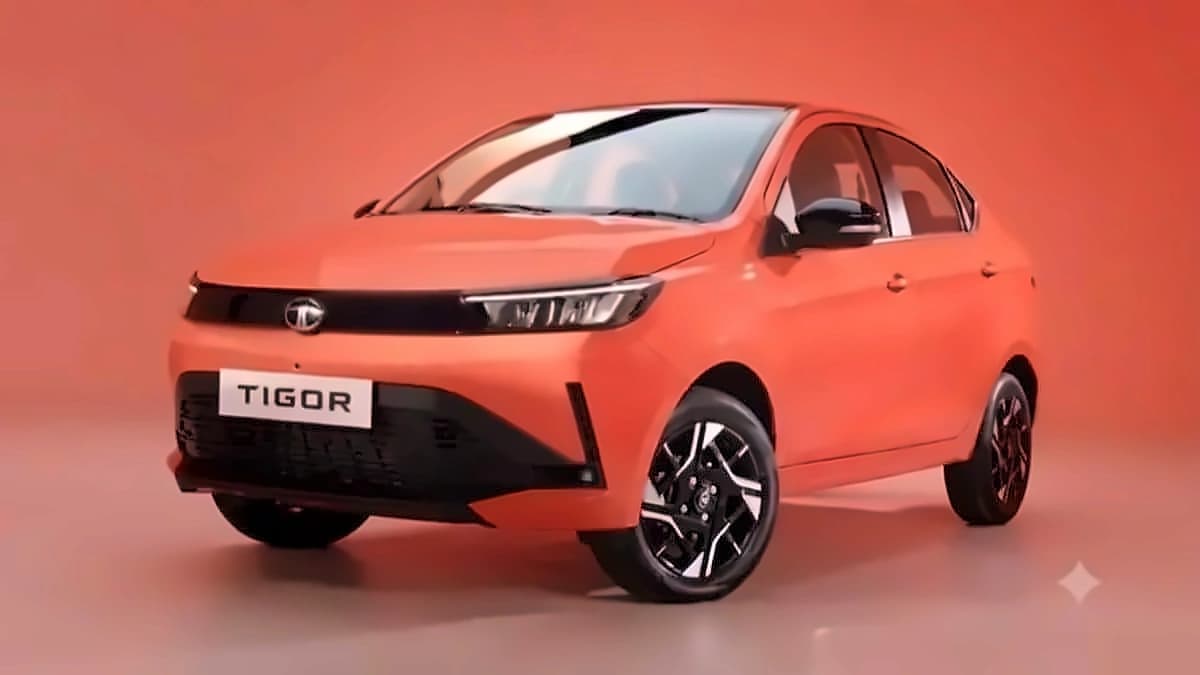
Tata Motors has patented the design of the upcoming Tigor facelift in India, confirming that the updated compact sedan will borrow several design elements from the recently launched Tiago facelift. The new Tigor facelift is expected to share LED headlamps, body-coloured bumpers, dual-tone roof options, redesigned tail lamps, and updated alloy wheels with its hatchback sibling. The latest design patent images reveal a sleeker fascia with slimmer headlights and a connecting bar at the centre, which could have a gloss black finish similar to the Tata Tiago. The bumper design appears cleaner, houses larger air vents, and features pixel-style LED fog lamp housings. In profile, the alloy wheel design is also fresh, but the wheel sizes are expected to be the same 15 inches. The design patent images also reveal a notchback-style tapering roofline, with the rear styling featuring tail-lights connected by a plastic trim, a simpler rear bumper with reflectors on both sides, and a housing for the reversing lamp at the centre. The Tigor EV is expected to have a similar design to the ICE version, albeit with EV-specific changes including a blanked-off grille, a different set of wheels and revised bumpers. Tata is also expected to introduce new exterior paint options for the facelifted Tigor, featuring the brand's latest colour-naming strategy, which could share a few shades with the Tiago.
The new Tigor facelift will offer a significantly enhanced interior experience with a larger floating touchscreen infotainment system, a fully digital instrument cluster, a redesigned steering wheel, touch-sensitive climate controls, wireless charging pads, and faster USB Type-C charging ports. Inside the cabin, the facelifted Tigor is expected to sport a new interior theme along with a tweaked dashboard layout. Feature-wise, one can expect updates like a larger touchscreen infotainment system and a fully digital instrument cluster - both equipped as freestanding units as seen in the new Tiago. It is also likely to get a wireless phone charger. Other existing features like auto AC, cruise control, push-button start/stop, electrically adjustable ORVMs, and wireless Android Auto and Apple CarPlay will be retained. The features list will remain largely unchanged from the Tiago facelift, which includes a 360-degree camera, rear AC vents, new infotainment system, and fast charging ports. The cabin is expected to feature wireless Android Auto and Apple CarPlay, wireless phone charging, auto-folding ORVMs, and Type-C charging ports across variants. Safety equipment could see an upgrade, with six airbags likely to be offered as standard across the range, similar to recent Tata launches. The interior will also feature rain-sensing wipers, twin wireless chargers, and automatic climate control as premium features.
The new Tigor will offer the same engine options as the Tiago, including a 1.2L petrol engine with CNG availability as an option. According to reports, both manual and AMT transmissions will be available, with the CNG variant featuring twin cylinder technology. The CNG variant is likely to continue with an AMT gearbox and steering-mounted paddle shifters for improved convenience. The 1.2-litre naturally aspirated petrol engine produces 86 PS, while the CNG version generates around 75.5 PS. Reports suggest Tata could introduce paddle shifters with AMT-equipped variants, a feature recently seen on some of its updated models. This engine lineup will provide customers with multiple fuel and transmission choices to suit their driving preferences and budget requirements. The Tigor is built on the same platform as the Tiago, ensuring continuity in engine and gearbox options.
The Tigor EV will receive the same treatment as the Tiago EV, with the launch planned for this financial year. The 2026 Tigor EV is expected to borrow the Tiago EV's battery and electric motors, including a 19.2kWh option paired with a 61hp motor, and a larger 24kWh battery with a 75hp motor. The Tigor EV could see improved charging times compared to the current model. The claimed range could differ from the Tiago EV's 226km to 285km, owing to the different body style. The Tigor EV could additionally feature an IP67-rated battery pack and an extended warranty package. The updated Tigor and Tigor EV are expected to carry a slight premium over the outgoing models. Currently, the Tigor starts at ₹5.55 lakh to ₹8.84 lakh for ICE variants, while the Tigor EV is priced from ₹12.49 lakh to ₹13.75 lakh. Like the Punch EV and Tiago EV, Tata Motors could offer the Tigor EV with a battery-as-a-subscription (BaaS) scheme for a lower upfront price, providing more affordable access to electric mobility.
The Tata Tigor facelift is expected to debut during the festive season later this year, though Tata Motors has not announced an official launch date. Tata Motors announced in May 2025 that it will launch four facelifts in FY27 (until March 2026), two of which were the ICE and EV versions of the Tiago. The 2026 Tigor and Tigor EV will be the other two models to get a facelift this fiscal year. The updated model is shaping up to be a meaningful upgrade, blending modern design elements with improved features and technology. With Tata Motors focusing on refinement and value, the updated sedan could appeal to both new buyers and existing customers. Its expected enhancements may help it stay competitive in an evolving compact sedan market, positioning it well against established rivals in the segment. The Tigor is Tata's sub-4-metre compact sedan, sold alongside the Tiago hatchback, and is offered in petrol, CNG, and electric variants. The facelift could help Tata Motors attract buyers looking for a practical and value-focused sedan alternative, with pricing expected to see a slight revision over the current model which is currently positioned as one of the most affordable sedans in India. The facelifted version is expected to start from ₹6 lakh (ex-showroom), representing a slight increase from the current pricing range.