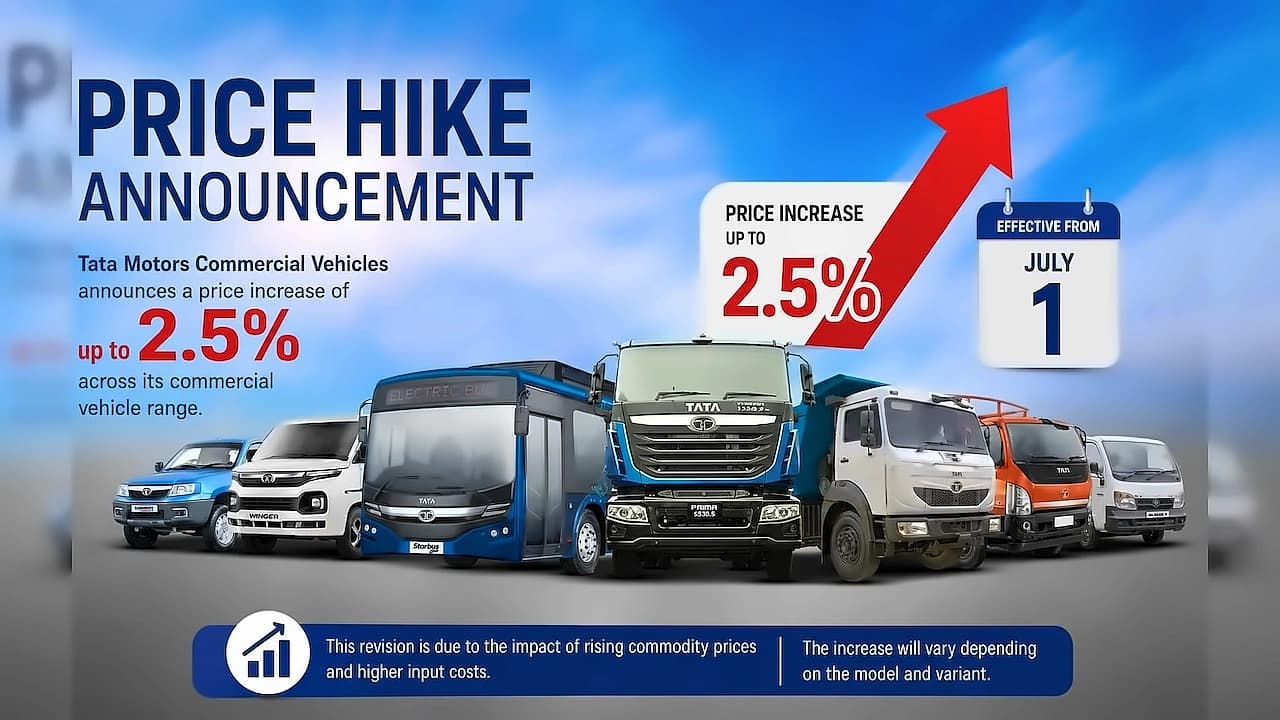
Tata Motors Commercial Vehicles announced a 2.5% price increase across its commercial vehicle range, effective from Wednesday, July 1, 2026. According to the company's exchange filing on Thursday, June 18, 2026, the hike will vary depending on the model and variant. The automaker cited the impact of rising commodity prices and higher input costs as the primary reason for the price revision. This marks the second price increase in FY27 for the CV business, following an earlier 1.5% hike announced in April 2026. As per Business Standard, the price increase is being undertaken to partially offset the impact of rising commodity prices and other input costs. In a significant development, Tata Motors has also joined the government's truck and bus replacement scheme for Delhi-NCR, providing an 8% discount on ex-showroom prices of eligible vehicles purchased under the scheme.
The government's truck and bus replacement scheme for Delhi-NCR has been significantly expanded with Tata Motors joining Ashok Leyland and Switch Mobility, bringing the combined market share of participating companies to around 50% in trucks and buses. Under the Memorandum of Understanding (MoU) signed between the Ministry of Road Transport and Highways and Tata Motors, the automaker will provide an 8% discount on the ex-showroom price of eligible trucks and buses purchased under the scheme. For electric vehicles, the discount shall be equal to the amount applicable to an Internal Combustion Engine (ICE) vehicle of the equivalent Gross Vehicle Weight (GVW) category. The central government will provide 5% interest subvention and fixed monthly fuel vouchers for five years, while participating state governments will offer up to 100% concession on motor vehicle tax for ten years and waiver of registration fees for eligible beneficiaries. This partnership aligns with the government's ₹9,585 crore scheme to support replacement of ageing vehicles with cleaner alternatives. According to government estimates, around 2.07 lakh vehicle owners, including nearly 1.91 lakh trucks and 16,329 buses, are expected to benefit from the programme. The initiative seeks to encourage owners of trucks and buses registered in Delhi-NCR and complying with Bharat Stage-IV (BS-IV) or earlier emission norms to replace them with BS-VI or stricter emission-compliant vehicles, or electric vehicles.
The latest price hike announcement comes after Tata Motors reported a 17% year-on-year increase in total commercial vehicle sales to 32,850 units in May 2026, compared with 28,075 units in the corresponding month last year. Domestic commercial vehicle sales rose 19% to 30,784 units in May 2026 from 25,872 units a year earlier, while international commercial vehicle sales declined 9% year-on-year to 2,066 units. Within key segments, heavy commercial vehicle (HCV) trucks increased 11% to 7,877 units in May, up from 7,106 units in the year-ago period. The passenger carrier segment also posted strong growth, with sales surging 21% to 5,757 units compared with 4,748 units in May 2025. Domestic sales of medium and heavy intermediate commercial vehicles (MH&ICV) stood at 13,679 units in May 2026, marking a 10% increase from 12,406 units in the same month last year.
The price increase at Tata Motors reflects a broader industry trend as automobile manufacturers have increasingly resorted to calibrated price hikes in recent months to protect margins amid fluctuations in raw material prices and higher operational expenses. Earlier this month, Tata Motors Passenger Vehicles (TMPV) announced a price increase of up to 1.5% across its passenger vehicle portfolio, including internal combustion engine (ICE) and electric vehicle (EV) models, effective next month. Similarly, Hyundai Motor India announced a price increase of up to ₹12,800 across its model range, citing higher commodity prices, rising input costs and elevated operating expenses. Maruti Suzuki India revised prices across several models earlier this year to mitigate the impact of rising production costs. The selective implementation strategy across different vehicle segments and applications ensures the price increase applies across the company's portfolio of trucks, buses, pick-ups and utility vehicles, with the increase varying by model, segment and application requirements.
Tata Motors shares were trading at ₹402.05, down 1.26% from the previous close at around 12 pm on Thursday, despite the company's positive developments. However, the stock has gained 2.75% over the past week, though it remains down 5.72% year-to-date (YTD). The price movement reflects broader market sentiment rather than company-specific developments, as the stock has been impacted by broader market conditions. The latest price hike announcement and participation in the Delhi-NCR replacement scheme are expected to support long-term demand prospects for the commercial vehicle segment, despite short-term market volatility.