Tata Motors CV shares rallied as much as 5.73% to ₹435 apiece on Thursday, June 25, following an optimistic outlook by CEO Girish Wagh. The CEO termed fuel price hikes and increases in commodity costs as 'cyclical headwinds' that will lead to some changes in quarterly and annual demand, but emphasized that 'India's growth story will lead to an increase in road freight, and therefore the commercial vehicle demand'. Wagh noted that 'the Middle East crisis, the resultant increase in oil prices, and the final resultant but reduced intensity increase in diesel prices -- it is a headwind', but believes these are more cyclical in nature. The company is implementing a price hike of up to 2.5% across its commercial vehicle range from July 1, 2026 to partially offset rising commodity costs.
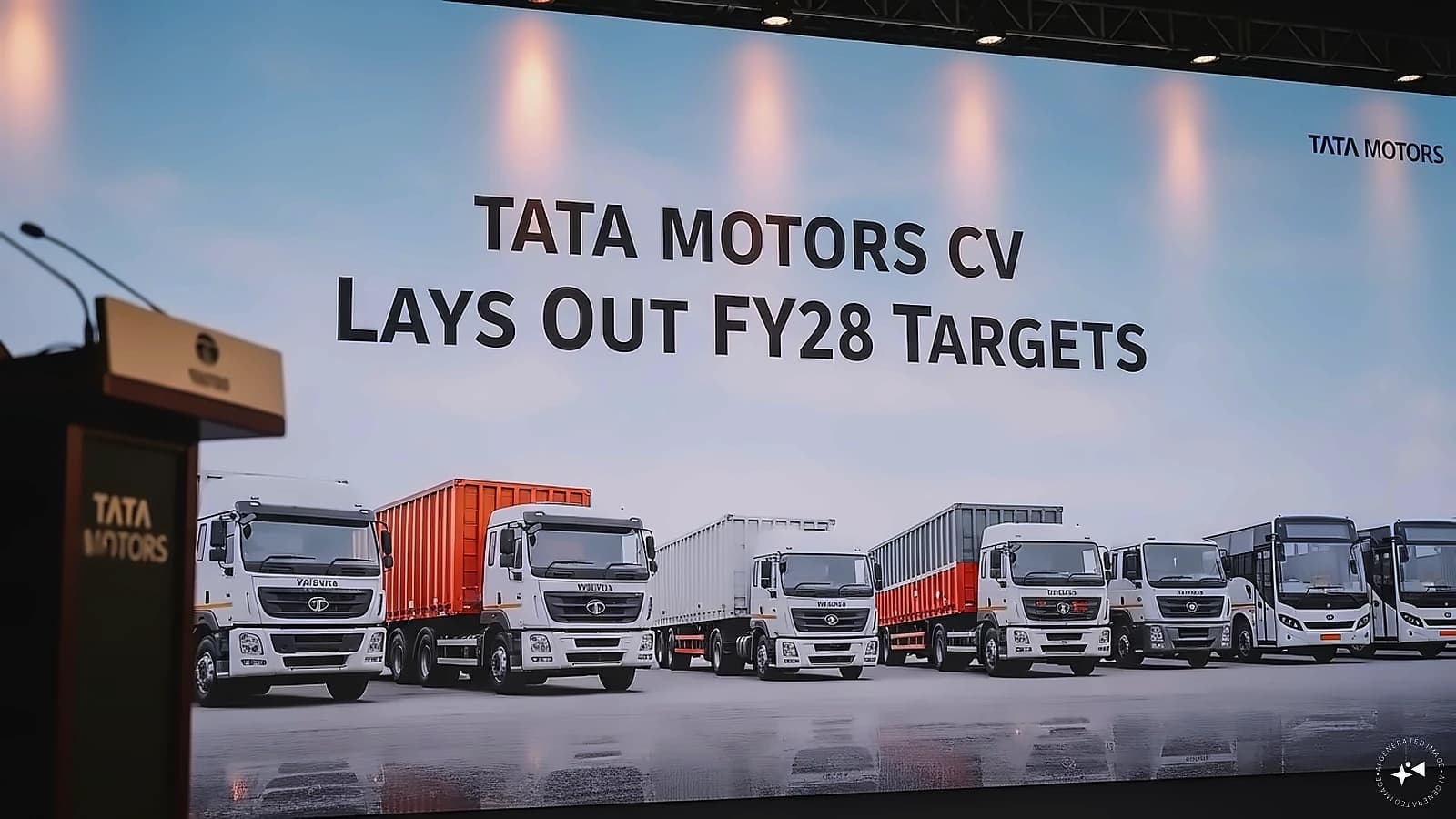
According to CNBC TV18, Tata Motors CV has outlined an ambitious growth roadmap targeting a stronger global position by FY28, aiming to become the fourth largest global commercial vehicle player by FY28. The company is leveraging expanded capabilities and international reach post the Iveco deal, with the integration expected to drive significant operational synergies. CLSA raised its market-share target for Tata Motors' CV business to 40% from 36% earlier, while expecting the company to sustain double-digit EBITDA margins through the cycle. On the domestic front, Tata Motors is targeting a 40% market share in India's commercial vehicle segment by FY28, reinforcing its leadership position in a market where it already holds a dominant presence. The Iveco acquisition remains on track for completion by the second quarter of FY27, with most regulatory approvals already in place.
As reported by Business Standard, Tata Motors CV delivered its strongest-ever financial performance in FY26, with revenue reaching ₹77,399 crore and EBITDA margin improving to 13.2% from 12% in FY25. The company achieved free cash flow of ₹9,186 crore, equivalent to about 12% of revenue, while net cash rose to ₹7,500 crore. Return on capital employed reached 72%, demonstrating exceptional capital efficiency. The CV business is projecting improved efficiency and profitability over the next few years, targeting free cash flow between 7% to 9% of revenue and Return on Capital Employed of 30% to 35% after the Iveco deal completion. The company expects margins to remain in double digits throughout the business cycle, with potential to rise into the teens during favourable demand phases. CLSA expects domestic commercial vehicle industry volumes to grow in the high-single digits in FY27, supported by freight growth and fleet expansion.
According to Business Standard, Tata Motors CV is repositioning itself from a traditional truck manufacturer into a broader logistics and mobility platform, with digital businesses becoming increasingly important growth drivers. Non-cyclical businesses grew 1.6 times faster than the core cyclical business in FY26, supporting margins despite accounting for only 16% of FY26 revenue compared to 84% from the core commercial vehicle business. The company has created AIEQU Mobility as the umbrella entity for digital businesses, while Freight Tiger became a subsidiary in the first quarter of FY27. Digital platforms including Fleet Edge, Freight Tiger, and AIEQU Mobility are helping create an integrated logistics ecosystem that extends beyond vehicle sales, with the company describing its evolution as 'from products to platforms'. Management emphasized a demand-led approach anchored on retail market data and greater focus on value-based pricing, product mix optimisation and cash generation. CLSA believes non-cyclical businesses could grow 1.5 times faster than the core operations, helping reduce earnings volatility.
According to CNBC TV18, earlier this week, Tata Motors secured over 3,400 orders for electrical CVs across freight, logistics and passenger mobility segments. These include 2,000 small CVs and pick-ups, nearly 900 rucks and around 500 buses. The vehicles will be deployed across e-commerce, FMCG, logistics, mining, steel, cement operations and inter and intra-city passenger transport sectors. The company said over the past 12 months, it has significantly strengthened its electric commercial vehicle portfolio, introducing a new generation of eCVs tailored to varied duty cycles and operating conditions. This wide-ranging deployment reflects growing customer confidence in electric mobility solutions in real-world conditions and signals a decisive shift from pilot programmes to scaled, operational integration of EVs across use cases.
As reported by PTI, CEO Girish Wagh acknowledged that the West Asia war has had an impact on Tata Motors' international business and a bigger impact on the supply chain. The Middle East used to contribute about 20% of the company's total international business (monthly volumes), but in the first two months of the US-Iran war, it came to zero with no shipments or movement. However, starting from last month, the company has slowly started getting back there, with this month seeing vehicle shipments to the Middle East. Wagh noted that the company looked at alternate routes for reaching vehicles to the UAE despite being longer, circuitous, and higher cost, but 'because the Strait of Hormuz is open now, we don't have to do that'. The supply chain impact included reduced material availability for some time, mostly for commodities, and increased prices of commodities such as aluminum. All this has been managed now, with the production impact not being to a large extent, though the residual impact on commodity cost and inflation remains. The company has reassessed its supply chain network and started de-risking exercise, with Wagh stating 'So much of dependence on one route is something that we will de-risk'.