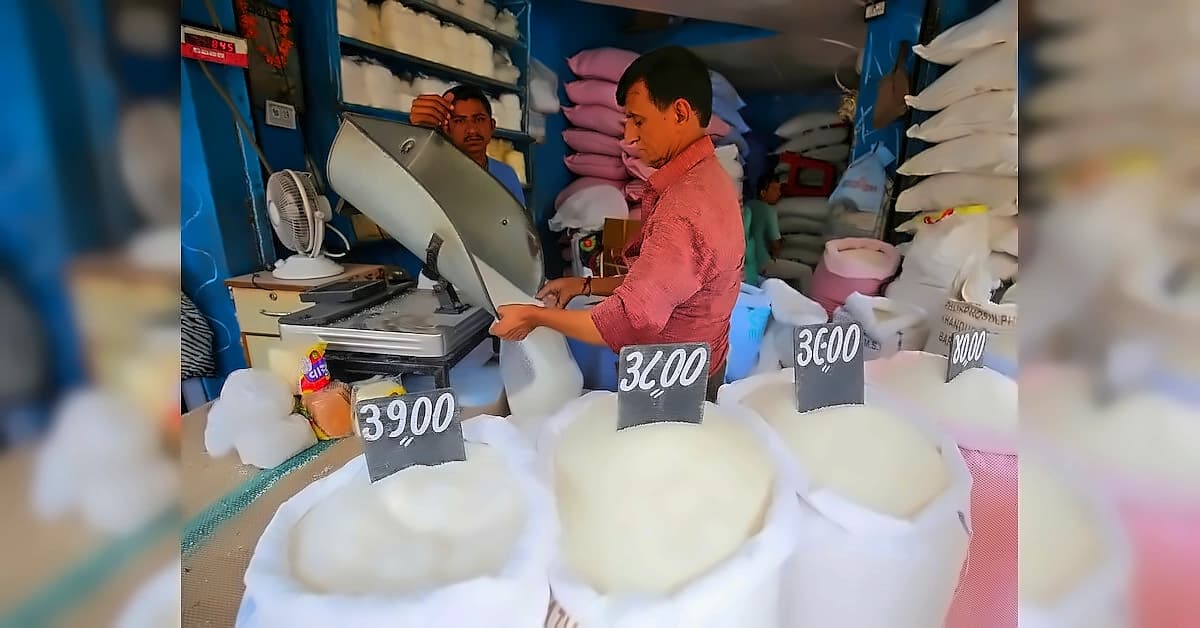
India has suspended sugar exports with immediate effect until September 30, 2026, marking a sharp policy reversal aimed at keeping domestic sugar prices in check as food inflation remains politically sensitive. According to government notification, India, the world's biggest sugar exporter after Brazil, had allowed mills to export 1.59 million metric tons, betting output would exceed domestic demand. However, industry projections now suggest India may produce less sugar than it consumes for the second consecutive season, largely due to lower sugarcane yields in key producing states. The export ban covers all forms of sugar exports, including raw, white and refined sugar, with the government clarifying that exemptions will be provided for shipments to the European Union and United States under CXL and TRQ quota as well as exports under the Advance Authorisation Scheme (AAS) and government-to-government shipments for food security purposes. Additionally, shipments can proceed if loading had started before the notification date, or if the shipping bill had already been filed and the vessel had berthed or anchored at an Indian port before the order came into effect. The timing has left traders in a difficult position, with roughly 800,000 tonnes of approved export quota already contracted to overseas buyers, of which more than 600,000 tonnes had already departed Indian ports before the sudden halt.

Sugar prices have rallied sharply to 1-week highs amid concerns about tighter global sugar supplies and supply disruptions from the ongoing closure of the Strait of Hormuz. According to Covrig Analytics, the closure of the strait has curbed approximately 6% of the world's sugar trade, constraining refined sugar output. July NY world sugar #11 (SBN26) is up +0.33 (+2.20%) and August London ICE white sugar #5 (SWQ26) is up +12.40 (+2.81%). On February 13, India's government approved an additional 500,000 MT of sugar for export for the 2025/26 season, on top of the 1.5 MMT approved in November. The USDA on Thursday said it expects a 2026/27 sugar surplus in India of 2.5 MMT, the first surplus in two years, while Covrig Analytics cut its 2026/27 global sugar surplus estimate to 800,000 MT from 1.4 MMT previously. Czarnikow also reduced its 2026/27 global sugar surplus estimate to 1.1 MMT from 3.4 MMT in February, and cut its 2025/26 surplus estimate to 5.8 MT from 8.3 MMT.
Major dairy players Amul and Mother Dairy have announced milk price hikes, citing rising procurement and operational costs. As reported by The Hindu BusinessLine, Amul has increased prices across India with Mother Dairy revising rates for the National Capital Region (NCR). The revision translates into an increase of around 2.5–3.5 per cent, coming after nearly a year without any consumer price hike since May 2025. Key price changes include Amul Gold 500 ml increasing from ₹34 to ₹35, Amul T Special 1 litre rising from ₹63 to ₹66, and Amul Taaza 500 ml moving from ₹28 to ₹29. Following the announcement, Mother Dairy has also implemented a ₹2 per litre increase across all milk variants effective May 14. The new rates have become effective from May 14 for full cream milk, toned milk, cow milk, buffalo milk and premium variants.
Within just two days, the government has implemented three significant economic decisions—raising import duty on gold and silver, increasing milk prices, and banning sugar exports till September. According to economists and industry analysts, these moves reflect a broader government strategy focused on conserving resources, managing inflation and preparing for prolonged global uncertainty rather than treating the current crisis as temporary. The immediate objective is to stop domestic prices from rising sharply due to export-driven shortages, speculative trading or higher transportation costs linked to rising crude oil prices. Prime Minister Narendra Modi had already made a public appeal asking people to avoid buying gold for a year as the economy absorbs the strain of the Iran war and volatile global markets. The rupee has weakened sharply, hitting a record low of 95.75 against the US dollar, adding urgency to measures aimed at managing import demand and stabilising the currency. Veteran banker Uday Kotak warned at the CII Annual Business Summit 2026 that "The shock is coming, and it's big. India must prepare for serious economic fallout if the West Asia crisis prolongs."
India's sugar production outlook remains challenging, with the 2025-26 season expected to produce around 275 lakh tonnes of sugar, running from October to September. Along with the opening stock of nearly 50 lakh tonnes, total sugar availability is expected to stand at about 325 lakh tonnes, while domestic demand is projected at around 280 lakh tonnes, leaving closing stocks at roughly 45 lakh tonnes. That would mark the lowest stock level since 2016-17, when inventories had fallen to nearly 39.4 lakh tonnes. The government is also concerned about the next sugar season, with 2026-27 production likely to come under pressure due to weaker rainfall linked to El Niño and possible fertiliser shortages arising from the Middle East crisis. India's sugar export policy has undergone significant volatility over recent years, reflecting changing domestic supply dynamics. Exports rose steadily from 3.8 million tonnes in 2018-19 to a peak cap of 11 million tonnes in 2021-22, before being scaled down to 6 million tonnes in 2022-23, halted entirely in 2023-24, and then allowed in limited quantities in subsequent seasons.