National Aluminium Company Limited (Nalco) inaugurated an indigenous pilot plant for processing bituminous coal fly ash and recovering multiple value-added products at the Nalco Research and Technology Centre (NRTC) in Bhubaneswar. According to reports from UNI, the 50-kg-per-day capacity pilot plant has been designed and established by the Council of Scientific and Industrial Research–Institute of Minerals and Materials Technology (CSIR-IMMT) and KIIT, with support from Nalco, CSIR and the Ministry of Mines, Government of India. The facility is based on a jointly patented process developed by CSIR-IMMT and Nalco for the holistic utilisation of coal fly ash.
The fly ash processing pilot plant has been jointly designed by IMMT and KIIT with support from Nalco, the Council of Scientific and Industrial Research (CSIR) and the Ministry of Mines. As reported by Business Standard, the patented process enables recovery of multiple value-added products, including alumina, calcium silicate for ceramic applications, quartz residue with potential applications in glassmaking and an iron hydroxide residue enriched in REEs. Alumina serves as the principal feedstock for aluminium production and an important industrial raw material. The facility is expected to generate adequate quantities of REE concentrate to support further research and development on mixed REE recovery and separation, facilitating the development of downstream value-added products.
According to Business Standard, rare earth elements have emerged as critical inputs for strategic and high-technology sectors including permanent magnets, electric mobility, renewable energy, electronics and defence. Recovering such materials from secondary resources can enhance resource efficiency, supplement primary sources and unlock additional value from industrial residues. The recovery of alumina and other valuable materials from industrial residues can improve resource efficiency, supplement primary sources and unlock additional value from waste streams. If successfully validated at pilot scale, the technology could provide a pathway for recovering multiple valuable materials from bauxite residue while reducing dependence on conventional primary resources.
Brijendra Pratap Singh, Chairman and Managing Director of Nalco, who inaugurated the facility, emphasized that pilot-scale validation of indigenous technologies was an important step towards developing commercially viable solutions capable of strengthening resource efficiency, critical mineral security and the circular economy. As reported by UNI, Singh stated that the company was committed to leveraging research, innovation and strategic partnerships to transform industrial residues into valuable resources. He noted that through sustained research and development, strategic collaborations with premier national research institutions and pilot-scale validation of emerging technologies, Nalco was working towards integrated resource-recovery pathways aligned with national priorities in critical mineral security, circular economy and sustainable industrial development.
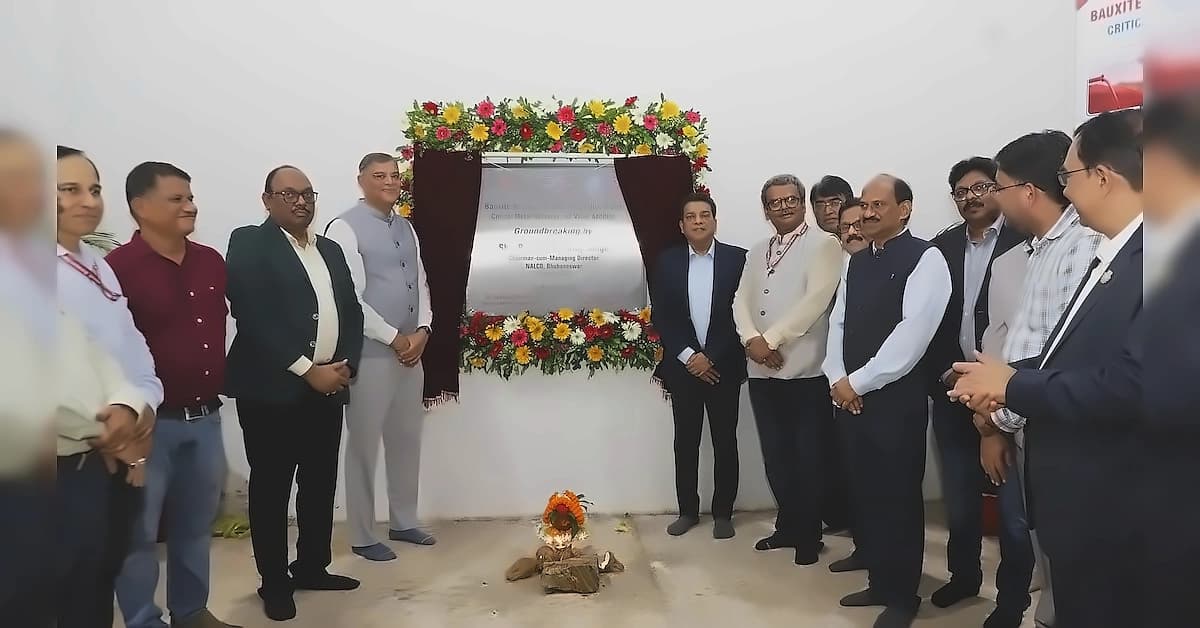
According to Business Standard, the initiative aligns with national priorities on critical mineral security, circular economy and sustainable industrial development. Singh noted that Nalco is working towards integrated resource-recovery pathways through sustained R&D, strategic collaborations with premier national research institutions and pilot-scale validation of emerging technologies. The ground-breaking ceremony for the red mud valorisation facility was also held on the occasion, with the proposed facility focusing on recovering ferro-titanium alloy, metallic iron and rare earth elements from red mud. The initiatives underscore Nalco's commitment to sustainable, innovative and technology-driven industrial development.