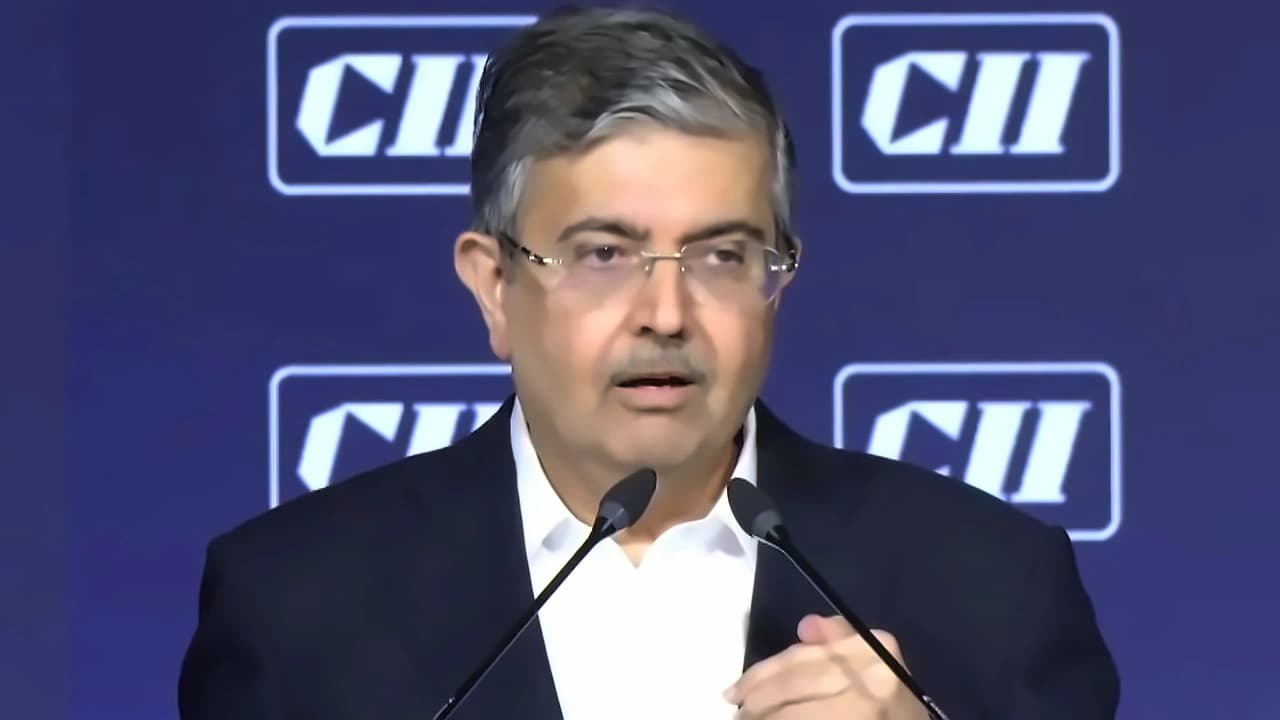
Speaking at the CII Annual Business Summit 2026, Kotak Mahindra Bank founder Uday Kotak warned that India has not yet fully experienced the impact of the recent surge in global energy prices triggered by tensions in the Middle East. According to PTI, Kotak said 'We have not seen the impact in the last two months of the Middle East war in terms of energy price transmission. It's coming, and it's coming big, and consumers have not felt the pressure at all.' He emphasized that 'I would like India to assume we will be in rough weather and prepare to do very well in rough weather. Men and women and strength are not built in good weather.' Explaining the likely impact on households, Kotak noted that consumers with limited incomes would face a double blow as fuel costs rise directly and also push up prices of other goods dependent on transportation and energy inputs. He warned that the transmission of higher oil prices into the domestic economy was inevitable and that the situation could improve only if geopolitical tensions ease quickly. As reported by Rediff Moneynews, Kotak described the current global environment as becoming increasingly fragmented as countries prioritize their own strategic and economic interests, making it critical for India to strengthen domestic sources of capital and production.
Kotak Mahindra Bank founder Uday Kotak emphasized the need for India to reduce its dependence on foreign capital and establish stronger domestic sources of long-term risk capital. Speaking at the CII Annual Business Summit 2026, Kotak defined a truly 'Aatmanirbhar' nation as one that 'does not need to depend on somebody else's money or power' as quoted by PTI. Calling it a 'provocative' statement for a finance professional, Kotak said 'India has financialised too early.' According to Kotak, the world is becoming increasingly fragmented as countries prioritize their own strategic and economic interests, making it critical for India to strengthen domestic sources of capital and production. As reported by Rediff Moneynews, Kotak noted that India had relied heavily on foreign portfolio investment (FPIs) for many years and only after the pandemic did domestic investors begin to play a larger role in capital markets.
Kotak highlighted the growing role of domestic investors in India's economy, contrasting it dramatically with foreign capital flows. According to PTI, Kotak revealed that while foreign investors have invested roughly ₹1.5 trillion, domestic investors including retail participants and insurance companies have invested nearly ₹80 trillion into the economy. In a strong endorsement of India's retail investing boom, Kotak described systematic investment plans (SIPs) and mutual funds as the country's most important macroeconomic stabilisers. 'The most important macroeconomist of India today is not what any of us think he is. The most important macroeconomist of India today is Mr Rohit Sharma — mutual funds sahi hai,' he remarked. Kotak said India had historically depended excessively on foreign equity capital but mutual funds had helped channel domestic household savings into equities, creating a more stable pool of risk capital.
Kotak criticized companies for becoming excessively focused on quarterly earnings, stock movements and ESOP gains rather than building businesses with a longer-term vision. According to PTI, he urged companies to 'not be excessively focused on the short-term stock price... but think about building a company three to five years.' As reported by Rediff Moneynews, Kotak said 'Corporate India has got a phenomenal tax rate. What have you done with it? Are we reinvesting or running corporate treasuries?' He urged companies to reinvest profits rather than simply managing large treasury portfolios, representing a fundamental shift in corporate strategy away from short-term market pressures toward sustainable, long-term business development. At the same summit, Bharti Enterprises founder Sunil Bharti Mittal echoed similar concerns, stating there is a need to invest more in the country and move faster towards renewable energy, while calling for the industry to follow Modi's call by lowering energy costs and reducing gold imports.
During the summit discussion, Kotak called for greater debate on the role and efficiency of state-owned enterprises, citing examples from China and Singapore, where several globally competitive firms remain state-controlled. 'State-owned enterprises are not necessarily the wrong thing,' he said, pointing to India's digital public infrastructure such as Unique Identification Authority of India's Aadhaar as an example of successful public-sector-led innovation. He also advocated a gradual opening up of pension and insurance funds towards private equity and venture capital investments, arguing that India needs deeper pools of long-term domestic capital to support innovation and entrepreneurship. Kotak suggested that pension funds and insurance companies, which are accumulating large pools of household savings, should gradually be allowed to allocate more money to private markets in a regulated manner with adequate safeguards. Meanwhile, government think tank NITI Aayog has advised the Centre to halt all major construction works across India for two years, including the demolition and reconstruction of the Nirman Bhavan, Udyog Bhavan and Shastri Bhavan ministerial complexes.