Former HDFC chairman Deepak Parekh emphasized that India's future growth will depend on the quality of governance in public and private sector institutions, stating that 'the premium on good governance, transparency, and abiding by the spirit of law is non-negotiable'. Speaking at the 118th Annual General Meeting of the IMC Chamber of Commerce and Industry, Parekh highlighted that there is a need to take a call on how to expedite pending judicial cases, add that land acquisition needs to be simplified and taxation regimes need better clarity and consistency. He noted that the government has demonstrated its commitment to staying on the reform express, having implemented taxation reforms and ease of doing business reforms. The former chairman stressed that reforms that the country is seeing today will lay the foundation for India's future growth, with the financial sector being very heavily involved in resilience today.
Parekh reiterated the critical need for banking sector reforms during India's current strong financial position. Speaking at the 118th Annual General Meeting of the IMC Chamber of Commerce and Industry, Parekh stated that 'India's banking sector needs new reforms and the time to do this is when the sun is shining or when the banks are at their strongest'. He emphasized that 'we have been advocating that India needs a few large banks rather than many small banks. The public sector banks have already consolidated, but there is a case for further consolidation. The government has announced this and is working toward this momentum'. Recent data shows gross non-performing loans of banks at under 2 per cent, representing a multi-decade low, while manufacturing capacity utilisation at 75.6 per cent currently reflects an expansion mode, supported by growth in new orders and stable inventory levels. Parekh noted that capital buffers are adequate and India's macroeconomic fundamentals remained structurally intact despite external geopolitical uncertainty.
Parekh called for raising foreign direct investment limits in both public and private sector banks to bring in additional capital. On the debt market front, he advocated for a stronger domestic bond market, stating that 'India needs to move out of its legacy policy frameworks' to support the country's investment needs. He highlighted that corporate bond markets need significant expansion, requiring them to double from 18 per cent of GDP currently to meet India's investment requirements. The former chairman also welcomed the government's recent decision to exempt interest and capital gains tax on government securities held by foreign investors. He emphasized the need for bold measures like adopting cross border securitisation transactions, having deeper credit default swap markets, more credit enhancement mechanisms, a thriving municipal bonds market and of course, the need for a more diversified investor base. Parekh stressed that India must move beyond legacy policy frameworks to support its long-term growth ambitions.
Despite foreign portfolio investors being relentless sellers over the past one-and-a-half years of nearly $50 billion, Parekh described this as a temporary phase. He noted that domestic institutional investors, particularly systematic investment plan (SIP) inflows into mutual funds of around ₹30,000 crore every month, had helped keep Indian equity markets resilient. Parekh highlighted that India's diversified market capitalisation, with its market capitalisation well diversified rather than dependent on two to three key stocks, as seen in some emerging markets like Taiwan and South Korea, supports long-term confidence. He concluded that 'We just have to ride out this current phase' and noted that the IPO pipeline is strong and India has demonstrated easy entry and exit for investors with attractive returns, building long-term confidence in the market. The ongoing global reallocation of capital driven by artificial intelligence and geopolitical developments has resulted in sustained foreign selling, but Parekh emphasized this represents a temporary phase.
Addressing India's broader financial architecture, Parekh noted that the funding needs are immense and India will need to rely on both domestic and more foreign capital to fund its future growth. He emphasized that India remained on track to become the world's third-largest economy, with rising per capita incomes creating a virtuous cycle of higher consumption, investment, and wealth creation. With India having set an ambitious target of becoming a $30 trillion economy by 2047, requiring the economy to expand seven to eight times over the next two decades, Parekh stressed that foreign capital flows are increasingly linked to the evolving geopolitical environment. He concluded that 'geopolitics is the new macro-economics' and that India's manufacturing, technology, and research and development increasingly shifting towards indigenisation would require immense funding requirements. The funding requirements would be immense as manufacturing, technology, and research and development increasingly shift towards indigenisation.
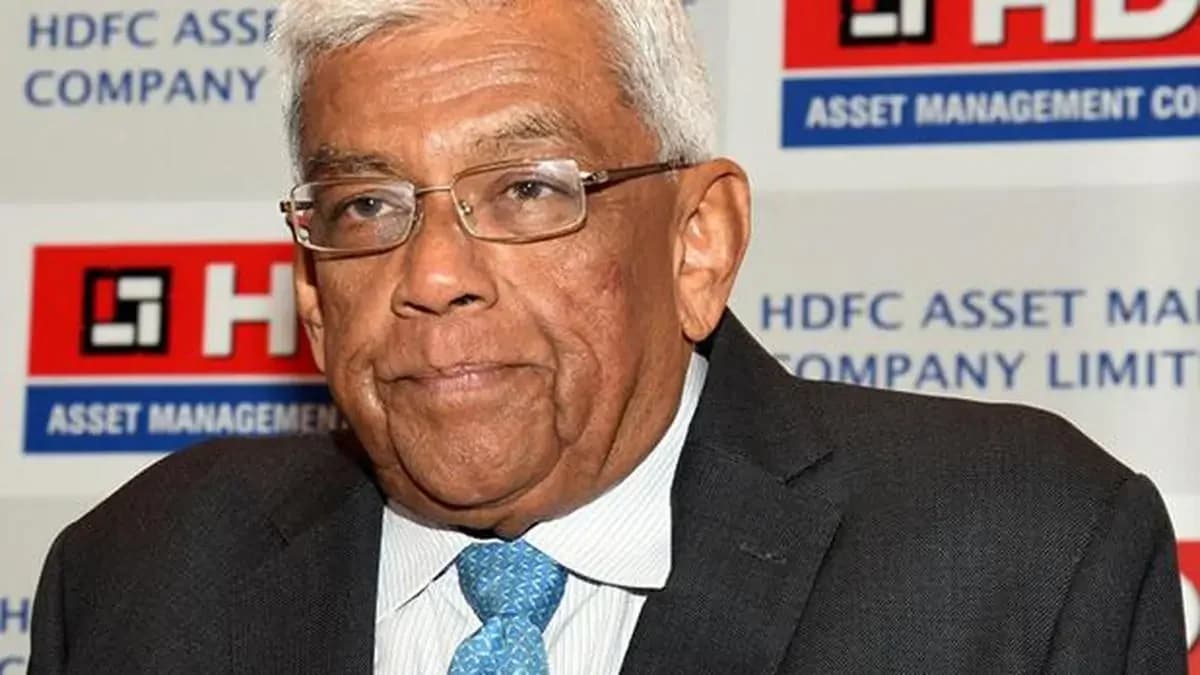
Parekh highlighted that the MSME segment, which accounts for a third of India's GDP, has the potential to unlock significant growth but remains most vulnerable to economic shocks. He emphasized that building in these projections is imperative for businesses to thrive and to attract investors. Looking ahead, Parekh stressed that India would also need to create jobs at a much faster pace while embracing artificial intelligence. He concluded that 'geopolitics is the new macro-economics' and that India's manufacturing, technology, and research and development increasingly shifting towards indigenisation would require immense funding requirements. The former chairman stressed the need for India to move beyond legacy policy frameworks and develop deeper credit default swap markets, expand credit enhancement mechanisms, build a thriving municipal bond market, and diversify its investor base to support long-term economic growth.