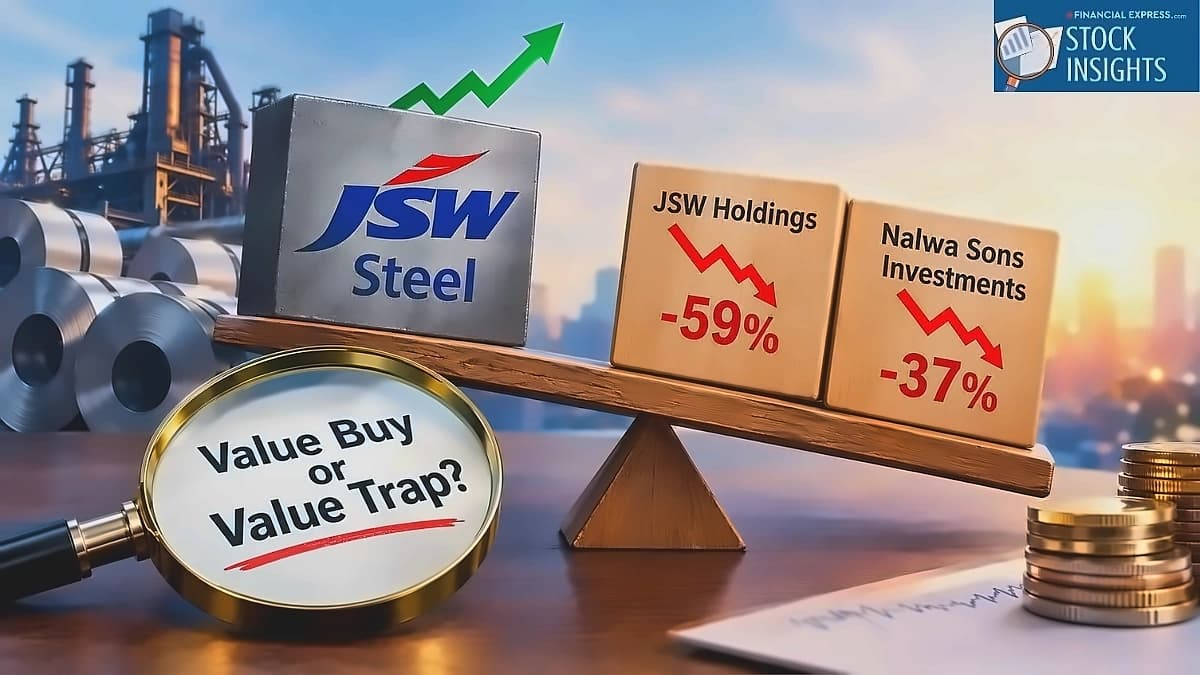
JSW Steel is trading at ₹1,280 on September 21, 2026, not far from its 52-week high of ₹1,351, according to The Financial Express. However, two debt-free investment companies of the O.P. Jindal family that own significant stakes in the steelmaker have experienced dramatic declines. JSW Holdings is down 59% from its record high of ₹27,740 reached in April 2025, while Nalwa Sons Investments has fallen 37% from its November 2024 peak of ₹9,950. The market values each company at roughly half of what their JSW Steel stakes alone are worth, creating what analysts describe as a paradox where the crown jewel rallies while the holding companies sink.
JSW Holdings, incorporated in 2001, owns approximately 18.14 crore shares (7.42%) of JSW Steel as of March 2026, valued at about ₹23,150 crore at the September 18, 2026 closing price, reports The Financial Express. The company's market capitalization stood at ₹12,523 crore on that day, meaning the market values the entire entity at approximately 54% of its JSW Steel stake. The company maintains zero borrowings for at least twelve years and shareholders' funds of ₹31,980 crore at the end of FY26. Revenue grew at 14% CAGR over five years to ₹179 crore in FY26, with net profit increasing at 13% CAGR to ₹122 crore. JSW Holdings approved related party deals allowing up to ₹2,000 crore lending to JSW group firms with pledging up to 10 crore JSW Steel shares as security, representing more than half of its JSW Steel holding. JSW Holdings hit a record ₹27,740 on April 21, 2025, but has since lost about 59% of its value, with its 52-week high of ₹22,839 being roughly double today's price.
Nalwa Sons Investments owns approximately 4.55 crore JSW Steel shares (1.86% stake) worth about ₹5,800 crore at ₹1,276 per share, according to The Financial Express. The company's market capitalization stands at ₹2,840 crore, making it less than a quarter the size of JSW Holdings but offering a deeper discount. Shareholders' funds were ₹15,170 crore at the end of FY26, putting the stock at around 0.19 times book value with borrowings of just ₹3 crore. The company holds strategic stakes in other Jindal group firms including Jindal Steel (13.10 lakh shares worth ₹149 crore) and Jindal Stainless (50.36 lakh shares worth ₹374 crore). Revenue grew at 9% CAGR over five years to ₹101 crore in FY26, with net profit increasing at 6% CAGR to ₹57 crore. The investment book shrank from ₹18,510 crore to ₹16,740 crore in FY26, pulling reserves down by approximately ₹1,500 crore. Nalwa Sons was among the holding companies swept up in the call auction rally, hitting a record ₹9,950 on November 19, 2024, and was also eligible for the October 2025 call auction session, touching its 52-week high of ₹8,777.60 on October 17, 2025, before falling 37% since then.
Both companies have paid no dividends in any of the last twelve years, with JSW Holdings holding the promoter group's 66.28% stake and Nalwa Sons owned by promoters at 55.61%, as reported by The Financial Express. JSW Holdings trades at a PE of about 99x against the current industry median of 25x, while Nalwa Sons trades at 51x versus the industry median of 25x. The SEBI call auction framework of June 2024 initially drove holding company valuations higher, but both companies have since corrected significantly. JSW Holdings' share price compounded at about 140% over five years, reaching ₹11,175 in September 2026 from ₹4,750 in September 2021, while Nalwa Sons has compounded at 26% annually over five years, reaching ₹5,526 in September 2026. JSW Holdings approved related party deals allowing up to ₹2,000 crore lending to JSW group firms with pledging up to 10 crore JSW Steel shares as security for loans taken by them. Price to book matters more than PE here, with JSW Holdings trading at 0.39x book value and Nalwa Sons at 0.19x book value, reflecting their debt-free status and income streams primarily from dividends and interest.
According to The Financial Express, holding company discounts typically close only when forced by dividend policies, buybacks, mergers, or stake sales. Neither company has announced such measures, suggesting the current discount may reflect fair pricing for minority shareholders unable to access underlying wealth. Retail investor participation increased with JSW Holdings shareholder numbers rising from 22,550 in March 2025 to 28,192 in June 2026, while Nalwa Sons saw numbers jump from 24,100 to 38,400 before easing to 35,859. The practical approach involves adding both stocks to watchlists and monitoring dividend policy changes, lending approval utilization, and potential call auction participation. JSW Holdings is bigger, trades more, has foreign investors holding 22.28%, and is turning into a group lender, while Nalwa Sons is smaller, cheaper on book value, slower growing and far thinner in trading. Holding company discounts tend to close only when something forces the issue: a steady dividend, a buyback, a merger, a delisting, or a sale of the underlying stake. Until one of these occurs, the discount may be less a mistake by the market than a fair price for wealth that minority shareholders cannot easily reach.