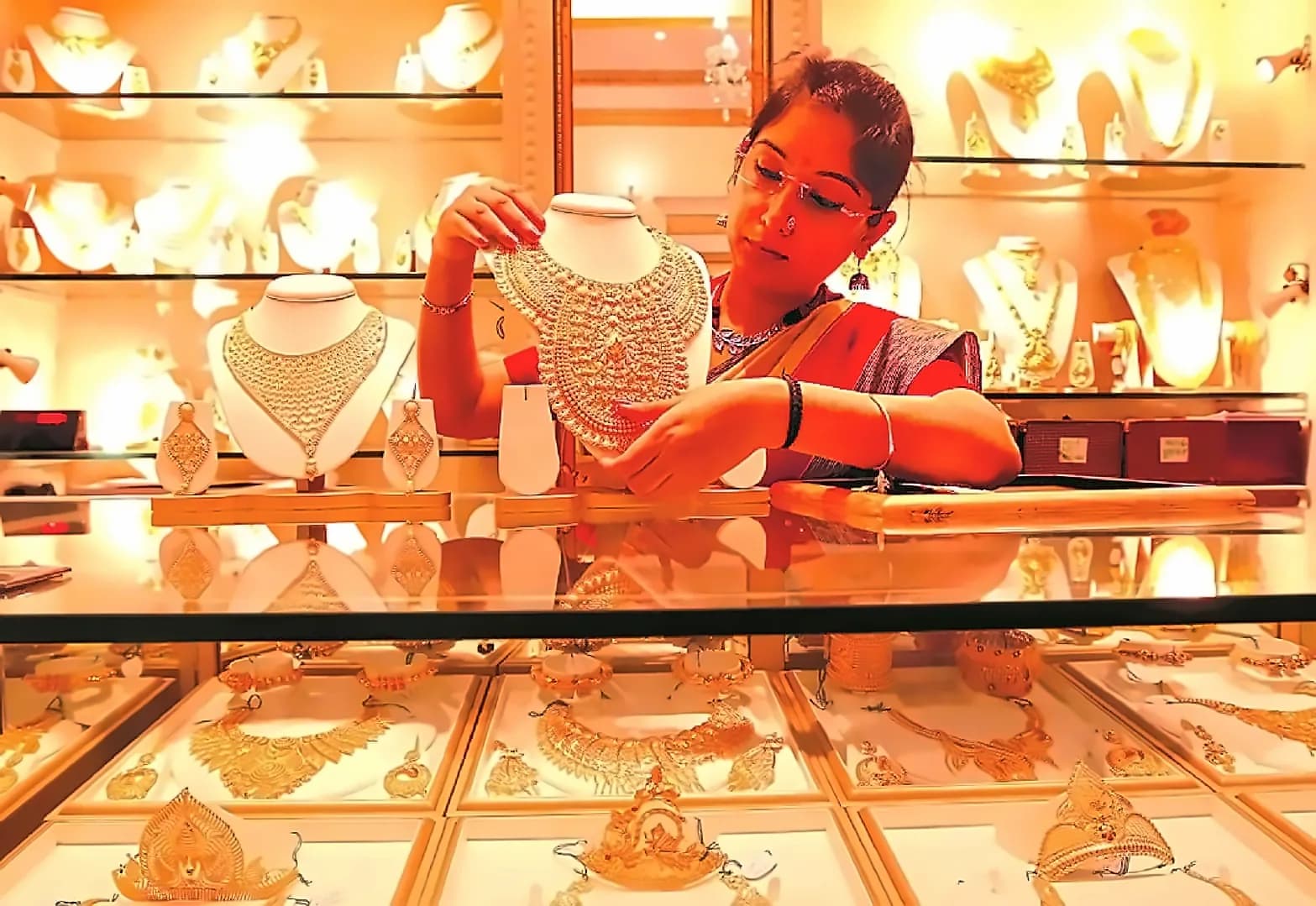
Jewellery stocks experienced significant declines on May 13 following the government's announcement of increased import duties on precious metals and Prime Minister Modi's appeal to reduce gold purchases. According to reports from Moneycontrol, Kalyan Jewellers emerged as the biggest loser, declining 4.33% to ₹346.15, while Sky Gold and Diamonds declined 5.4%. Other major players including Thangamayil Jewellery (down 4%), Rajesh Exports (down 3%), Goldiam International (down 2%), and Titan Company (down 1%) also traded lower. P N Gadgil Jewellers declined 0.81% during the session. The latest decline brings the total stock drop to 11% following the combined impact of duty hikes and policy announcements.
The Ministry of Finance issued a notification on May 12 revising customs duties on gold and silver imports to 10% from the earlier 5%. As reported by The Financial Express, the revised rates came into effect immediately from midnight. The notification covers not only gold and silver but also jewellery components such as hooks, clasps, clamps, pins and screw backs used in manufacturing. The government has also increased duty provisions on imports of spent catalysts and ash containing precious metals used for recovery and recycling purposes. The duty hike comes just days after Prime Minister Narendra Modi appealed to citizens to reduce gold purchases for a year, especially for weddings.
The policy announcements address mounting economic pressures as India's gold imports rose to an average 83 tonnes per month in the first two months of 2026, up from an average 53 tonnes in 2025. According to a World Gold Council report, this surge was largely supported by strong investment demand during January. India's gold demand nearly doubled year-on-year to a record ₹2.27 lakh crore in Q1 CY2026, with total gold demand rising 10% to 151 tonnes. India remains one of the world's largest importers of gold, with gold and silver accounting for nearly 11% of India's total imports. The country ran a merchandise trade deficit of more than $330 billion in FY26, up from over $280 billion the previous year, with energy costs and Middle East disruptions significantly impacting the rupee.
Despite the record import costs, India's appetite for gold remained resilient during the January-March quarter, with total gold demand rising 10% year-on-year to 151 tonnes in Q1 CY2026. According to the World Gold Council, the value of demand nearly doubled to ₹2.27 lakh crore due to soaring prices. Investment demand significantly outpaced jewellery consumption, with gold investment volumes surging 55% year-on-year as investors turned to gold-backed assets and ETFs amid heightened uncertainty and market volatility. However, this strong investment demand has contributed to the overall import pressure and the government's decision to increase duties.
The higher import duties are expected to make gold more expensive in the domestic market and affect jewellery demand, particularly in price-sensitive categories and wedding-related purchases. Vishrut Rana, Asia-Pacific economist at S&P Global Ratings, told CNBC that "lower gold imports can indeed help lower current account outflows for India, as gold import outlays are substantial." However, he added that "energy costs are still front and center, and while these are elevated, we expect pressure on the rupee will persist." India imports nearly 85% of its fuel needs and relies on the Strait of Hormuz for about 50% of its crude imports before the war. The country has not raised fuel prices at the pump, instead raising import duties, leading to "demand destruction" concerns among economists. Trinh Nguyen, senior economist at Natixis, told CNBC that "India is backtracking on liberalization of the market, which investors like about India."