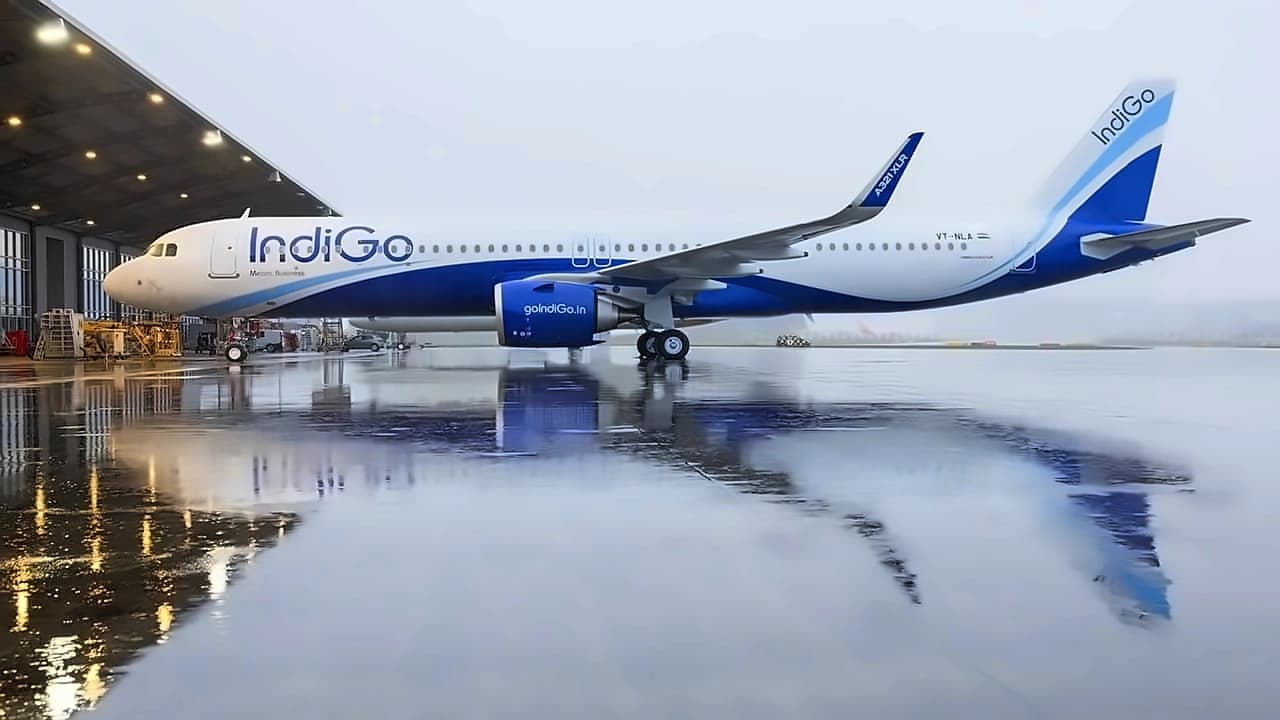
Shares of InterGlobe Aviation Ltd, the parent company of IndiGo, rose over 4% on June 9 following the airline's Investor Day presentation where management outlined ambitious long-term growth plans. According to LiveMint, the positive momentum came after several domestic and global brokerages reiterated their bullish views on the airline. The stock had previously gained 2% to an intraday high of ₹4,454 on Tuesday following the airline's analyst meet, with shares touching an intraday high of ₹4,532.45 per share on Wednesday. As per JM Financial, the Investor Day focused less on near-term earnings and more on IndiGo's vision for FY30, with the airline aiming to transform itself from a dominant domestic carrier into a globally significant aviation platform.
The airline's leadership position and long-term growth strategy target carrying 200 million passengers per year, operating more than 3,000 daily flights (up from about 2,200 currently), and expanding its fleet to over 550 aircraft from roughly 400. As reported by LiveMint, the airline aims to increase its available seat kilometres (ASK) to 300 billion by FY30, up from 172.4 billion in FY26, implying a 15% CAGR. The growth will be driven by rising number of first-time international travellers, increasing inbound tourism into India and the development of airport infrastructure, with around 50 new airports expected to be added over the next five years. JM Financial noted that the strategy remains rooted in IndiGo's traditional strengths of cost leadership, fleet commonality, and disciplined execution, while the successful implementation of international expansion and premiumisation plans will be closely watched by investors.
IndiGo expects international operations to account for a larger share of its business over the coming years as it expands into longer-haul routes and seeks to position India as a global aviation transit hub connecting Europe, the Middle East, Africa and Southeast Asia. According to LiveMint, the airline reiterated its ambition to raise international capacity share to around 40% by FY30 from the current 30% range. The management intends to leverage its dominant domestic franchise to build a globally relevant aviation platform with a significantly larger international presence, broader customer segments, higher ancillary monetisation and greater infrastructure ownership. The airline's international destinations have gained significant traction, expanding from just 5 in FY16 to 44 in FY26, while international routes have expanded from 12 to over 150 currently. Management expects FY27 available seat kilometre (ASK) growth to remain in the single digits due to fleet constraints, with stronger mid-teen ASK growth projected between FY28 and FY30.
Goldman Sachs reiterated its Buy rating with a target price of ₹5,300, highlighting IndiGo's robust 900-aircraft order book and expectations that international capacity will increase to 40% of total capacity by FY30. Jefferies maintained a Buy rating and target price of ₹5,380, noting that IndiGo's focus is increasingly shifting from capacity expansion toward pricing discipline and profitability. HSBC retained its Buy rating with a target price of ₹5,545, citing long-term earnings growth potential despite higher fuel costs. Emkay highlighted India's long-term aviation growth potential and retained its 'Buy' rating with a target price of ₹5,200, citing strong pricing power, international growth opportunities, and initiatives such as long-haul expansion, premium offerings, and potential fuel hedging for international operations. JPMorgan maintained a Neutral rating and ₹4,610 target price, pointing to slower FY27 capacity growth before a stronger expansion phase from FY28 to FY30.
IndiGo reported a net loss of ₹2,536 crore for Q4 FY26, a significant drop from the net profit of ₹3,067 crore reported during the same quarter the previous year. According to LiveMint, revenue from operations increased by 1% to ₹22,438 crore. The airline's capacity, as measured by available seat kilometres (ASKs), grew by 3.4% to 43.6 billion despite interruptions caused by the ongoing conflict in the Middle East, while passenger traffic decreased by 1.1% to 31.6 million and the load factor declined by 1.7 percentage points to 85.8%. Yield decreased by 2% year-over-year to ₹5.2, with EBITDAR margin falling to 28.7% from 31% excluding foreign exchange impact. Reported EBITDAR saw a significant decline to ₹2,228 crore compared to ₹6,948 crore in the same quarter last year, with the margin decreasing to 9.9% from 31.4%.