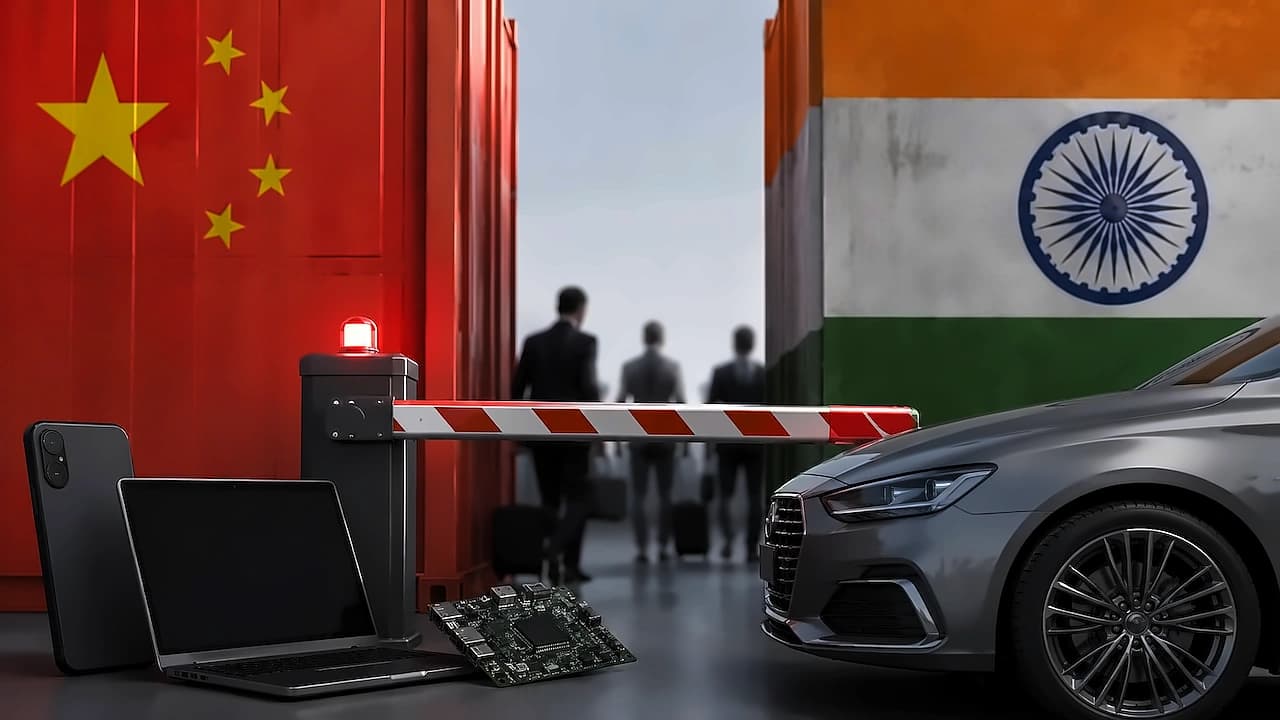
Dixon Technologies shares fell more than 3% on Wednesday, July 22, following reports that its proposed joint venture with Chinese smartphone maker Vivo may require approval from Beijing even after receiving clearance from Indian authorities under the Press Note 3 framework. The stock was trading 2.15% lower at ₹13,814 on the NSE at around 2:09 pm, compared with its previous close of ₹14,118. Dixon Technologies touched an intraday low of ₹13,650, representing a decline of more than 3% at the day's lowest level. The sharper fall during afternoon trade appeared to coincide with reports about a potential additional regulatory hurdle for India-China joint ventures, including the Dixon-Vivo partnership.
India-China joint ventures are encountering fresh regulatory challenges as China's revised outbound investment framework, effective from July 1, 2026, introduces additional approval requirements beyond Indian authorities. The new framework requires Beijing clearances even after companies secure approvals from Indian authorities, creating a dual approval process for cross-border partnerships. India has been classified as a 'sensitive destination' under China's new outbound investment framework, resulting in closer examination of proposed investments including equity participation, technology transfers and governance rights. This two-sided approval requirement creates uncertainty around the time needed to complete India-China joint ventures, even after they receive approval under India's Press Note 3 (PN3) norms, which require government approval for investments from countries sharing a land border with India.
The revised Chinese framework places greater emphasis on national security, technology controls, data governance and geopolitical risks, creating additional layers of scrutiny for India-China partnerships. Chinese companies seeking to invest capital, transfer technology, provide guarantees or obtain management rights in Indian businesses may need approval from authorities in Beijing. Any arrangement involving Chinese equity participation, shareholder funding, guarantees, management rights or technology transfer may require separate analysis under the regulations of both countries. The approval process may delay funding or implementation of the partnership, with technology transfers requiring separate China-side clearance. Investors currently lack clarity on the timeline and final structure of joint ventures, with the development representing a regulatory and timing risk rather than confirmation that the proposed partnership will not proceed.
Several major India-China joint ventures are affected by these changes, including Dixon Technologies' partnership with Vivo, Uno Minda's proposed venture, Amber Enterprises' tie-up with Oppo, and projects involving PG Electroplast. The proposed partnership is important for Dixon because it could deepen the company's relationship with one of India's major smartphone brands and expand its presence in the mobile-device manufacturing market. However, any delay in obtaining Chinese clearance could postpone the formalisation, funding or commercial implementation of the Vivo joint venture. Possible alternatives may include a pure technology-licensing arrangement, contract manufacturing or commercial supply agreements without Chinese capital participation, though the feasibility would depend on whether the technology is freely exportable from China and whether the commercial arrangement provides the capabilities Dixon requires.
The new rules could significantly reshape future India-China deal structures, with companies potentially modifying ownership arrangements, technology-sharing mechanisms and governance frameworks to meet regulatory requirements. Companies planning partnerships with Chinese entities may now need to pursue the Indian and Chinese approval processes simultaneously rather than treating them as separate sequential exercises. The enhanced scrutiny could also impact the overall structure of future India-China deals, requiring companies to adapt their business models to meet the new regulatory environment. Regulators may also examine whether a nominal licensing or third-country structure effectively gives the Chinese party control or influence over the Indian company, making a third-country route require genuine commercial purpose and operating presence. Until there is greater clarity, the market may assign a regulatory-delay risk to the expected benefits from the partnership.