India's Drug Controller General of India (DCGI) has granted market authorization to QDENGA, making it the first vaccine authorized in the country to help prevent the mosquito-borne disease. According to reports from Takeda, this decision marks a significant landmark breakthrough for public health in India, coming at a critical time as health authorities continue to grapple with recurring outbreaks across several states. The approval is particularly significant because India accounts for nearly one-third of the global dengue burden, making the country one of the most affected by the disease globally. Goh Choo Beng, Medical Affairs Head for Takeda's Southeast Asia and India Cluster, emphasized that "QDENGA is designed to protect against all four serotypes, regardless of prior exposure. Its approval represents an important step in strengthening India's comprehensive approach to dengue prevention, alongside vector control, surveillance, community awareness and other public health measures."
The approval is supported by comprehensive clinical trial data from Takeda's global clinical development programme, which included 19 Phase I, II and III clinical trials involving more than 28,000 participants in countries where dengue is common as well as regions where it is not. According to Takeda, the decision was also supported by results from the Phase III DEN-302 clinical trial conducted in India, which evaluated the safety and immune response in people between 4 and 60 years of age. The study demonstrated that QDENGA was found to be tolerated, safe and immunogenic in healthy adults, adolescents and children. Mahender Nayak, Takeda's Head of Intercontinental Markets, stated that the vaccine has long-term data collected over seven years showing continued protection against dengue infection and hospitalisation caused by all four dengue virus serotypes. The company noted that these clinical outcomes are further supported by real-world evidence generation and ongoing pharmacovigilance to deepen understanding of the vaccine's safety and impact.
As reported by Takeda, dengue is a mosquito-borne viral disease reported in more than 125 countries, with India carrying one of the world's highest dengue burdens. Reported dengue cases in India have risen nearly elevenfold in the past two decades, highlighting the country's expanding struggle with the mosquito-borne disease and the urgent need for stronger preventive measures. In 2025, reported cases exceeded 113,000, but modelling analyses suggest the dengue burden in India appears to be higher than reported, likely representing tens of millions of infections each year. Dengue outbreaks have become increasingly frequent, especially during and after the monsoon season, placing immense pressure on hospitals and public health systems across several states. The vaccine's live-attenuated formulation provides broad-spectrum immunity against the four dengue serotypes, addressing the complex nature of dengue transmission patterns and the fact that all four dengue virus serotypes have been documented as co-circulating in several regions across India. Goh Choo Beng noted that India carries a substantial dengue burden, with millions of Indians remaining at risk each year due to widespread endemicity, rapid urbanisation and climate-related factors that drive mosquito proliferation.
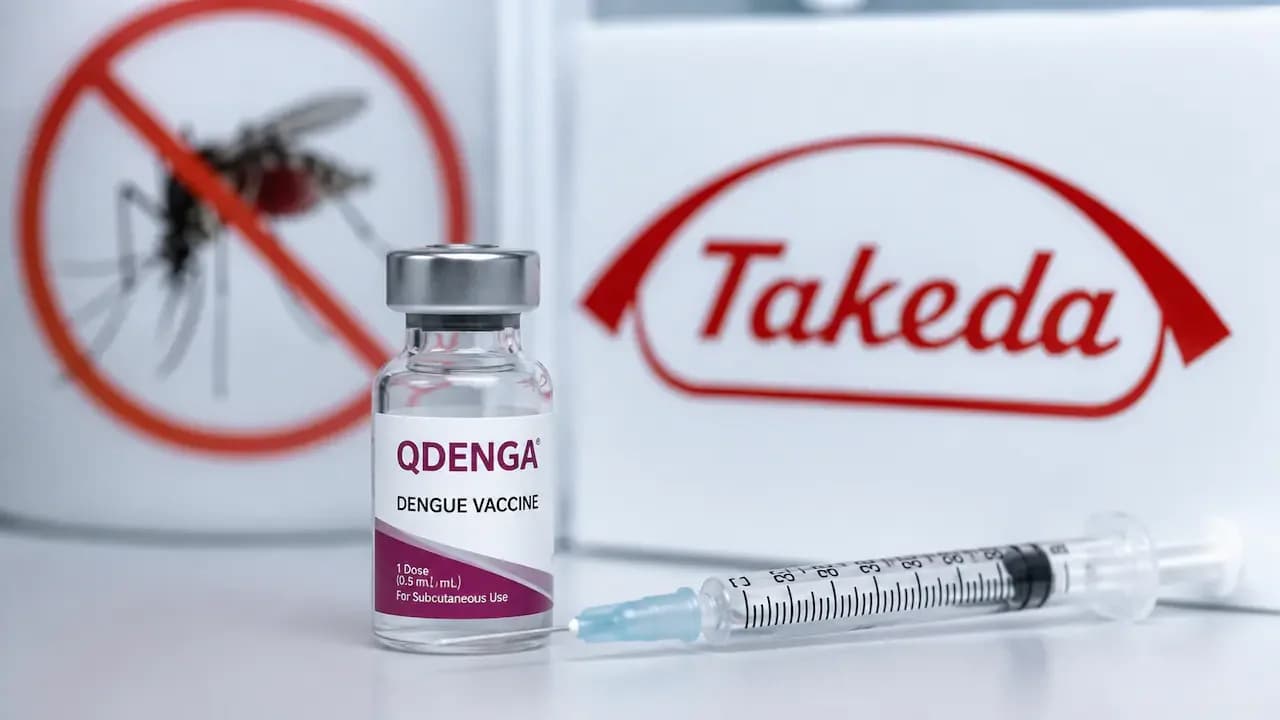
The World Health Organization (WHO) recommends QDENGA for use in dengue-endemic regions and supports its introduction in public immunisation programmes in areas with high transmission, without requiring pre-vaccination screening. According to Takeda, QDENGA has also received WHO prequalification, confirming that it meets international standards for quality, safety and efficacy, and enabling eligibility for procurement through international agencies such as UNICEF and the Pan American Health Organization (PAHO). Since its global launch in 2022, QDENGA has been approved in 43 countries, with more than 32 million doses distributed worldwide through public and private programs. The vaccine is administered as two injections of 0.5 ml, given under the skin three months apart, with the company noting that unlike some dengue vaccines, QDENGA does not require pre-vaccination screening, allowing eligible individuals to receive the vaccine without first being tested for past dengue infection. The vaccine can be administered irrespective of whether an individual has previously been infected with dengue, simplifying its use in large-scale immunisation programmes.
To strengthen supply, Takeda entered into a partnership with Hyderabad-based vaccine manufacturer Biological E in 2024. Under the agreement, Biological E plans to establish manufacturing capacity for up to 50 million doses annually, contributing to Takeda's target of producing 100 million doses globally each year by the end of the decade. The partnership is expected to improve vaccine availability for both India and international markets, with the company stating that long-term follow-up data continue to demonstrate sustained protection against symptomatic dengue and dengue-related hospitalisation. Mahender Nayak emphasized that this approval marks an important step forward in strengthening dengue prevention in India, with experts noting that wider rollout will depend on pricing, supply, recommendations from India's immunisation and public health authorities, and integration into dengue prevention strategies.