In a significant breakthrough for India's electric mobility sector, Hindustan Zinc Ltd (HZL) and the Indian Institute of Technology (IIT) Madras have successfully unveiled an electric three-wheeler prototype fitted with an approximately 1 kWh zinc-air battery designed to function as a range extender. The technology was unveiled at the recent IIT Madras Energy Summit 2026, marking a transition from laboratory-scale experimentation to vehicle-level demonstration. The collaboration, which began in 2024, has now progressed to the crucial stage where zinc-air battery technology can be integrated into operating vehicles. The unveiling was attended by Guest of Honour Praveen Chakravarthy, Member of Parliament (Rajya Sabha); Amarendu Prakash, CEO and Whole-time Director, Hindustan Zinc; Prof. Manu Santhanam, Dean (ICSR), IIT Madras; and Dr. Aravind Kumar Chandiran of the Department of Chemical Engineering, IIT Madras, who led the project.
The three-wheeler prototype employs a dual-battery configuration where the existing lithium-ion battery handles acceleration and peak power requirements, while the 1 kWh zinc-air unit contributes nearly 10% of the vehicle's total energy requirements during steady operation. As reported by Business Standard, unlike conventional lithium-ion batteries that store energy through electrochemical reactions involving lithium-based materials, zinc-air batteries generate electricity through the reaction of zinc with oxygen drawn from the surrounding air. This allows the battery to use oxygen from the atmosphere as one of its reactants, reducing the amount of active material required onboard. The demonstration highlights how zinc-based batteries could complement existing energy storage systems in electric mobility applications.
According to Aravind Kumar Chandiran, associate professor at IIT Madras who led the project, zinc-air technology offers significant advantages for commercial electric vehicles, particularly three-wheelers where operating economics and vehicle utilization are critical factors. As reported by Business Standard, zinc has inherent advantages as a battery material, being recyclable and relatively inexpensive compared to several materials used in advanced battery chemistries. The prototype also utilizes a non-flammable, water-based electrolyte, offering potential safety advantages over batteries that rely on flammable organic electrolytes. Prof V Kamakoti, Director, IIT Madras, emphasized that energy generation, storage and distribution from renewable sources is the most important topic for research, development and commercialization, with this collaboration being yet another important effort towards this goal.
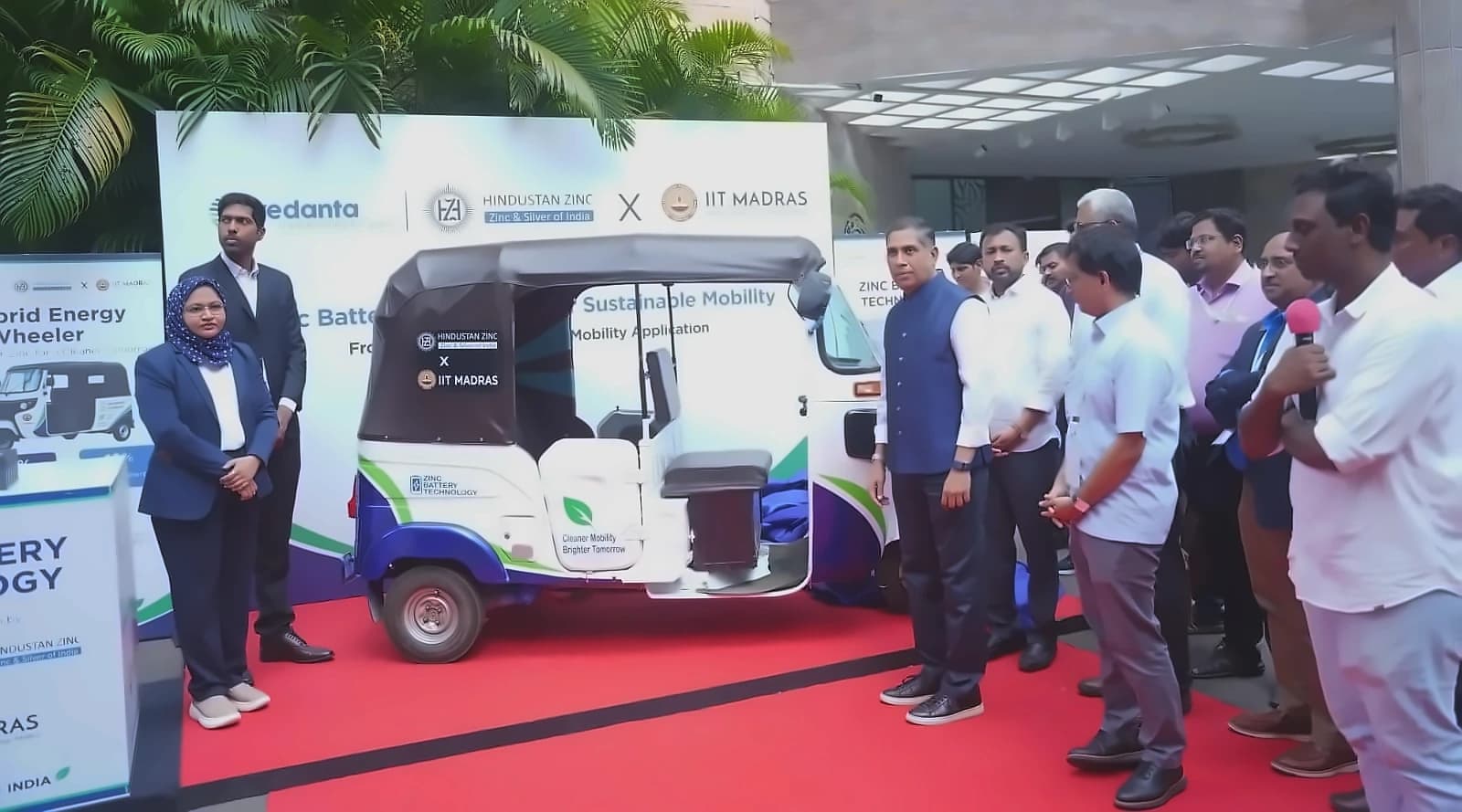
Amarendu Prakash, CEO and whole-time director of Hindustan Zinc, emphasized that the collaboration aims to expand zinc applications and translate scientific research into commercially relevant technologies. According to Business Standard, with zinc being abundantly available in India, there is an opportunity to explore indigenous energy storage solutions contributing to the Viksit Bharat vision. The technology could find applications in electric three-wheelers, commercial mobility segments, and stationary energy storage, including renewable energy integration. The project forms part of HZL's HZL 2.0 growth and diversification strategy, exploring zinc-based battery technologies for renewable energy storage and electric mobility. Further research and development are underway to improve performance, durability, and overall economics of deployment.
Hindustan Zinc share price was trading at ₹529.55 as of November 26, 2026, 2:08 pm, representing a 1.90% increase from the previous closing price. The announcement covers a vehicle-level prototype, with HZL not providing details of commercial production, launch date, or expected driving range of the three-wheeler. Hindustan Zinc Limited, a Vedanta Group company, is the world's largest integrated zinc producer and holds approximately 74% market share of the primary zinc market in India. The development comes at a time when demand for energy storage technologies is expanding alongside renewable energy generation and electric mobility adoption. HZL was recognized as the world's most sustainable company in the metals and mining category for the third consecutive year in the S&P Global Corporate Sustainability Assessment 2025 and became the first Indian company to join the International Council on Mining & Metals in 2025.