State-run GAIL (India) Ltd announced on Friday, July 17, 2026, that it has signed a Memorandum of Understanding (MoU) with Khanij Bidesh India Ltd. (KABIL) to collaborate in the field of critical and strategic minerals. According to reports from ANI, the agreement provides a framework for identifying and evaluating opportunities in critical and strategic minerals, while facilitating the exchange of technical expertise and capacity building. The partnership aims to support India's long-term resource security and clean energy transition. The MoU was signed in New Delhi by Sanjeev Kumar, Executive Director (R&D & E&P), GAIL, and Sunil Kumar Singh, Chief Executive Officer, KABIL, in the presence of R. K. Singhal, Director (Business Development), GAIL, along with senior officials from both organisations. GAIL (India) Limited is a Maharatna Central Public Sector Enterprise under the Ministry of Petroleum and Natural Gas, with a diversified presence across the natural gas value chain including transmission, marketing, LNG sourcing and regasification, LPG transmission, petrochemicals, city gas distribution, renewable energy, and upstream exploration & production.
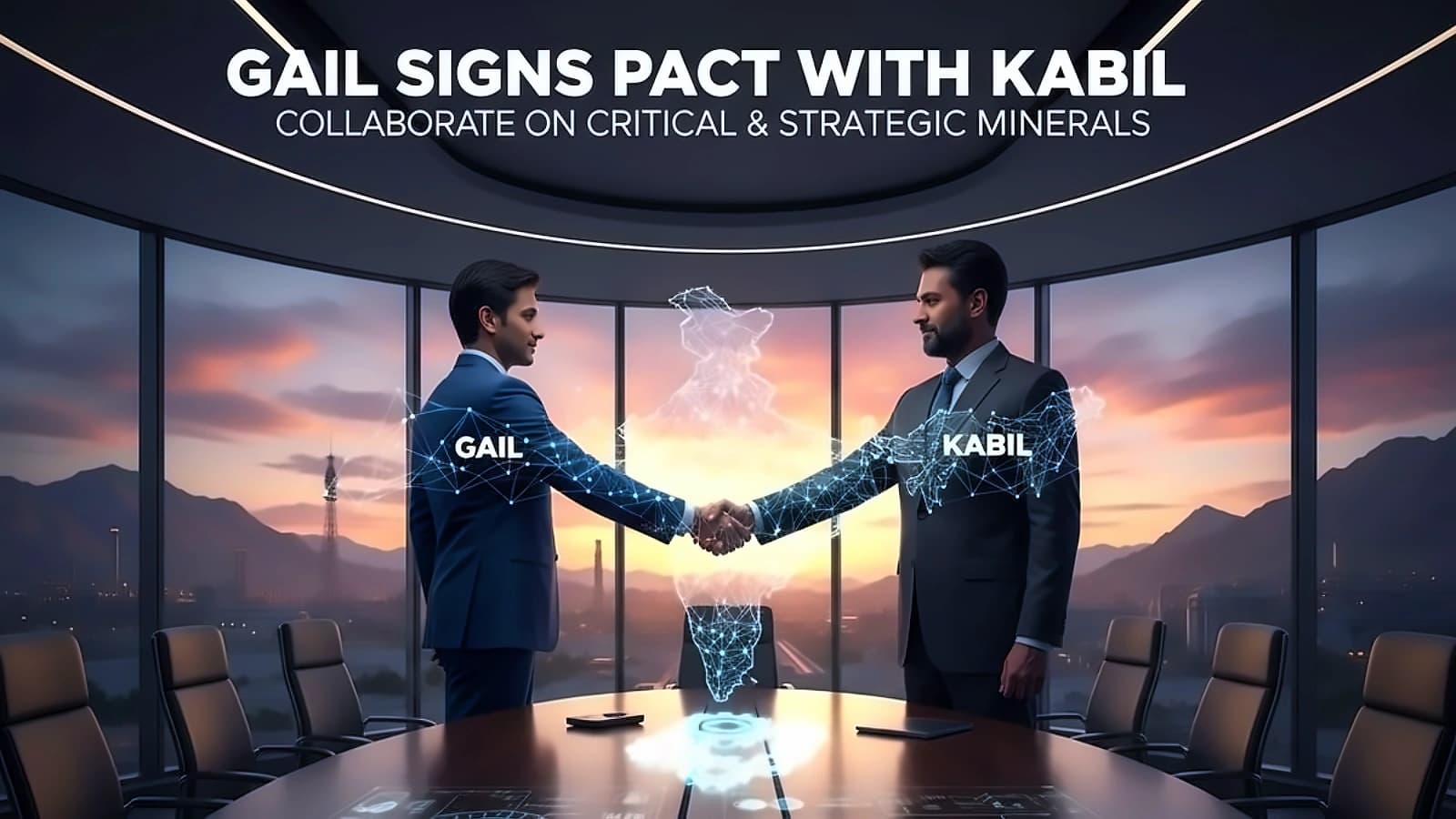
Under the expanded agreement, GAIL and KABIL will jointly identify and evaluate opportunities related to critical and strategic minerals, facilitate the exchange of technical expertise, promote capacity building and explore collaborative initiatives across the mining value chain. As per Sarkaritel, the partnership is expected to improve India's long-term access to minerals that are essential for emerging technologies, renewable energy systems, battery manufacturing and strategic industries. The collaboration will focus on identifying critical and strategic mineral opportunities, joint evaluation of mining projects, capacity building and skill development, exploring collaboration across the mining value chain, and supporting India's long-term supply of critical minerals. The collaboration aligns with the Government of India's focus on strengthening critical mineral security, reducing dependence on imports and building resilient supply chains for minerals such as lithium, cobalt, nickel, graphite and rare earth elements, which are crucial for electric vehicles, clean energy technologies and advanced industrial applications. KABIL is a joint venture of three Central Public Sector Enterprises (CPSEs) — National Aluminium Company (NALCO), Hindustan Copper (HCL) and Mineral Exploration & Consultancy (MECL) established to identify, acquire, develop and secure overseas critical and strategic mineral assets to support India's long-term economic growth, industrial development, and energy transition.
In a separate development reported by CNBC TV18, GAIL had approved an equity investment of up to $64 million (around ₹530 crore) in its wholly owned subsidiary GAIL Global (USA) Inc. on March 25. The investment will be made in one or more tranches and is primarily aimed at reducing the subsidiary's outstanding loan obligations related to its shale assets in the Eagle Ford basin in Texas. GAIL Global (USA) Inc., which operates in the oil and gas sector, reported a standalone turnover of $7.6 million in calendar year 2025.
According to CNBC TV18, GAIL also entered into a Memorandum of Understanding (MoU) with RailTel Corporation of India Limited on March 5, 2026, to collaborate in key sectors of digital infrastructure in the country. Speaking on the development, Deepak Gupta, Chairman and Managing Director, GAIL, stated that this partnership is fully in sync with their vision to integrate energy and digital infrastructure, leveraging the transformative potential of artificial intelligence (AI), which are pivotal to India's development journey.
A May 2026 note by the Institute for Energy Economics and Financial Analysis (IEEFA) and Climate and Sustainability Initiative (CSI) emphasises that meeting the rising demand for critical minerals will require significant investment across the supply chain over the next two decades. The note highlights funding shortfalls across the supply chain, from upstream exploration to capital-intensive midstream processing. It underscores the importance of private investment and targeted de-risking measures to attract capital into the sector, given that much of this investment is front-loaded with uncertain returns in the long term. The success of the critical minerals mission also hinges on scaling India's green manufacturing capacity across key sectors such as batteries, electric vehicles, solar modules, and electronics, which can drive growth in the critical minerals sector. Industry experts believe that strategic collaborations like this will help India reduce supply chain risks, encourage technological cooperation, and support sustainable economic growth in the coming years.