PL Capital has retained Bharat Electronics Limited (BEL) as its top defence pick with a target price of ₹452, implying an upside of around 26% from current levels. According to Amit Anwani, Research Analyst at PL Capital, "For Bharat Electronics I am building in 14-15% topline growth this quarter, and roughly about 26.5% margin." The brokerage expects order inflows to gather pace in Q4, with Anwani noting that order inflows across the sector could be weighted towards the final quarter of the financial year, with several clearances potentially coming through in January, February and March. Despite recent market pressure, shares of BEL remained under pressure, trading at ₹363.50, down ₹7.70 or 2.07% as of 9:26 am on the NSE on October 22.
Bharat Electronics Limited (BEL) has secured additional orders worth ₹1,011 crore, as informed in the filing dated October 13, 2026. This adds to the ₹533 crore order the PSU had previously secured, bringing total recent order inflows to ₹1,544 crore. However, shares of BEL remained under pressure, trading at ₹363.50, down ₹7.70 or 2.07% as of 9:26 am on the NSE on October 22. The major orders included improved low level light weight radar, communication equipment, sonar, jammer, upgrade, spares and services, though the company hasn't revealed the specific company from which it received these orders in the filing.
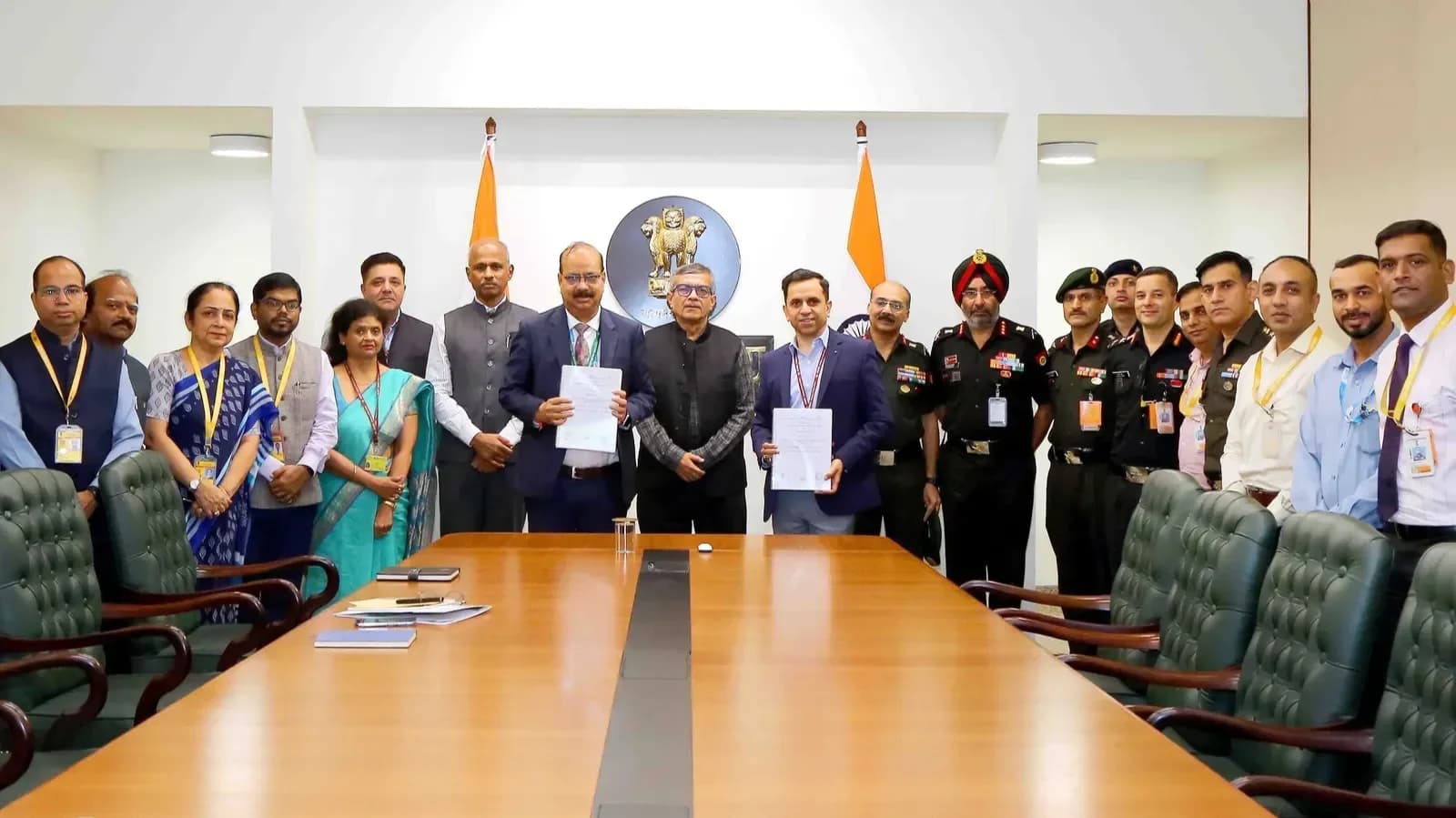
The Ministry of Defence has signed a ₹770 crore contract with BEL for Improved Low-Level Lightweight Radars (LLLR-I) that can detect and track fighter jets as well as mini and micro drones. The contract is specifically aimed at plugging critical gaps in the Indian Army's air defence network at low altitudes. As reported by the ministry, the LLLR-I system can detect and track fighter-size targets and mini and micro drones, with the additional capability of prioritising aerial targets enabling the Army to counter threats from unmanned aerial systems (UAS). The need for such capabilities was underscored during Operation Sindoor, when Pakistan launched waves of drones, including Turkish and Chinese-origin systems, towards military and civilian locations along the western front during the four-day hostilities. The system is designed to detect targets with an RCS as small as 0.001 square metre, equivalent to that of a micro drone.
The LLLR-I system represents a significant technological upgrade with four fixed phased-array antenna panels using Active Electronically Scanned Array (AESA) technology to provide 360-degree surveillance without moving parts. The radar incorporates Gallium Nitride (GaN) amplifiers and digital beamforming technology to improve radar performance, while its Track While Scan capability allows automatic target tracking while continuing to scan the surrounding airspace. The radar features electronic counter-countermeasure (ECCM) capabilities and monopulse tracking technique for accurate target tracking in elevation. The system is man-portable and can be deployed in plains, deserts and high-altitude areas, with the ability to provide target information to weapon systems through wired or wireless communication links. Low-level radars act as gap-fillers in the larger air defence network, covering low altitudes where long-range radars are constrained by terrain and the earth's curvature, this being the airspace exploited by drones.
The procurement represents a significant step towards indigenisation of air defence platforms and is expected to give a boost to India's defence manufacturing ecosystem, including micro, small and medium enterprises (MSMEs). According to the ministry, the acquisition is in line with the government's vision of Viksit Bharat @2047 and aims to build a 'resilient, self-reliant and globally competitive Defence Industry'. The LLLR-I is an upgraded version of the Aslesha radar, designed by the Defence Research and Development Organisation's (DRDO) Electronics and Radar Development Establishment (LRDE) and produced by BEL. Apart from its core defence business, BEL has exposure to non-defence segments, including cybersecurity, civil projects and electronic voting machines (EVMs). The non-defence business currently accounts for around 10–15% of BEL's operations, and the brokerage expects it to grow steadily, potentially at around 15%. However, the larger growth opportunity lies in the defence business, with new contracts for quick reaction surface-to-air missile (QRSAM) system, next-generation aircraft and naval platforms expected to strengthen BEL's order pipeline and improve revenue visibility through FY31.
Despite recent market pressure, BEL reported strong Q1 FY27 results with consolidated net profit rising 9% year-on-year to ₹1,054.34 crore, compared with ₹969.91 crore in the same quarter last year. Revenue from operations increased 25% YoY to ₹5,546.98 crore, from ₹4,439.74 crore in the year-ago period. However, the company faced sharp increase in material costs, rising 55% YoY to ₹3,041.23 crore in Q1 FY27, compared with ₹1,960.84 crore in the corresponding quarter last year. The company's order book stood at ₹72,258 crore as of July 1, 2026, providing strong revenue visibility for future quarters. BEL has also proposed increasing its authorised share capital to ₹1,000 crore from ₹750 crore, subject to shareholder approval at the upcoming AGM. The company also proposed a final dividend of ₹0.55 per share for FY 2025-26, with the record date fixed as August 13, 2026.