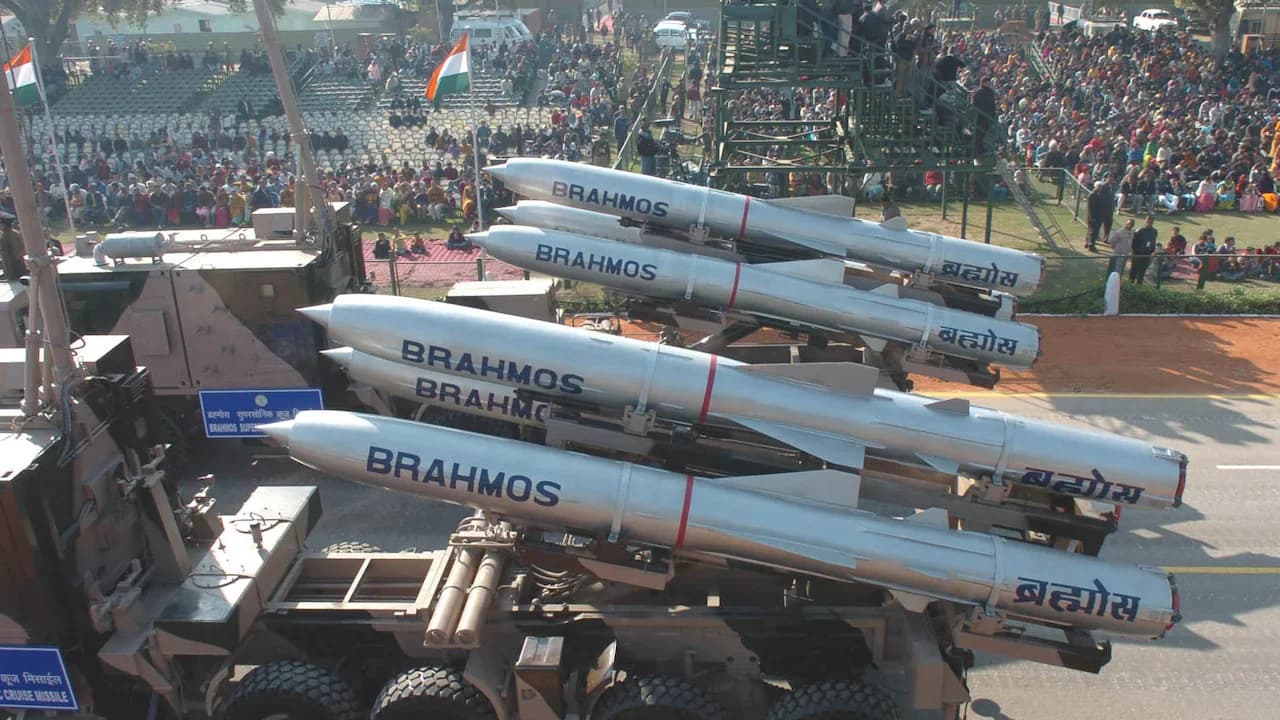
India marked another significant milestone in its defence indigenisation journey with the flagging off of the 100th indigenous booster for the BrahMos supersonic cruise missile at Solar Industries' facility in Nagpur. The ceremony took place at the Solar Industries facility in Nagpur, Maharashtra, and was jointly presided over by BrahMos Aerospace Chief Dr. Jaiteerth Joshi and Solar Industries India Ltd Chairman Satyanarayan Nuwal. This achievement highlights the accelerating pace of India's Atmanirbhar Bharat (self-reliance) initiatives in high-tech defence manufacturing. The missile system recently demonstrated its operational effectiveness during Operation Sindoor, India's military response against Pakistan to the Pahalgam terror attack in May 2025.
As reported by ANI, BrahMos Aerospace CEO Dr. Jaiteerth Joshi detailed the programme's remarkable scaling from import dependence to domestic production. The technology transfer from Russia was initiated in 2018, leading to successful trials in late 2020 and serial manufacturing beginning in 2022. Solar Industries Chairman Satyanarayan Nuwal confirmed the company absorbed the transferred technology within a year and secured final approvals from BrahMos Aerospace and Russian experts in September 2022. The company has now scaled up production capacity from one booster per month to approximately 60 boosters per month, with Solar Industries now capable of producing around 150 boosters annually. Joshi highlighted that this development represents a significant leap in reducing dependence on foreign suppliers, with the booster now being manufactured domestically following the successful technology transfer.
According to company officials as reported by ANI, SDAL has already developed the BrahMos warhead and dispatched it for trials. The component is equipped with advanced seekers that enable precision targeting and strike capabilities. BrahMos Aerospace CEO Dr. Jaiteerth Joshi confirmed that warhead trials have been conducted and once successful, imported warheads will be replaced with indigenous ones. Solar Industries Chairman Satyanarayan Nuwal indicated that if approvals come through within the next month, they will immediately begin manufacturing the indigenous warheads. Solar Industries was the first to take the technology transfer forward for warhead indigenisation, with the company now playing a pivotal role in this critical component development. Nuwal revealed that Solar has already developed the BrahMos warhead and has dispatched it for trials, with the warhead being manufactured and sent for testing today. If trials are successful within the next month, regular production will begin.
Looking ahead, BrahMos Aerospace CEO Dr. Jaiteerth Joshi expressed confidence that the successful production of 100 boosters has laid the foundation for major expansion in manufacturing capacity. He expressed confidence that production would increase significantly in the coming months and stressed the importance of achieving the target of producing up to 12 boosters per month by the end of 2026. Solar Industries Chairman Satyanarayan Nuwal confirmed that another production line will become operational from August, enabling the company to produce around 150 boosters annually. Nuwal noted that within three years they were able to reach production stage, with manufacturing capacity continuously increasing. He called it a major achievement, noting that critical components such as the propulsion system and warhead were previously imported, making this a huge milestone for both Solar and India's self-reliance mission.
This milestone occurs amidst a massive push for defence exports, with India recently securing a $629 million export deal to supply BrahMos missiles to Vietnam and being in final negotiations with Indonesia. Furthermore, Russia has expressed a strong interest in inducting Indian-manufactured BrahMos systems to augment its own armed forces. Alongside the 100th booster dispatch, the facility also delivered India's first indigenous BrahMos warheads, developed via technology transfer from the Defence Research and Development Organisation (DRDO), which are heading for final trials before entering large-scale domestic production. This export success demonstrates the growing global demand for Indian-manufactured defence systems and the country's increasing capability to meet international requirements.