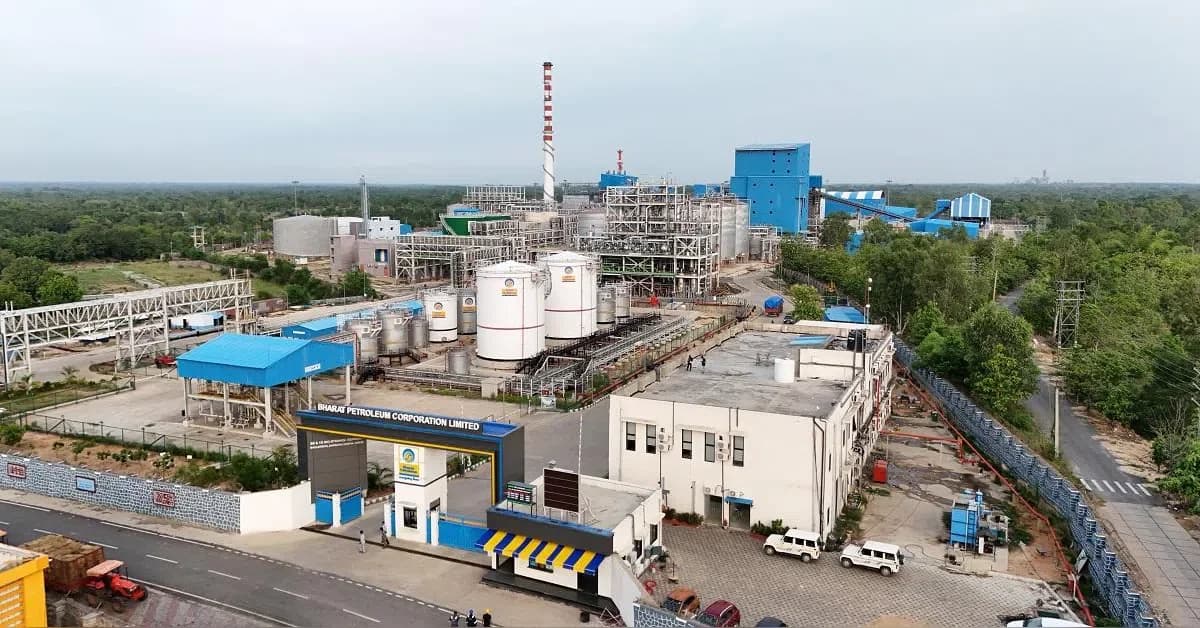
Union Home Minister Amit Shah is scheduled to inaugurate Bharat Petroleum Corporation Limited's (BPCL) ₹1,775 crore integrated bio-ethanol refinery in Bargarh, Odisha on July 4. According to reports from Business Standard, this facility marks a significant milestone in India's biofuel mission and represents the country's first integrated 1G-2G bio-ethanol refinery capable of converting agricultural waste into fuel. The project has been developed under the Pradhan Mantri Jaiv Indhan-Vatavaran Anukool Fasal Awashesh Nivaran (JI-VAN) Yojana and will be inaugurated during Shah's two-day visit to Odisha. As a senior BPCL official told Business Standard, the facility is a first-of-its-kind unit in India as it has been designed as an integrated facility with both 1G and 2G bio-ethanol production units with a capacity of 100 kilolitres per day each.
The integrated refinery features annual production capacity of 6.3 crore litres of ethanol with 100 kilolitres per day capacity for each 1G and 2G production units. According to Business Standard, the facility is the first of its kind in the country to commercially produce second-generation ethanol from paddy straw and other lignocellulosic agricultural residues. The 1G process converts surplus and broken rice into fuel-grade ethanol for blending with petrol under the Ethanol Blended Petrol (EBP) Programme, while generating distillers dried grains with solubles (DDGS) as a valuable animal feed co-product. The 2G process transforms rice straw into ethanol, providing an environmentally responsible alternative to crop residue burning and supporting sustainable biomass utilisation. The plant will have an annual production capacity of 3.3 crore litres from the 1G ethanol unit and 3 crore litres from the 2G unit.
The plant processes 480 tonnes of rice straw daily sourced from 1.6 lakh acres of farmland through an organised biomass supply chain, producing 100 kilolitres of 2G ethanol. According to Business Standard, the technology for the project has been provided by Praj Industries Ltd. The facility operates under a zero liquid discharge (ZLD) system ensuring complete treatment and recycling of all process effluents, and uses only rice straw as boiler fuel with no fossil fuel required for regular production. The company plans to source more than 200,000 tonnes of rice straw from within a 20-km radius of the project area. The project is expected to channel more than ₹100 crore into the rural economy annually and generate direct employment for around 800 people. The biomass supply chain is projected to generate indirect employment for nearly 1,200 people in rural areas and foster entrepreneurship among around 250 local entrepreneurs, farmers and women's self-help groups in western Odisha through biomass collection, transportation, logistics, plant operations and ancillary industries.
The refinery supports India's clean energy transition by converting agricultural waste into clean transport fuel while addressing stubble burning issues. As reported by Business Standard, the facility is expected to serve as a model for similar projects across the country as India rapidly expands its ethanol economy with an installed capacity of nearly 20 billion litres annually. The government has shifted focus towards second-generation biofuels that utilise agricultural residues without competing with food production, supporting the ambitious target of increasing ethanol blending in petrol to reduce dependence on imported crude oil and lower carbon emissions. Revenue and Disaster Management Minister Suresh Pujari stated that the facility will utilise crop residue that used to go to waste in the area, benefiting both the nation and the state in the energy sector.